Do-it-yourself repair work can save you time and money -- in addition to giving you a lot of satisfaction. But you have to be careful to avoid beginner's mistakes, which can end up costing you more in time and money than you would have spent farming the work out to a professional mechanic -- and sour you on the idea of ever getting under the hood yourself again.
These include:
* Randomly pulling parts before you know what's wrong -- This is a common beginner's mistake that quickly leads to frustration and an empty wallet. Doctors don't begin treatment before evaluating the patient and making a diagnosis. It should be no different with any automotive "operation." Find out what's wrong first -- then fix it.
* Attempting a repair without having a shop manual to refer to -- Easily the number two pratfall on any list of beginner DIY mistakes. Never disassemble components without knowing how they fit back together, etc. A shop manual will typically have schematics, photos, diagrams and so on -- as well as a step-by-step procedure for each repair. "Winging it" without the manual is about as bright as trying to prepare an elaborate gourmet dinner you've never made before -- without the cookbook.
* Not using the proper tools -- This is commonplace because few beginners have a full set of mechanic's tools; in particular, the often specialized equipment needed to properly perform certain diagnostic and repair procedures. Using the wrong tool can lead to physical damage of the part being worked on -- in addition to skinned knuckles and a lot of cursing. If specialized tools are required, be sure you have access to them -- and know how to use them properly.
* Not having the right place to work -- It's important to have a safe, secure area to work on your vehicle. The shopping mall parking lot isn't it. A covered space with good lighting is ideal. And if you need to raise the vehicle, make sure it is parked on a level (and solid) surface, not grass. Beginners get killed or badly injured every year when an improperly supported car either rolls on top of them or slips off the jack stands and crushes them.
* Rushing it -- Deciding to tear your car apart late Sunday afternoon but needing to have it ready to make the commute Monday morning is a recipe for disaster. And a common beginner DIY mistake. Always allot sufficient time to finish the job; don't try to emulate a NASCAR pit crew. Those guys have it down to a science and have many years of experience. You don't. Expect delays as a result of things you didn't anticipate -- such as needing to get a part in the middle of the job, or spending an hour on getting at a bolt you thought you'd be able to remove in a minute or two.
* Getting mad -- This mistake often springs from the loins of the other mistakes already listed. You've got the car's guts all over the driveway and have no idea how to get them back together. Or you lost something. Or something's not fitting right. Whatever. This kind of thing happens to professional mechanics, too. The difference between them and a ranting do-it-yourselfer is the pro knows when to step away for a minute, have a cup of coffee, a smoke -- whatever -- and relax about it.
* Rigging it -- It can be tempting to "home engineer" a fix that isn't quite what the manual called for, but seems like it ought to work. This is ok in an emergency -- as when you're dealing with a broken down car in the middle of nowhere and just need to get it to run long enough to get you somewhere -- but don't do it otherwise. It can be tempting, sure -- but more often than not, the "fix" ends up causing more problems than it solved. Do it the right way, "by the book."
* Refusing to ask for help -- Pride definitely goes before the fall, in politics and car repair alike. Even the best of us don't know everything; the smart among us know it's no sign of weakness to ask someone who does. Just the opposite. If you can't figure out what the manual says, or are having trouble getting something to work, there is no shame in seeking the counsel of others, be they more experienced friends, online resources -- even a professional mechanic at a car dealership, etc. (They're often quite willing to help out; it just takes your having the guts to go up and ask them.)
(From an article by Eric Peters )
Tuesday, April 17, 2007
Saturday, April 14, 2007
Do Synthetic oils have a molecular structure that can cause leaks?
 It is widely known that all Synthetic oils have a molecular structure that is much smaller than conventional oils and therefore synthetic oils must use seal swelling additives in order to stop the oil from leaking out. Is this so?
NO! Synthetic oils are unique that there structure is more uniform then petroleum oils not smaller. In Petroleum oils the molecules are larger and not as even in size as synthetic oils. Just because synthetic oils have more uniform molecules in size, has nothing to do with seal failure or oil leaks. For example, the Olefins in Mobil 1 tend to cause seal shrinkage and seal swelling additives are used to counteract this tendency of like group IV synthetics. However ester based lubricants group V’s (example: Neo)tend to cause seals to expand, and the need for seal swelling agents is totally unnecessary.

Monday, April 09, 2007
Alternative Ticket Fighting Strategies
You've probably read articles about fighting traffic tickets -- but the reality is many of us (probably most of us) just don't have the money to hire a lawyer -- or the time/expertise (let alone gumption) to actually challenge a ticket on our own.
There are some alternatives, however.
* Plead "guilty -- with explanation":
Sometimes, you can get a reduced charged by pleading guilty -- but with an explanation. Provided you have an otherwise clean record --and the charge itself is relatively minor -- often, this can yield good results.
Remember -- what they want most is money. The charge itself is of secondary importance.
A great deal depends on the judge, however. Some are hard cases; others more reasonable. Before you decide to go this route, it's smart to get to court early and watch how your judge handles other cases -- especially those similar to your own. If you think, based on his actions, that he's going to throw the book at you -- you can always request a continuance; in many states, these are granted automatically upon request. Simply tell the judge you are not ready to go to trial. A continuance will push your court date off for another few weeks or so and give you time to prepare a defense -- or hire a lawyer.
* Bargain
Traffic court's a lot like buying a new car -- because there's lots of haggling involved. You can ask the judge (or the prosecuting/commonwealth's attorney) about the possibility of agreeing to attend driving school and/or pay a fine in return for dropping the charge against you -- or changing the charge to a non-moving violation, which avoids DMV "points" being assigned to your driving record. That means your insurance company won't have a pretext for a rate hike. In some counties/states, certain charges aren't reported to the DMV at all -- especially if it's an out-of-state ticket. (Mostly, these include non-moving violations such as "defective equipment" -- a common "lesser charge" that's often assigned in lieu of the original moving violation.)
The key thing, however, is to avoid the moving violation conviction -- even if it means paying a larger fine than you'd otherwise have paid for just the ticket/offense you were originally charged with. A one-time hit to your wallet is infinitely preferable to having that ticket held against you for anywhere from three to five years -- the length of time it will be on your DMV record -- and used by your insurance company to justify higher premiums. The total cost of a single moving violation on your DMV record can easily exceed the one-time hit of a fine for "defective equipment" (or whatever) many times over. And keep in mind: If you should be unlucky enough to receive another ticket before the old one "drops off" -- your jeopardy has just doubled. The points stack up -- and your insurance goes through the roof. How likely is it you can go for another five years without gettting nailed again? For many of us, that's a virtual impossibility!
(As an aside, it's possible in some states to take the DMV-authorized "driving school" online -- and avoid the hassle of spending an entire Saturday re-living high school detention. See http://www.trafficschoolonline.com for more information.)
Bottom line: Either of these alternatives -- pleading guilty with an explanation or bargaining your way to a lesser charge -- can be more cost-effective than hiring a lawyer or spending days/weeks of your own time doing what's necessary to fight the ticket yourself. Most of us have jobs and responsibilities that make that very difficult, if not impossible. And it can be very intimidating for a layman to go up against the system, subpoenaing records, questioning the ticketing officer in open court -- and so on. By challenging the system in this way, one also runs the very real risk of antagonizing the court -- and becoming the target of an angry judge looking to "teach someone a lesson." It's true you can always appeal a conviction (in many states, a traffic law case may even entitle you to a jury trial, if you want to take it that far). But that involves yet more time, yet more expense. How much of either can you afford to spend on a traffic ticket beef?
Yes, there's the principle involved. If it's a really unjust ticket, you may be motivated to go all the way -- and do whatever it takes to beat the rap. But sometimes, it's smart to pick your battles -- and go for the best outcome you can realistically hope for given time and other constraints.
There are some alternatives, however.
* Plead "guilty -- with explanation":
Sometimes, you can get a reduced charged by pleading guilty -- but with an explanation. Provided you have an otherwise clean record --and the charge itself is relatively minor -- often, this can yield good results.
Remember -- what they want most is money. The charge itself is of secondary importance.
A great deal depends on the judge, however. Some are hard cases; others more reasonable. Before you decide to go this route, it's smart to get to court early and watch how your judge handles other cases -- especially those similar to your own. If you think, based on his actions, that he's going to throw the book at you -- you can always request a continuance; in many states, these are granted automatically upon request. Simply tell the judge you are not ready to go to trial. A continuance will push your court date off for another few weeks or so and give you time to prepare a defense -- or hire a lawyer.
* Bargain
Traffic court's a lot like buying a new car -- because there's lots of haggling involved. You can ask the judge (or the prosecuting/commonwealth's attorney) about the possibility of agreeing to attend driving school and/or pay a fine in return for dropping the charge against you -- or changing the charge to a non-moving violation, which avoids DMV "points" being assigned to your driving record. That means your insurance company won't have a pretext for a rate hike. In some counties/states, certain charges aren't reported to the DMV at all -- especially if it's an out-of-state ticket. (Mostly, these include non-moving violations such as "defective equipment" -- a common "lesser charge" that's often assigned in lieu of the original moving violation.)
The key thing, however, is to avoid the moving violation conviction -- even if it means paying a larger fine than you'd otherwise have paid for just the ticket/offense you were originally charged with. A one-time hit to your wallet is infinitely preferable to having that ticket held against you for anywhere from three to five years -- the length of time it will be on your DMV record -- and used by your insurance company to justify higher premiums. The total cost of a single moving violation on your DMV record can easily exceed the one-time hit of a fine for "defective equipment" (or whatever) many times over. And keep in mind: If you should be unlucky enough to receive another ticket before the old one "drops off" -- your jeopardy has just doubled. The points stack up -- and your insurance goes through the roof. How likely is it you can go for another five years without gettting nailed again? For many of us, that's a virtual impossibility!
(As an aside, it's possible in some states to take the DMV-authorized "driving school" online -- and avoid the hassle of spending an entire Saturday re-living high school detention. See http://www.trafficschoolonline.com for more information.)
Bottom line: Either of these alternatives -- pleading guilty with an explanation or bargaining your way to a lesser charge -- can be more cost-effective than hiring a lawyer or spending days/weeks of your own time doing what's necessary to fight the ticket yourself. Most of us have jobs and responsibilities that make that very difficult, if not impossible. And it can be very intimidating for a layman to go up against the system, subpoenaing records, questioning the ticketing officer in open court -- and so on. By challenging the system in this way, one also runs the very real risk of antagonizing the court -- and becoming the target of an angry judge looking to "teach someone a lesson." It's true you can always appeal a conviction (in many states, a traffic law case may even entitle you to a jury trial, if you want to take it that far). But that involves yet more time, yet more expense. How much of either can you afford to spend on a traffic ticket beef?
Yes, there's the principle involved. If it's a really unjust ticket, you may be motivated to go all the way -- and do whatever it takes to beat the rap. But sometimes, it's smart to pick your battles -- and go for the best outcome you can realistically hope for given time and other constraints.
Saturday, April 07, 2007
Refueling Fires
Not to be argumentative but, I take exception to
the answer and the reasons given.
Safety is my foremost goal, I want to be sure that
everyone still shuts-down their car while refueling
for the utmost in safety.
While I do agree that static discharge is probably the
most common reason for refueling fires, I disagree with
a "mythbuster" type attitude that refueling fires don't
or can't happen because of a running engine.
Gasoline is NOTHING TO BE TAKEN LIGHTLY!
I've personally been in two gasoline fires in
my career and want you to understand that there
is NO WARNING of the ignition and fire and NO TIME
and NO WAY 'undue' the event!
Here is the question and rationale that goes with the answer for those
that may have missed it in the monthly quiz:
***QUOTE***
3)True or false:
A car could catch fire if you don't turn off the engine while refueling.
False: In the old days that was a problem because of the potential of the
engine back firing, with gas fumes present. Today, modern engines do not
backfire. Outside of static electricity problems modern cars could have
a problem with evaporative emissions systems sensing a problem and
turning on a check engine light, which in most cases would reset itself
in time once the gas cap is replaced.
***END-QUOTE***
Now some real world FACTS to consider.
In my decades of servicing automobiles and trucks I have
personally witnessed:
*More than a dozen cars or light trucks that unexpectedly and
spontaneously suffered a wiring fire IN MY BAY.
*AT LEAST ONE CAR A MONTH that is backfiring (dismisses the above
assumption that modern cars don't backfire).
*Many dozens of cars or light trucks that unexpectedly and
spontaneously began leaking or spraying fuel IN MY BAY.
You guessed it, they were all running!
Some reference info...
www.pei.org
http://www.quiktrip.com/gasoline/gasoline_safety.asp
Both of the above sites are authoritative.
You'll find that both of them recommend to turn off the engine
while refueling.
http://findarticles.com/p/articles/mi_qa3988/is_200410/ai_n9470573
Here is a quote from the findarticles site:
* As of March 2004, 39 states had reported fires to the Petroleum
Equipment Institute (PEI). The number of fires that have occurred may
not be accurate as some fires are extinguished quickly and never
reported. However, fires continue to occur.
* Wearing rubber soled shoes does not protect the consumer during
refueling. It insulates the wearer, making it more difficult to
discharge static buildup to the ground.
* On the average, it takes only 1 to 3 minutes to refuel an automobile
(a full-size SUV, 3 to 5 minutes).
* Gasoline vapors are heaver than air. As gasoline is dispensed into
the vehicle fill pipe, the vapors fall to the ground. If a vehicle is
running, these vapors can migrate under the vehicle where the engine
fan can circulate the vapor/air mixture over the engine and other
ignition sources. Beyond the issue of static, a running car presents a
number of "ignition sources" for fuel vapor:
* The exhaust components of a modern car literally can glow red hot
during normal operation.
* The typical ignition system creates above 40,000 volts.
* Starting a vehicle during refueling can result in a flash fire if
the gasoline vapors are near the starter and alternator when it is
engaged.
* One gallon of gasoline is equivalent to 20 sticks of dynamite.
* Gasoline can produce vapors than can ignite at all temperatures,
even at -45°F
...*End of quote*...
Also, there are still vehicles that are equipped or sometimes
retrofitted with "spark arrestors" on the tailpipe.
That should tell us something...
Be safe,
Mike.
the answer and the reasons given.
Safety is my foremost goal, I want to be sure that
everyone still shuts-down their car while refueling
for the utmost in safety.
While I do agree that static discharge is probably the
most common reason for refueling fires, I disagree with
a "mythbuster" type attitude that refueling fires don't
or can't happen because of a running engine.
Gasoline is NOTHING TO BE TAKEN LIGHTLY!
I've personally been in two gasoline fires in
my career and want you to understand that there
is NO WARNING of the ignition and fire and NO TIME
and NO WAY 'undue' the event!
Here is the question and rationale that goes with the answer for those
that may have missed it in the monthly quiz:
***QUOTE***
3)True or false:
A car could catch fire if you don't turn off the engine while refueling.
False: In the old days that was a problem because of the potential of the
engine back firing, with gas fumes present. Today, modern engines do not
backfire. Outside of static electricity problems modern cars could have
a problem with evaporative emissions systems sensing a problem and
turning on a check engine light, which in most cases would reset itself
in time once the gas cap is replaced.
***END-QUOTE***
Now some real world FACTS to consider.
In my decades of servicing automobiles and trucks I have
personally witnessed:
*More than a dozen cars or light trucks that unexpectedly and
spontaneously suffered a wiring fire IN MY BAY.
*AT LEAST ONE CAR A MONTH that is backfiring (dismisses the above
assumption that modern cars don't backfire).
*Many dozens of cars or light trucks that unexpectedly and
spontaneously began leaking or spraying fuel IN MY BAY.
You guessed it, they were all running!
Some reference info...
www.pei.org
http://www.quiktrip.com/gasoline/gasoline_safety.asp
Both of the above sites are authoritative.
You'll find that both of them recommend to turn off the engine
while refueling.
http://findarticles.com/p/articles/mi_qa3988/is_200410/ai_n9470573
Here is a quote from the findarticles site:
* As of March 2004, 39 states had reported fires to the Petroleum
Equipment Institute (PEI). The number of fires that have occurred may
not be accurate as some fires are extinguished quickly and never
reported. However, fires continue to occur.
* Wearing rubber soled shoes does not protect the consumer during
refueling. It insulates the wearer, making it more difficult to
discharge static buildup to the ground.
* On the average, it takes only 1 to 3 minutes to refuel an automobile
(a full-size SUV, 3 to 5 minutes).
* Gasoline vapors are heaver than air. As gasoline is dispensed into
the vehicle fill pipe, the vapors fall to the ground. If a vehicle is
running, these vapors can migrate under the vehicle where the engine
fan can circulate the vapor/air mixture over the engine and other
ignition sources. Beyond the issue of static, a running car presents a
number of "ignition sources" for fuel vapor:
* The exhaust components of a modern car literally can glow red hot
during normal operation.
* The typical ignition system creates above 40,000 volts.
* Starting a vehicle during refueling can result in a flash fire if
the gasoline vapors are near the starter and alternator when it is
engaged.
* One gallon of gasoline is equivalent to 20 sticks of dynamite.
* Gasoline can produce vapors than can ignite at all temperatures,
even at -45°F
...*End of quote*...
Also, there are still vehicles that are equipped or sometimes
retrofitted with "spark arrestors" on the tailpipe.
That should tell us something...
Be safe,
Mike.
Is there a difference between brands of gasoline?
 It doesn't matter what brand of gasoline you use in your vehicle today, because all gasoline is about the same? This is not true anymore with the advent of Top Tier Gasoline. Currently, many gasoline retailers provide fuels with lower-quality additive packages that can build up deposits on fuel injectors and on intake valves. Others can build up deposits in combustion chambers and may lead to intake valve sticking. These lower levels of additives can have negative impacts on engine performance and vehicle responsiveness.
Here is a list of Top Tier Gasolines. Make sure your buying your gas from one of them, to avoid the problems mentioned above!
QuikTrip
Chevron
Conoco
Phillips
76
Shell
Entec Stations
MFA Oil Company
Kwik Trip/Kwik Star
The Somerset Refinery, Inc.
Chevron-Canada
Aloha Petroleum
Tri-Par Oil Company
Shell-Canada
Texaco
Petro-Canada
Sunoco-Canada
To learn more visit http://www.toptiergas.com
Monday, April 02, 2007
What To Avoid When Buying Your Next Car
Buying a car can be quite a process. Not only do you have to find a car you like and haggle for the best price, you have to worry about how you will pay for it. So many people have such high car payments that they struggle to pay their bills. They fall back on credit cards. They think that the cards are the problem, when in fact the car payment is at the foundation of their troubles.
When you are looking to buy a car, you need to know how much you can really afford to spend. You should spend no more than 15% of your after-tax monthly income on your car payments. Your car payments shouldn't exceed this amount.
If your family must have more than one vehicle, focus on having one good family vehicle that has a loan on it and one that is paid off. Two car payments at once are really pushing it for most people. For example, if you make around $40,000 before-taxes each year, you shouldn't be spending any more than $400 a month on your car payments. That doesn't get you to far.
Keep in mind that there is more to a car than the monthly payment for the loan. You will also have insurance to pay for. This can vary depending on the make, model and your area. Some vehicles also have higher repair and maintenance costs. Consider these costs when choosing the type of vehicle you are looking to purchase. And don't forget gasoline expenses!
If money is an issue for your family, a used car is really the best deal out there. New cars depreciate so quickly within the first two years. A used car really is a better deal. If you really want a new vehicle or are concerned about warranties, look for a vehicle that really holds its value well.
You need to know how to handle yourself when it comes to financing. You should always be prepared. Go home and work out the figures before you sit down with the finance manager. Know if the rebate or low interest rate is a better deal. Look closely at choosing the shortest loan as possible. If you can pay off the loan in 36 months, you are choosing the best financial option.
Be careful when buying a car. If a manager pushes you to move too fast, walk away for a while. Slow things down and really let the numbers add up. Don't let them change the numbers around for tax purposes (to save you money). Take your time and make sure that you are getting what you want.
When you are looking to buy a car, you need to know how much you can really afford to spend. You should spend no more than 15% of your after-tax monthly income on your car payments. Your car payments shouldn't exceed this amount.
If your family must have more than one vehicle, focus on having one good family vehicle that has a loan on it and one that is paid off. Two car payments at once are really pushing it for most people. For example, if you make around $40,000 before-taxes each year, you shouldn't be spending any more than $400 a month on your car payments. That doesn't get you to far.
Keep in mind that there is more to a car than the monthly payment for the loan. You will also have insurance to pay for. This can vary depending on the make, model and your area. Some vehicles also have higher repair and maintenance costs. Consider these costs when choosing the type of vehicle you are looking to purchase. And don't forget gasoline expenses!
If money is an issue for your family, a used car is really the best deal out there. New cars depreciate so quickly within the first two years. A used car really is a better deal. If you really want a new vehicle or are concerned about warranties, look for a vehicle that really holds its value well.
You need to know how to handle yourself when it comes to financing. You should always be prepared. Go home and work out the figures before you sit down with the finance manager. Know if the rebate or low interest rate is a better deal. Look closely at choosing the shortest loan as possible. If you can pay off the loan in 36 months, you are choosing the best financial option.
Be careful when buying a car. If a manager pushes you to move too fast, walk away for a while. Slow things down and really let the numbers add up. Don't let them change the numbers around for tax purposes (to save you money). Take your time and make sure that you are getting what you want.
Saturday, March 31, 2007
Cracks in a serpentine belt! Is this an indication to replace it?

The presence of small cracks in a serpentine belt are not an indication the belt is about to fail and needs to be replaced. Widely spaced small cracks are acceptable on ribbed serpentine belts. Some indications of potential serpentine belt failures include:
a. Three or more cracks within a 3-inch section of the belt.
b. Cracks extending from the tips of the ribs to the belt body.
c. Chunks of the ribs are missing.
d. There is a buildup of belt material between the ribs.
Monday, March 26, 2007
How To Wire Your Car For Trailer Lights
With summer around the corner there will be a lot of people pulling those campers and trailers. Make sure you get those lights wired and working correctly.
What you will need:
12 Volt Test Light
Heavy Duty 12V Flasher
Wire Crimper or Pliers
Trailer Light Connector
Electrical Tape
Before You Start:
Follow these instructions carefully. Read and be sure you understand them before you begin. Gather together all of your tools and supplies before you begin. Allow plenty of time to do the job so you don't have to hurry. Remember that these are general instructions. For more detailed instructions pertaining to your specific vehicle, consult an appropriate repair manual.
Safety is important whenever you're working around machinery. Beware of hot objects, sharp instruments and hazardous materials. Don't substitute tools unless you're sure you won't compromise either your safety or the performance of your vehicle. Never work on a vehicle that is only supported by a jack. Use jack stands to support the vehicle while you work. Work on a solid, level surface. Never jack a car up on dirt or grass.
Wiring your vehicle for trailer lights is easy and only takes a few minutes. Most factory and custom built trailers are wired with a flat 4-wire, quick connect receptacle. There are two basic types of this connector available - a shield type and the standard type, either of which is compatible with the other. The wires on either type of receptacle are color coded - white, yellow, green and brown. The most common or widely used wiring code is:
Brown wire to the tail or parking lights
Green wire to right turn signal/stoplight
Yellow wire to the left turn signal/stoplight
White wire to common or chassis ground
An exception to this wiring code is if your vehicle has a 5-wire system that incorporates an amber or separate turn signal light in the rear of your vehicle. In this case you will need to purchase a trailer light converter that adapts the trailer's 4-wire system to your vehicle's wire system. They are available at your nearest Auto Store and come with complete and detailed wiring instructions. Just ask an experienced sales person for assistance.
Several types of wiring kits are available, from the basic economical kit with plug-ins and wire, to the deluxe kit that comes complete with chrome mounting brackets. Choose the kit that best fits your need and your pocketbook. The first step for wiring your vehicle for trailer lights is to locate the taillight wiring harness.
Most taillight wiring is accessible from inside the trunk or near the rear bumper. Next, find a suitable spot to connect the quick connect harness to, and double check to make sure the harness is long enough to reach the connector on the trailer. If additional wire or connectors are needed, just ask, your nearest Auto Store should have what you need.
Next, connect the clip end of the test light to a good, clean metal chassis ground. Next, turn the headlight switch to the headlamp/parking lamp "ON" position. With the test light, probe the wires (Figure 3) until the test light comes on and stays on. Connect the brown wire to that wire with a quick connector (usually supplied with the kit). Remember to turn off the headlights once connected.
Turn the ignition switch to the "ON" or "RUN" position and activate the right turn signal. Once again, probe the wires with the test light until the light flashes. This wire will be the right turn signal and right brake light wire. Connect the yellow wire to this wire. Turn off the ignition.
With the ignition switch still in the "RUN" position, activate the left turn signal. Once again, probe the wires with the test light until the light flashes. This wire will be the left turn signal and left brake light wire. Connect the yellow wire to this wire. Turn off the ignition.
The last wire to connect is the white wire. Locate a good metal chassis ground and connect the white wire there using sheet metal screw, or attach it to an existing ground wire. Your installation is complete.
Now hook the harness to the trailer connector and check all the lights for proper operation. If not all lights work at first, double check the quick connectors for proper connector or check the trailer light bulbs. You may want to tape all connections with electrical tape to help ensure trouble-free connections in the future. Place the wired trailer connector back in the trunk or secure underneath the car, clear from any exhaust pipes or road obstructions.
Remember to double check trailer lights every time you hook up to your trailer and recheck them about every 100 miles when towing. I would also suggest you install a heavy-duty turn signal flasher to carry the additional electrical load of the trailer lights.
What you will need:
12 Volt Test Light
Heavy Duty 12V Flasher
Wire Crimper or Pliers
Trailer Light Connector
Electrical Tape
Before You Start:
Follow these instructions carefully. Read and be sure you understand them before you begin. Gather together all of your tools and supplies before you begin. Allow plenty of time to do the job so you don't have to hurry. Remember that these are general instructions. For more detailed instructions pertaining to your specific vehicle, consult an appropriate repair manual.
Safety is important whenever you're working around machinery. Beware of hot objects, sharp instruments and hazardous materials. Don't substitute tools unless you're sure you won't compromise either your safety or the performance of your vehicle. Never work on a vehicle that is only supported by a jack. Use jack stands to support the vehicle while you work. Work on a solid, level surface. Never jack a car up on dirt or grass.
Wiring your vehicle for trailer lights is easy and only takes a few minutes. Most factory and custom built trailers are wired with a flat 4-wire, quick connect receptacle. There are two basic types of this connector available - a shield type and the standard type, either of which is compatible with the other. The wires on either type of receptacle are color coded - white, yellow, green and brown. The most common or widely used wiring code is:
Brown wire to the tail or parking lights
Green wire to right turn signal/stoplight
Yellow wire to the left turn signal/stoplight
White wire to common or chassis ground
An exception to this wiring code is if your vehicle has a 5-wire system that incorporates an amber or separate turn signal light in the rear of your vehicle. In this case you will need to purchase a trailer light converter that adapts the trailer's 4-wire system to your vehicle's wire system. They are available at your nearest Auto Store and come with complete and detailed wiring instructions. Just ask an experienced sales person for assistance.
Several types of wiring kits are available, from the basic economical kit with plug-ins and wire, to the deluxe kit that comes complete with chrome mounting brackets. Choose the kit that best fits your need and your pocketbook. The first step for wiring your vehicle for trailer lights is to locate the taillight wiring harness.
Most taillight wiring is accessible from inside the trunk or near the rear bumper. Next, find a suitable spot to connect the quick connect harness to, and double check to make sure the harness is long enough to reach the connector on the trailer. If additional wire or connectors are needed, just ask, your nearest Auto Store should have what you need.
Next, connect the clip end of the test light to a good, clean metal chassis ground. Next, turn the headlight switch to the headlamp/parking lamp "ON" position. With the test light, probe the wires (Figure 3) until the test light comes on and stays on. Connect the brown wire to that wire with a quick connector (usually supplied with the kit). Remember to turn off the headlights once connected.
Turn the ignition switch to the "ON" or "RUN" position and activate the right turn signal. Once again, probe the wires with the test light until the light flashes. This wire will be the right turn signal and right brake light wire. Connect the yellow wire to this wire. Turn off the ignition.
With the ignition switch still in the "RUN" position, activate the left turn signal. Once again, probe the wires with the test light until the light flashes. This wire will be the left turn signal and left brake light wire. Connect the yellow wire to this wire. Turn off the ignition.
The last wire to connect is the white wire. Locate a good metal chassis ground and connect the white wire there using sheet metal screw, or attach it to an existing ground wire. Your installation is complete.
Now hook the harness to the trailer connector and check all the lights for proper operation. If not all lights work at first, double check the quick connectors for proper connector or check the trailer light bulbs. You may want to tape all connections with electrical tape to help ensure trouble-free connections in the future. Place the wired trailer connector back in the trunk or secure underneath the car, clear from any exhaust pipes or road obstructions.
Remember to double check trailer lights every time you hook up to your trailer and recheck them about every 100 miles when towing. I would also suggest you install a heavy-duty turn signal flasher to carry the additional electrical load of the trailer lights.
Saturday, March 24, 2007
Tuneups, are they a waste of money today?

As the vintage picture on the left shows "Tune-Up" has been with the automotive industry for some time! However, some things never change, such as the need for periodic preventive maintenance. But a tune-up is one job that's changed a great deal over the course of automotive history. The outdated term is still widely used by many people to describe a service procedure that's supposed to make an engine run better.
There's no absolute definition of what exactly a tune-up should include, but most would agree that it involves replacing the spark plugs and performing other adjustments to maintain or restore like-new engine performance. The problem is there's not much that can adjusted under the hood on many late model vehicles. Ignition timing is fixed and controlled by the engine computer, as is idle speed and the fuel mixture. You can still check base timing (maybe), idle speed and various emission functions to make sure everything is functioning within factory specs and are functioning properly. But there really isn't much of anything left to "tune." Yet motorists still want tune-ups and believe tune-ups are an important and necessary service.
A simple maintenance type tune-up (a new set of plugs) may make an engine easier to start, improve fuel economy, lower emissions, restore lost pep and power, and so on provided engine performance deteriorated because of worn or fouled spark plugs. But if the problem lies elsewhere, a new set of plugs alone won't do the trick and A "tune-up" under these circumstances would be a waste of time and money.
The first thing you should do, therefore, when someone asks about a tune-up is to find out why he thinks he wants one. If he gives any reason other than scheduled maintenance, he has a performance problem that will require additional testing to identify the cause (or causes) of the problem. Only after the performance problem has been diagnosed should any parts be replaced.
The word 'Tune-Up' has a little different meaning today, but one thing is for sure, no vehicle that's yet been built can even come close to going 100,000 miles without needing some type of maintenance or repair.
Monday, March 19, 2007
Find Good Buys at Government Seized Car Auctions
If you have dreamed of owning a luxury vehicle but you always thought it would be too extravagant a purchase, you should think again. You can actually get a classy car at a price you can well afford, by winning a bid at a government seized car auction. These are cars repossessed by federal agencies like the DEA and FBI, or by local and state governments, as part of the seizure of assets of convicted criminals.
Many cars are auctioned off for only a few hundred dollars, and while luxury vehicles attract more bids that drive up the price, in general the winning price bid at a seized car auction ranges from 30 to 60 percent off the original market price, depending on how new the vehicle is.
There are many types of vehicles at these auctions as well, so that you can probably find the kind of car you want with little trouble. If you're in the market for a pickup truck or an SUV, those types of cars are often available at a seized car auction. The government also has auctions of seized boats, ATVs, RVs, motorcycles, and snowmobiles.
Auctions of seized property usually follow a set schedule, such as once a month or once a quarter. You should check with your local government to find out what the schedule is. You can probably find out with a call to your police department. To take part in an auction you will have to pay a token registration fee. After you have paid, you will be given a bidder number. Your bids will not be recognized at an auction if you do not have a bidder number.
Before you attend the seized car auction, you should prepare yourself by getting a used auto price guide like the Kelley Blue Book. The guide will give you an idea of the retail and trade-in prices of various vehicles so you can better come up with an appropriate bid. This is very important as you do not want to set your bid too high. You should also take into account that in addition to the amount of the winning bid, the winner must also pay a buyer's premium that can range between five and 15 percent of the top bid.
With seized car auctions growing in popularity, you may end up bidding against quite a number of people. Arrive at the auction venue as early as possible so you have time to get comfortable and get a feel for the situation. Be relaxed and don't let yourself feel pressured if there is a large crowd.
Many cars are auctioned off for only a few hundred dollars, and while luxury vehicles attract more bids that drive up the price, in general the winning price bid at a seized car auction ranges from 30 to 60 percent off the original market price, depending on how new the vehicle is.
There are many types of vehicles at these auctions as well, so that you can probably find the kind of car you want with little trouble. If you're in the market for a pickup truck or an SUV, those types of cars are often available at a seized car auction. The government also has auctions of seized boats, ATVs, RVs, motorcycles, and snowmobiles.
Auctions of seized property usually follow a set schedule, such as once a month or once a quarter. You should check with your local government to find out what the schedule is. You can probably find out with a call to your police department. To take part in an auction you will have to pay a token registration fee. After you have paid, you will be given a bidder number. Your bids will not be recognized at an auction if you do not have a bidder number.
Before you attend the seized car auction, you should prepare yourself by getting a used auto price guide like the Kelley Blue Book. The guide will give you an idea of the retail and trade-in prices of various vehicles so you can better come up with an appropriate bid. This is very important as you do not want to set your bid too high. You should also take into account that in addition to the amount of the winning bid, the winner must also pay a buyer's premium that can range between five and 15 percent of the top bid.
With seized car auctions growing in popularity, you may end up bidding against quite a number of people. Arrive at the auction venue as early as possible so you have time to get comfortable and get a feel for the situation. Be relaxed and don't let yourself feel pressured if there is a large crowd.
Saturday, March 17, 2007
The voltmeter that Lied!

A component isn’t working, so you hook up your voltmeter and discover you have system voltage. You turn the component on and still see system voltage, but the component doesn’t run. You assume the component is faulty so you change it?
But it still doesn’t work – so now what? Why didn’t it work?
The answer is simple: your voltmeter can’t ‘see’ – and therefore can’t ‘tell’ you there is a high resistance in the circuit, or that changing the component will change nothing. You simply wasted the time it took to locate, collect and change a perfectly serviceable component – ‘thanks’ to your voltmeter!
So the voltmeter lied? Well – Yes! It ‘lied’ because it wasn’t designed to ‘see’ high resistance in the wiring - even though that is one of the most common occurrences in circuit faults.
So what’s the answer? An ohmmeter? NO! – that won’t tell you what you need to know, which is: can the circuit carry load; or can it carry current.
TESlite Voltmeter Leads will give you the answer you need at the push of a button, in just seconds.
Shocking – but true! So before you next need to rely on your voltmeter, treat your meter to a set of TESlite Voltmeter Leads and get right first time results.
Then watch the video below where the inventer of the Teslite (a mechanic) talks about how Testlite works!
Monday, March 12, 2007
Lemon Laws - and 'Catches'
If your steak is undercooked (or just plain mangy) you can always send it back -- or at least get a refund. But if the new car or truck you just bought turns out to be a lemon, sending it back -- or just getting satisfaction -- can be more complicated. And unpleasant.
In the first place, it takes a lot, hassle-wise, for a car to be officially acknowledged as a "lemon." You may have to wrangle extensively with the dealer who sold it to you -- and the manufacturer who built it -- before you can get out from under. The process can take a year or longer -- and repeated service calls, breakdowns and pains in the rear in the meanwhile.
Once they've got your money, it's hard to get it back.
The first thing to know is how your state defines a "lemon." Laws vary, but most have a few general provisions in common.
One, the problem(s) must be objective -- and covered by the manufacturer's original new car warranty. For example, if your six month old car suffers a transmission failure (or has a sunroof that leaks) that would be an objective, warranty-covered repair. If the transmission fails a second time -- or the leaky sunroof still leaks -- you've got the makings of "lemonade."
Two, despite repeated attempts -- typically no more than three or four -- the dealer has been unable to fix the problem. Or the car has been "out of service" for a given period of time -- typically, more than 30 days -- during the first year of ownership.
In a nutshell: You've taken it back for the same thing several times, but the transmission (or whatever) just keeps on acting up. They can't seem to fix it. The car's in the shop more than it's in your driveway, etc.
But there are several catches to be aware of.
The first of these is that many state lemon laws have a so-called "presumptive period" -- for example, 18 months or 18,000 miles, whichever comes first, as in California -- during which there must be tangible evidence of an abnormal, recurrent problem(s) in order for the full force of a lemon law's protections to be available after the manufacturer's new car warranty has run out.
This is why it is critical to bring any problems that crop up to the attention of the dealer as soon as they are discovered, and to document them. Keep records of every service visit -- and to make sure the work order/receipt clearly lists the reason why the car was brought in, as well as the date and the odometer reading at the time of service.
The longer you wait -- and the shorter the paper trail -- the more the odds are stacked against you.
The second catch is that the dealer/manufacturer may acuse you of having "abused" the vehicle. Most state lemon laws do not apply if the problem is deemed to be the result of "abuse" -- and that includes such things as failure to maintain and service the vehicle according to the factory recommendations. This is why it is important to a) adhere to the factory-recommended service protocols and b) keep detailed records of all work done, the date the work was done -- and the mileage at which it was done.
It's still ok to change your own oil and filter -- or to do other service work -- but for lemon law purposes, you must be able to produce proof that you did, in fact, change the oil and filter as per the factory time/mileage interval -- and with the correct weight and American Petroleum Institute (API) service specification (e.g., API specification SE, CD; 5W-15) oil and an Original Equipment Manufacturer (OEM) or equivalent "approved" brand of oil filter -- not a generic or unapproved "off-brand" part. That means keeping receipts for everything you buy (with dates stamped on them) and a log book of the dates/mileage readings when you performed the work. If you can't produce such records -- or use generic brand parts not specifically approved by the manufacturer -- you could be left holding the bag should a problem arise. The above is true as regards any home maintenance performed on the vehicle -- so be forewarned.
The moment you suspect you have a lemon on your hands -- unusual, recurrent problems, peeling/fading paint, leaks, "unfixable" electrical problems, premature failure of major components; constantly having to bring the car back to the shop, etc. -- it's a good idea to consult with an attorney who specializes in this type of consumer law. Most will not charge you for an initial consultation to determine whether you, in fact, have a valid cause of action.
Don't "learn to live with" a balky, unreliable car -- or accept blarney from the dealer that it's "normal" (as an example) for a car to need a new transmission at 12,000 miles. Remember: If there is in fact a defect with a component such as a transmission, it may recur -- even if a "new" unit is installed. The basic design could be flawed -- and the "new" transmission probably won't last any longer than the first one. And once the warranty period (or lemon law coverage "window") has expired, you could be out of luck -- even if you're on your third transmission in less than 40,000 miles.
If you do have a solid case, you and your lawyer should be able to get the dealer/manufacturer to either "buy back" the lemon (less an "adjustment" for the mileage on it), or replace it with another vehicle of equivalent value -- if that's acceptable to you. Sometimes, the dealer will offer "unlimited free service" for the life of the car -- or something along those lines -- instead of a buy-back or replacement offer But it's up to you whether the "free" service will compensate you for the hassle of owning a car you feel you can't trust or depend on.
For a state by state listing of lemon laws and their provisions, see www.123car.com/lemon/lemonbystate.html or www.lemonlawamerica.com.
In the first place, it takes a lot, hassle-wise, for a car to be officially acknowledged as a "lemon." You may have to wrangle extensively with the dealer who sold it to you -- and the manufacturer who built it -- before you can get out from under. The process can take a year or longer -- and repeated service calls, breakdowns and pains in the rear in the meanwhile.
Once they've got your money, it's hard to get it back.
The first thing to know is how your state defines a "lemon." Laws vary, but most have a few general provisions in common.
One, the problem(s) must be objective -- and covered by the manufacturer's original new car warranty. For example, if your six month old car suffers a transmission failure (or has a sunroof that leaks) that would be an objective, warranty-covered repair. If the transmission fails a second time -- or the leaky sunroof still leaks -- you've got the makings of "lemonade."
Two, despite repeated attempts -- typically no more than three or four -- the dealer has been unable to fix the problem. Or the car has been "out of service" for a given period of time -- typically, more than 30 days -- during the first year of ownership.
In a nutshell: You've taken it back for the same thing several times, but the transmission (or whatever) just keeps on acting up. They can't seem to fix it. The car's in the shop more than it's in your driveway, etc.
But there are several catches to be aware of.
The first of these is that many state lemon laws have a so-called "presumptive period" -- for example, 18 months or 18,000 miles, whichever comes first, as in California -- during which there must be tangible evidence of an abnormal, recurrent problem(s) in order for the full force of a lemon law's protections to be available after the manufacturer's new car warranty has run out.
This is why it is critical to bring any problems that crop up to the attention of the dealer as soon as they are discovered, and to document them. Keep records of every service visit -- and to make sure the work order/receipt clearly lists the reason why the car was brought in, as well as the date and the odometer reading at the time of service.
The longer you wait -- and the shorter the paper trail -- the more the odds are stacked against you.
The second catch is that the dealer/manufacturer may acuse you of having "abused" the vehicle. Most state lemon laws do not apply if the problem is deemed to be the result of "abuse" -- and that includes such things as failure to maintain and service the vehicle according to the factory recommendations. This is why it is important to a) adhere to the factory-recommended service protocols and b) keep detailed records of all work done, the date the work was done -- and the mileage at which it was done.
It's still ok to change your own oil and filter -- or to do other service work -- but for lemon law purposes, you must be able to produce proof that you did, in fact, change the oil and filter as per the factory time/mileage interval -- and with the correct weight and American Petroleum Institute (API) service specification (e.g., API specification SE, CD; 5W-15) oil and an Original Equipment Manufacturer (OEM) or equivalent "approved" brand of oil filter -- not a generic or unapproved "off-brand" part. That means keeping receipts for everything you buy (with dates stamped on them) and a log book of the dates/mileage readings when you performed the work. If you can't produce such records -- or use generic brand parts not specifically approved by the manufacturer -- you could be left holding the bag should a problem arise. The above is true as regards any home maintenance performed on the vehicle -- so be forewarned.
The moment you suspect you have a lemon on your hands -- unusual, recurrent problems, peeling/fading paint, leaks, "unfixable" electrical problems, premature failure of major components; constantly having to bring the car back to the shop, etc. -- it's a good idea to consult with an attorney who specializes in this type of consumer law. Most will not charge you for an initial consultation to determine whether you, in fact, have a valid cause of action.
Don't "learn to live with" a balky, unreliable car -- or accept blarney from the dealer that it's "normal" (as an example) for a car to need a new transmission at 12,000 miles. Remember: If there is in fact a defect with a component such as a transmission, it may recur -- even if a "new" unit is installed. The basic design could be flawed -- and the "new" transmission probably won't last any longer than the first one. And once the warranty period (or lemon law coverage "window") has expired, you could be out of luck -- even if you're on your third transmission in less than 40,000 miles.
If you do have a solid case, you and your lawyer should be able to get the dealer/manufacturer to either "buy back" the lemon (less an "adjustment" for the mileage on it), or replace it with another vehicle of equivalent value -- if that's acceptable to you. Sometimes, the dealer will offer "unlimited free service" for the life of the car -- or something along those lines -- instead of a buy-back or replacement offer But it's up to you whether the "free" service will compensate you for the hassle of owning a car you feel you can't trust or depend on.
For a state by state listing of lemon laws and their provisions, see www.123car.com/lemon/lemonbystate.html or www.lemonlawamerica.com.
Saturday, March 10, 2007
1957 Plymouth Belvedere Sport Coupe-To be excavated!
 The lucky person who in 1957 correctly guessed what Tulsa, Oklahoma's population would be in 2007 is destined to win the brand-new 1957 Belvedere Sport Coupe sealed in a time capsule beneath Tulsa's courthouse.
On June 15, 1957, a new gold and white 1957 Plymouth Belvedere Sport Coupe was buried in a time capsule in downtown Tulsa, OK. The time capsule was part of Golden Jubilee Week: Tulsa's celebration of Oklahoma's semi-centennial. The car is buried under the sidewalk in front of the Tulsa County Courthouse, approximately 100 feet north of the intersection of Sixth Street and Denver Avenue.
The car was seen as a method of acquainting twenty-first century citizens with a suitable representation of 1957 civilization. According to event chairman Lewis Roberts Jr., the Plymouth was chosen because it was "an advanced product of American industrial ingenuity with the kind of lasting appeal that will still be in style 50 years from now."
The contents of a women's purse, including bobby pins, a bottle of tranquilizers, cigarettes and an unpaid parking ticket, were added to the glove compartment of the car shortly before burial.
Other items included in the time capsule were: 10 gallons of gasoline and 5 quarts of oil.
As part of the "Tulsarama!" festivities, citizens of Tulsa were asked to guess what the population of Tulsa would be in the year 2007. The guesses were then recorded on microfilm and sealed in a steel container buried with the car. When the car and artifacts are excavated, the person whose guess is closest to Tulsa's 2007 population is to be awarded the Belvedere.
Here is a quicktime video that shows what went on back in 1957!
http://www.buriedcar.com/MOVIECLIPS/buried4-tmj.qt
Monday, March 05, 2007
Used Car Buying Pros and Cons
Buying even a slightly used car can save you a bundle vs. buying the same car brand-new. But there are different risks to be aware of -- and to prepare yourself for. They include:
* Financing -- A chief advantage of buying new is that while the cost of the car itself may be higher, the cost of money (the interest rate you pay on the loan) is usually lower. It's important to take into account the total cost involved -- not just the car and its purchase price, but the interest rate you'll be paying if you finance the purchase. A $15,000 new car with a zero percent financing deal could make more sense than a used $10,000 car with a high interest rate loan.
* It's worth less faster -- Another thing to consider is that a car that's already a couple of years old when you buy it will be worth less, sooner than a newer car. That may be something you'll want to consider if future re-sale/trade-in value is a factor. On the other hand, if you are the kind of person who "drives it until the wheels fall off" this won't matter -- and the money you saved up front on depreciation losses (the biggest hit on a new car purchase) is money in your pocket.
* Each used car is different -- Unlike a new car, which is exactly identical to others of the same make/model (other than superficialities like color, trim and so on) every used car is individual and will have its own unique service history, including the legacy of the treatment (good or bad) it received by its former owner(s). Of two otherwise identical, same-make, same-model, same-year vehicles, one may have had a very easy prior life -- while the other one was "rode hard and put up wet." The first car might have another 100,000 miles of faithful, reliable service left in it; the second one might be in need of expensive repairs or its systems closer to being "worn out" -- and likely to cost you a lot more in terms of upkeep and maintenance. (This is why it is so important to have any used car you are considering buying thoroughly inspected by a shop you trust before you commit to buying. If the seller balks, walk away. Odds are you'll have done yourself a big favor.)
* Fewer options -- With a new car, you can usually order exactly what you want in terms of trim levels, engine choices, colors and so on. With used cars, you may have to compromise, especially if you find an otherwise great deal on a car that is a different color than you might have chosen, or doesn't have a sunroof, etc. You'll have to weigh the importance of being able to get exactly what you want (and paying full new car price) vs. settling for a car that may not have exactly everything -- but which cost you a lot less.
* No "grace period" -- With a new car, one of the big perks is the car should not require anything beyond very basic upkeep (oil and filter changes, tire rotation, etc.) for at least the first couple of years of ownership. A used car, on the other hand, has used brakes (even if the pads are new, the other system components, including things like the ABS pump on models so equipped, aren't), there's mileage on the clutch, the automatic transmission fluid, timing belt (on cars with overhead cam engines) and so on. You'll be be paying to fix/replace things like this sooner than you otherwise would -- and it's important to keep that in mind when buying a used vs. a new car.
* Warranty coverage -- More precisely, the lack thereof. All new cars come with a full "comprehensive" warranty that covers just about anything that might go wrong; with a used car, that warranty may have expired. At the least, it will be closer to expiring. You can usually buy an extended warranty, of course -- but the "piece of mind factor" is something many buyers consider to be well worth the added cost of buying a new car vs. a used one.
* It's not new -- This last (and most subjective) variable is one you'll have to weigh for yourself. For many people, that "new car smell" matters a great deal -- and of course, just isn't there with a used vehicle (even if you spray the interior with some of that aerosol "new car smell" stuff you can buy).
* Financing -- A chief advantage of buying new is that while the cost of the car itself may be higher, the cost of money (the interest rate you pay on the loan) is usually lower. It's important to take into account the total cost involved -- not just the car and its purchase price, but the interest rate you'll be paying if you finance the purchase. A $15,000 new car with a zero percent financing deal could make more sense than a used $10,000 car with a high interest rate loan.
* It's worth less faster -- Another thing to consider is that a car that's already a couple of years old when you buy it will be worth less, sooner than a newer car. That may be something you'll want to consider if future re-sale/trade-in value is a factor. On the other hand, if you are the kind of person who "drives it until the wheels fall off" this won't matter -- and the money you saved up front on depreciation losses (the biggest hit on a new car purchase) is money in your pocket.
* Each used car is different -- Unlike a new car, which is exactly identical to others of the same make/model (other than superficialities like color, trim and so on) every used car is individual and will have its own unique service history, including the legacy of the treatment (good or bad) it received by its former owner(s). Of two otherwise identical, same-make, same-model, same-year vehicles, one may have had a very easy prior life -- while the other one was "rode hard and put up wet." The first car might have another 100,000 miles of faithful, reliable service left in it; the second one might be in need of expensive repairs or its systems closer to being "worn out" -- and likely to cost you a lot more in terms of upkeep and maintenance. (This is why it is so important to have any used car you are considering buying thoroughly inspected by a shop you trust before you commit to buying. If the seller balks, walk away. Odds are you'll have done yourself a big favor.)
* Fewer options -- With a new car, you can usually order exactly what you want in terms of trim levels, engine choices, colors and so on. With used cars, you may have to compromise, especially if you find an otherwise great deal on a car that is a different color than you might have chosen, or doesn't have a sunroof, etc. You'll have to weigh the importance of being able to get exactly what you want (and paying full new car price) vs. settling for a car that may not have exactly everything -- but which cost you a lot less.
* No "grace period" -- With a new car, one of the big perks is the car should not require anything beyond very basic upkeep (oil and filter changes, tire rotation, etc.) for at least the first couple of years of ownership. A used car, on the other hand, has used brakes (even if the pads are new, the other system components, including things like the ABS pump on models so equipped, aren't), there's mileage on the clutch, the automatic transmission fluid, timing belt (on cars with overhead cam engines) and so on. You'll be be paying to fix/replace things like this sooner than you otherwise would -- and it's important to keep that in mind when buying a used vs. a new car.
* Warranty coverage -- More precisely, the lack thereof. All new cars come with a full "comprehensive" warranty that covers just about anything that might go wrong; with a used car, that warranty may have expired. At the least, it will be closer to expiring. You can usually buy an extended warranty, of course -- but the "piece of mind factor" is something many buyers consider to be well worth the added cost of buying a new car vs. a used one.
* It's not new -- This last (and most subjective) variable is one you'll have to weigh for yourself. For many people, that "new car smell" matters a great deal -- and of course, just isn't there with a used vehicle (even if you spray the interior with some of that aerosol "new car smell" stuff you can buy).
Saturday, March 03, 2007
Induction Thermal Expansion- Remove rusted bolts, nuts etc.
 Wouldn't it be nice to be able heat nuts, bolts, and other mechanical hardware cherry red in seconds without flame! By using an electromagnetic field it is possible by creating small electrical currents in metal parts, that cause the metal part to produce its own internal heat. The magnetic field has no affect on non-metals allowing heat to be applied near plastic objects or other sensitive areas without damage. This rapid heating will cause nuts to heat before the stud gets hot, which creates thermal expansion that allows a frozen nut to be removed with little effort.
In the picture on the upper left notice how the nut is hot while the stud is relatively cool. The difference in temperature causes the nut to expand faster than the stud, making it easier to remove. 500F to 600F is usually enough for most applications.
For more information see the "Autotron" which Utilizes induction heating.
See http://www.autotronheater.com/
Monday, February 26, 2007
Routine Maintenance
We all know it is cheaper to fix things yourself. It is the same with a car or truck. The biggest expense with any repair is not the parts, but the labor. It is not uncommon for repair and service shops to be charging $60 to $70 per hour of labor. And they round to the next half hour or hour for any repair. Just go to any new car dealer and ask to have your windshield wiper blades replaced. They will charge you 10 times the price of replacements at your local auto parts store. So anything you can do yourself to save will be a big help. The purpose of this article is to show you some things you can do on your own and how to get the lowest prices on parts so you can save big and put your money towards something better than fattening your local auto dealers pockets. First off is routine maintenance. Routine maintenance consists of items like oil changes, tire rotations, and similar. Oil changes are a must at every 4000 to 5000 miles for most every car. Do not go by what your dealer says. They want to rev up your maintenance plan and have you doing more than is required. Instead, use your owners manual. If your car didn't come with one, than buy one off of Ebay. The owners manual will give you exact recommendations for every service and when and what should be done. For oil changes use Walmart. They charge around $15 for a oil and filter change and will lube your chassis at the same time. They will also check your tires and change your air filter if you desire or need it. They have the best service for the lowest price and at $15 its better to have them do it than do it yourself. Expect to pay twice this at a new car dealer. It is also a good idea to check your tire pressure at every gas fill up. A tire pressure gauge can be purchased at Walmart or any auto parts store for a few dollars. Proper tire pressure will prolong the usefulness of your tires and help ensure better fuel economy. To most people a under inflated tire is pretty obvious, but a over inflated tire can be just as dangerous as it can lead to blowouts and loss of traction especially in wet conditions (hydroplaning). Also, check your tires for nails, punctures, slashes, anything that could be wrong with it. If you need new tires, be sure to shop around and avoid the new car dealer as they will have a huge markup on them. For instance, 1 ZR Goodyear tire for a 2002 Ford Mustang GT was $289. The same ZR tire with a different make (Kumho) was $100 installed and balanced (the $289 at the dealer did not include installation or balancing. Shop around and look at discount stores. Also look at Costco, Sams club and BJ's for tires. If you have an older car and don't care about matching the exact style you can always go to your local junk yard and buy an entire set for dirt cheap. You would be amavzed at what you might find there. A friend of mine picked up 4 tires for a 1999 corvette for $150 and the tires only had maybe 10,000 miles on them if that. Lights and lighting on your car are an item that is routinely overlooked. If your lights are dim you could have a battery charge, alternator or dim, cloudy lenses. These are all easy to fix. A battery should be checked for its ability to hold charge at least once a year (more in extremely cold climates). An alternator can be replaced very easily, or if you don't feel comfortable a local mechanic can do it. Do not do this at a new car dealer as they will charge at least 300% more. A good tip is to go and buy the part at your local auto parts store and then inquire with the counter clerk as to a mechanic that they recommend to install it. You will save a lot and it will be professionally done. They will probably even come to your house to do it. As to your headlights, turn on your lights. If they are dim, is it the bulb or cloudy lenses? If it is the bulb, the cheapest replacements can be found at Walmart or on Ebay. It is recommended you go with brighter Xeon bulbs as they are only a few dollars more and increase brightness and night visibility by over 20 percent. If it is cloudy headlights there is a new headlight repair and restoration kit that will restore the lenses to new. This will save you big over replacement as the average plastic automotive lens costs $250 to replace. Checking your fluid levels routinely is a good idea. A lot of cars now will do this for you and will even alert you to when it is time to perform a certain service. It takes 2 minutes to unscrew the oil cap and pull out the dipstick. On older cars you should also look under the cap. Is the oil really dirty, sludge like, or have white in it? These all indicate something needs to be done. The first two mean it is in dire need of an oil change. The latter with the whiteness or light chocolate look means you have a blown head gasket and coolant is leaking into the engine. That is really bad and requires major repairs and can be the result of running a car too hot. Fill all fluids to the fuel full line or indicator. By routinely checking your cars fluid levels you will be ahead of the game and keep your car running better and for much longer. Another great idea to keep service costs to a minimum and save you big at the same time is to buy 1 to 3 year old used cars with around 30,000 miles on them. Then drive them until you get 100,000 miles on it and replace it. Most major repairs rarely occur before 100,000 miles with proper routine maintenance. Use and follow your owners manual. It was written by the ultimate expert, the people who built, designed and tested your car.
Saturday, February 24, 2007
Change the oil filter every other oil change
 To reduce the costs of vehicle ownership and maintenance, many car makers say the oil filter only needs to be replaced at every other oil change. Is this a good practice?
 The oil filters on most engines today have been downsized to save weight, cost and space. The "standard" quart-sized filter that was once common on most engines has been replaced by a pint-sized (or smaller) filter. You don’t have to be a rocket scientist to figure out that a smaller filter has less total filtering capacity. Even so, the little filters should be adequate for a 3,000 mile oil change intervals -- but may run out of capacity long before a second oil change at 6,000 or 15,000 miles.
If you wait too long to change the filter, there’s a danger that it might become plugged. To prevent this from causing a catastrophic engine failure due to loss of lubrication, oil filters have a built-in safety device called a "bypass valve." When the pressure drop across the filter exceeds a predetermined value (which varies depending on the engine application), the bypass valve opens so oil can continue to flow to the engine. But this allows unfiltered oil to enter the engine. Any contaminants that find their way into the crankcase will be pumped through the engine and accelerate wear.
If you wait too long to change the filter, there’s a danger that it might become plugged. To prevent this from causing a catastrophic engine failure due to loss of lubrication, oil filters have a built-in safety device called a "bypass valve." When the pressure drop across the filter exceeds a predetermined value (which varies depending on the engine application), the bypass valve opens so oil can continue to flow to the engine. But this allows unfiltered oil to enter the engine. Any contaminants that find their way into the crankcase will be pumped through the engine and accelerate wear.
Replacing the oil filter every time the oil is changed, therefore, is highly recommended.
Monday, February 19, 2007
Always Read the Fine Print
While there are some great deals to be had on new cars today, it's always smart to be sure you understand the offers -- and whether there are any "qualifiers," "restrictions," "exclusions" or "limitations" that could affect you.
Most ad offers -- whether TV, print or online -- showcase the big numbers and best deals in very large type -- with any stuff that might not be so appealing scrunched down into micro-sized print at the every bottom of the page (or read-through at warp speed by an announcer who might as well be speaking Swahili, as far as your ability to follow what he's saying).
Here are some things to be on the lookout for:
* "Offer only available in FLA, GA, SC... " (and so on). Many incentives offered by the automakers are regional -- meaning, if you don't live in one of the areas where the deal is good, the deal is not available to you. The same car might cost $1,500 less (or more) just by crossing the state line.
* "All estimates are computed on the basis of a 10 percent down payment..." Some financing deals are contingent on things like the buyer coming up with a predetermined cash down payment. In the example above, you'd need $4,000 in cash at the time of sale to take advantage of the advertised low-rate financing on a vehicle with a sales price of $40,000. If you don't have the cash down payment, they may stick you with a higher finance rate.
* "Offer not compatible with other offers..." This means you may not be able to get both low-rate financing and "x" dollars cash back. You have to pick one or the other. It's important to run the numbers before you are in the pressure cooker of the dealer's store, too. This way, you'll know ahead of time whether it makes more sense for you to go with the lower-rate financing -- or the rebate.
* Dealer participation may affect savings... " This means the offer's contingent on the dealer's "participation" in the program (rebate/cash back, special rate financing, etc.) being advertised by the automaker. Remember: Dealers are independent operations; they may sell Fords or Hondas, etc. -- but you are not dealing with Ford or Honda, per se. Be sure the dealer you're negotiating with is, in fact, participating in the rebate/cash back deal you saw on TV. He may not be. Don't assume he is.
* "For Bonus Cash, buyer must take retail delivery by ..." As implied, the deal's only good if you buy the car before a specific date. This can put pressure on the consumer to make a snap decision -- or purchase a car "off the lot" that may not have all the features and equipment (or color) the buyer wanted, etc.
* Estimates do not include the cost of transportation and handling charges, dealer prep, labor..." This is a potential loophole big enough to drive a Hummer through. The price you thought you were getting could very well turn out to be nothing like the price you actually end up getting -- if you are not very careful. Insist that every charge/fee associated with the proposed purchase be clearly spelled out, in writing, before you commit to buy. "Dealer prep" alone can add hundreds to the bottom line -- negating any savings you may have expected via the "cash back" lure that got you into the showroom.
* "Not all buyers will qualify..." Most finance offers have this little caveat somewhere in the fine print. If you are a young/first-time buyer -- or have less than exemplary credit -- that 1.9 (or lower) finance rate you were counting on may be unavailable to you. It's a good idea to check alternate sources for financing -- such as a bank or credit union -- just in case the deal being offered by the automaker's finance arm won't be extended to you.
* Residency and other mileage restrictions may apply..." This means the offer might be contingent not just on where you happen to live -- but also on how many miles you drive annually (lease contract). It doesn't do you much good to get a great deal on a lease if your annual mileage exceeds the maximum allowable -- at which point you'll get whacked with additional charges. It's always best to over-estimate your annual mileage -- just to be safe -- when it comes to lease contracts.
* "Vehicle shown may contain optional equipment available at additional cost..." In other words, what you see (in the ad) may not be what you get (at the dealer). Be sure the car you want -- with the equipment you want -- is in fact available under the terms of the offer. A great deal on a car you don't want isn't much of a bargain.
* "Bonus cash offered on eligible vehicles must be financed or leased through (the automaker's captive finance arm)... " This means that in order to get the offered cash back/rebate, you have to finance the vehicle through the automaker's own finance company (Ford Credit, GMAC, etc.) rather than a credit union or private bank. You may also not be able to get the cash back if you pay cash for the vehicle. Basically, the automaker is looking to recoup the "cash back" by making money from you via interest payments. It may still be a good deal for you -- or not.
The key to negotiating the fine print shoals is to take the time to read and understand every clause, caveat and potential loophole before you sign anything or cut a check.
Most ad offers -- whether TV, print or online -- showcase the big numbers and best deals in very large type -- with any stuff that might not be so appealing scrunched down into micro-sized print at the every bottom of the page (or read-through at warp speed by an announcer who might as well be speaking Swahili, as far as your ability to follow what he's saying).
Here are some things to be on the lookout for:
* "Offer only available in FLA, GA, SC... " (and so on). Many incentives offered by the automakers are regional -- meaning, if you don't live in one of the areas where the deal is good, the deal is not available to you. The same car might cost $1,500 less (or more) just by crossing the state line.
* "All estimates are computed on the basis of a 10 percent down payment..." Some financing deals are contingent on things like the buyer coming up with a predetermined cash down payment. In the example above, you'd need $4,000 in cash at the time of sale to take advantage of the advertised low-rate financing on a vehicle with a sales price of $40,000. If you don't have the cash down payment, they may stick you with a higher finance rate.
* "Offer not compatible with other offers..." This means you may not be able to get both low-rate financing and "x" dollars cash back. You have to pick one or the other. It's important to run the numbers before you are in the pressure cooker of the dealer's store, too. This way, you'll know ahead of time whether it makes more sense for you to go with the lower-rate financing -- or the rebate.
* Dealer participation may affect savings... " This means the offer's contingent on the dealer's "participation" in the program (rebate/cash back, special rate financing, etc.) being advertised by the automaker. Remember: Dealers are independent operations; they may sell Fords or Hondas, etc. -- but you are not dealing with Ford or Honda, per se. Be sure the dealer you're negotiating with is, in fact, participating in the rebate/cash back deal you saw on TV. He may not be. Don't assume he is.
* "For Bonus Cash, buyer must take retail delivery by ..." As implied, the deal's only good if you buy the car before a specific date. This can put pressure on the consumer to make a snap decision -- or purchase a car "off the lot" that may not have all the features and equipment (or color) the buyer wanted, etc.
* Estimates do not include the cost of transportation and handling charges, dealer prep, labor..." This is a potential loophole big enough to drive a Hummer through. The price you thought you were getting could very well turn out to be nothing like the price you actually end up getting -- if you are not very careful. Insist that every charge/fee associated with the proposed purchase be clearly spelled out, in writing, before you commit to buy. "Dealer prep" alone can add hundreds to the bottom line -- negating any savings you may have expected via the "cash back" lure that got you into the showroom.
* "Not all buyers will qualify..." Most finance offers have this little caveat somewhere in the fine print. If you are a young/first-time buyer -- or have less than exemplary credit -- that 1.9 (or lower) finance rate you were counting on may be unavailable to you. It's a good idea to check alternate sources for financing -- such as a bank or credit union -- just in case the deal being offered by the automaker's finance arm won't be extended to you.
* Residency and other mileage restrictions may apply..." This means the offer might be contingent not just on where you happen to live -- but also on how many miles you drive annually (lease contract). It doesn't do you much good to get a great deal on a lease if your annual mileage exceeds the maximum allowable -- at which point you'll get whacked with additional charges. It's always best to over-estimate your annual mileage -- just to be safe -- when it comes to lease contracts.
* "Vehicle shown may contain optional equipment available at additional cost..." In other words, what you see (in the ad) may not be what you get (at the dealer). Be sure the car you want -- with the equipment you want -- is in fact available under the terms of the offer. A great deal on a car you don't want isn't much of a bargain.
* "Bonus cash offered on eligible vehicles must be financed or leased through (the automaker's captive finance arm)... " This means that in order to get the offered cash back/rebate, you have to finance the vehicle through the automaker's own finance company (Ford Credit, GMAC, etc.) rather than a credit union or private bank. You may also not be able to get the cash back if you pay cash for the vehicle. Basically, the automaker is looking to recoup the "cash back" by making money from you via interest payments. It may still be a good deal for you -- or not.
The key to negotiating the fine print shoals is to take the time to read and understand every clause, caveat and potential loophole before you sign anything or cut a check.
Saturday, February 17, 2007
Are all brands of Synthetic motor oils the same?

All Synthetic motor oils are made from the same process, where they take petroleum oil and continue to refine it. The major distinction is the price , where the best synthetic’s are processed more extensively. Is this so?
Not so! There are 3 groups of synthetic oils in use today in automobile engines. Group III which is actually "phony" synthetic oil. As described above it is protroluem oil that is refined over and over. Group III base stocks are produced by further hydrocracking of Group II base stocks. For the most part this is what you buy off the shelves in stores. Most manufacturers have labeled their group III based oils as synthetic in the US for reasons of economy and marketing.
Group IV which is made by converting natural gas into polyalphaolefins, and is much better then petroleum oils. Mobil 1, Amsoil, Royal Purple are all group IV oils.
Best of all there is group V polyol ester, which are man made and offer the best protection for your engine that money can buy! Oils such as Redline , Neo are group V.
Monday, February 12, 2007
Cell phone chatter can cause accidents
You have seen these drivers and, in frightening moments, you've driven near them. One hand is holding their cell phone and the other is clutching a cup of coffee or a burger, which begs the question, 'How are they driving?'
The answer, on far too many occasions, is badly. A 1997 report in the New England Journal of Medicine compared the effects of using a cell phone while driving to the impact of driving legally drunk. While the study's methodology has been criticized, eyewitness reports confirm the problem.
"I can always tell when I'm behind someone who is on the phone," says Patty Butler, an Atlanta labor attorney who has written articles on employer liability for their employees' auto accidents when they're on the phone. "They're not paying attention. They speed up, they slow down, they change lanes unexpectedly."
"You see them weaving and driving very slowly," says Tim Heerdt, a risk control director for the St. Paul Companies, a major business property and casualty insurer. "It's very similar to the impact of someone under the influence."
According to the Insurance Information Institute, nearly 135 million people used cell phones in the United States in 2002. That's up from about 4.3 million in 1990. But while cell phones provide a major convenience, recent studies have shed light on the safety risks of using one while driving.
The Harvard Center for Risk Analysis reported in December 2002 that cell phone use could be faulted in 6 percent of the auto accidents in the United States each year. In the past three years, cell phone usage has been an issue in several lawsuits, and employers are being held responsible if a worker causes an accident while talking on the phone.
In response to a growing number of accidents involving inexperienced drivers who were talking on the phone, the National Transportation Safety Board recommended this summer that states take immediate action. The NTSB called for all states to follow New Jersey's lead and ban drivers with learner's permits or intermediate licenses from using cell phones, pagers or any other electronic device while driving.
To date, New York has banned everyone from using hand-held cell phones while driving; hands-free devices are permitted. A first-time violation carries up to a $100 fine. Ten other states, and many municipalities, have regulations on the books restricting their use. This summer, a California bill that would have banned using hand-held phones while driving died in committee because the sponsor concluded that amendments to the bill would make it unenforceable.
Despite the legislative emphasis on hand-held phones, research has indicated that it's the conversation itself that keeps drivers from paying attention to the road. A National Safety Council study found that people who were talking on the phone, whether it was hand-held or hands-free, missed twice as many simulated traffic signals as drivers who weren't on the phone.
"We're aware of a case now with three fatalities with a hands-free phone," Heerdt says. "The person wandered out of his lane and pushed another car into oncoming traffic.
One thing about cell phone conversations is that lengthy ones can be very involved.
"People ask. 'How is it different from adjusting the radio?' Compare that to a half-hour business call, closing a deal or disciplining your children."
The information on cell phones' roles in accidents is still largely anecdotal, but that may be changing. Heerdt says that police departments are starting to include questions about cell phones on their accident reports, and his company asks applicants if their companies restrict employees from using cell phones while they're driving. A 'no' answer won't keep them from getting insurance, but it won't win them any brownie points, either.
State Farm Insurance, the nation's largest personal auto insurer, doesn't track cell phone usage on accident claims, but spokesman Dick Luedke says the company is aware that they are "one of many potential distractions while driving. They've become part of our culture and we hope people use them responsibly so it doesn't distract them from the most important activity at hand."
If you must use the cell phone while driving, highway safety experts recommend that you:
Get to know your phone and its features so you know where the buttons are.
Use a hands-free headset.
Keep your phone within easy reach so you don't have to reach or bend over to answer it.
Don't take or place calls during heavy traffic or severe weather.
Don't take notes or look up phone numbers.
If possible, place calls when you are stopped, or when you're not merging.
Don't have stressful or emotional conversations while you're driving.
The answer, on far too many occasions, is badly. A 1997 report in the New England Journal of Medicine compared the effects of using a cell phone while driving to the impact of driving legally drunk. While the study's methodology has been criticized, eyewitness reports confirm the problem.
"I can always tell when I'm behind someone who is on the phone," says Patty Butler, an Atlanta labor attorney who has written articles on employer liability for their employees' auto accidents when they're on the phone. "They're not paying attention. They speed up, they slow down, they change lanes unexpectedly."
"You see them weaving and driving very slowly," says Tim Heerdt, a risk control director for the St. Paul Companies, a major business property and casualty insurer. "It's very similar to the impact of someone under the influence."
According to the Insurance Information Institute, nearly 135 million people used cell phones in the United States in 2002. That's up from about 4.3 million in 1990. But while cell phones provide a major convenience, recent studies have shed light on the safety risks of using one while driving.
The Harvard Center for Risk Analysis reported in December 2002 that cell phone use could be faulted in 6 percent of the auto accidents in the United States each year. In the past three years, cell phone usage has been an issue in several lawsuits, and employers are being held responsible if a worker causes an accident while talking on the phone.
In response to a growing number of accidents involving inexperienced drivers who were talking on the phone, the National Transportation Safety Board recommended this summer that states take immediate action. The NTSB called for all states to follow New Jersey's lead and ban drivers with learner's permits or intermediate licenses from using cell phones, pagers or any other electronic device while driving.
To date, New York has banned everyone from using hand-held cell phones while driving; hands-free devices are permitted. A first-time violation carries up to a $100 fine. Ten other states, and many municipalities, have regulations on the books restricting their use. This summer, a California bill that would have banned using hand-held phones while driving died in committee because the sponsor concluded that amendments to the bill would make it unenforceable.
Despite the legislative emphasis on hand-held phones, research has indicated that it's the conversation itself that keeps drivers from paying attention to the road. A National Safety Council study found that people who were talking on the phone, whether it was hand-held or hands-free, missed twice as many simulated traffic signals as drivers who weren't on the phone.
"We're aware of a case now with three fatalities with a hands-free phone," Heerdt says. "The person wandered out of his lane and pushed another car into oncoming traffic.
One thing about cell phone conversations is that lengthy ones can be very involved.
"People ask. 'How is it different from adjusting the radio?' Compare that to a half-hour business call, closing a deal or disciplining your children."
The information on cell phones' roles in accidents is still largely anecdotal, but that may be changing. Heerdt says that police departments are starting to include questions about cell phones on their accident reports, and his company asks applicants if their companies restrict employees from using cell phones while they're driving. A 'no' answer won't keep them from getting insurance, but it won't win them any brownie points, either.
State Farm Insurance, the nation's largest personal auto insurer, doesn't track cell phone usage on accident claims, but spokesman Dick Luedke says the company is aware that they are "one of many potential distractions while driving. They've become part of our culture and we hope people use them responsibly so it doesn't distract them from the most important activity at hand."
If you must use the cell phone while driving, highway safety experts recommend that you:
Get to know your phone and its features so you know where the buttons are.
Use a hands-free headset.
Keep your phone within easy reach so you don't have to reach or bend over to answer it.
Don't take or place calls during heavy traffic or severe weather.
Don't take notes or look up phone numbers.
If possible, place calls when you are stopped, or when you're not merging.
Don't have stressful or emotional conversations while you're driving.
Saturday, February 10, 2007
Tip: When resetting the tire pressure monitoring systems

When resetting the tire pressure monitoring systems, don't touch the key fob button. Why? If the key fob is inadvertently pressed, tire pressure monitoring system data can be corrupted. Also when mounting the tire, be sure to copy the ID number on the sensor. The number will be needed when reprogramming the sensor after the tire is mounted.
Monday, February 05, 2007
Tire Inflation drops in cold temperature
Tire Inflation Goes Down As Temperatures Drop Some people love the hot and humid weather of summer. Others long for the freshness of spring. Some are autumn people. Another portion may be winter and cold weather lovers.
And with winter slamming itself up so greatly this time, it is very much important to note that our vehicles also do need a little caring for this winter season. You may have noticed the little sprinkle of snowflakes on your vehicle but there is more to that that winter may be doing on your vehicle.
According to Goodyear, one of the world's best known and trusted tire manufacturers, winter is the time when the inflation of your car's tires drops. This is because the air inside the tire goes down as the temperature around also drops. The company also does say that if the temperature drops to around ten degrees, the tire pressure also goes down by about one to two pounds. If you are not quite so observant about this on your tires, you may be experiencing some tire trouble later on as you do your winter driving.
Bob Toth is the marketing manager of Goodyear for its auto tires and he points out, "Odds are that many motorists haven't checked their tire pressure since the weather began turning colder. If the last time the tire pressure was checked was during the heat of summer, with temperatures around 80 degrees, many people could be riding on severely underinflated tires without realizing it." He also does continue, "Even though consumers can simply and quickly check the air pressure of their tires, it becomes a neglected practice by many. That's too bad, because the four patches of rubber that come in contact with the road surface are vitally important to the performance of the vehicle. They are key for acceleration, lateral traction and braking grip."
To be sure, check your car's tires and make sure that you maintain the required air pressure as specified in your car owner's manual. After all, if you have underinflated tires and you continue on using your vehicle, you would be surprised to find severe tread wear on the outside edges of your tires.
And with winter slamming itself up so greatly this time, it is very much important to note that our vehicles also do need a little caring for this winter season. You may have noticed the little sprinkle of snowflakes on your vehicle but there is more to that that winter may be doing on your vehicle.
According to Goodyear, one of the world's best known and trusted tire manufacturers, winter is the time when the inflation of your car's tires drops. This is because the air inside the tire goes down as the temperature around also drops. The company also does say that if the temperature drops to around ten degrees, the tire pressure also goes down by about one to two pounds. If you are not quite so observant about this on your tires, you may be experiencing some tire trouble later on as you do your winter driving.
Bob Toth is the marketing manager of Goodyear for its auto tires and he points out, "Odds are that many motorists haven't checked their tire pressure since the weather began turning colder. If the last time the tire pressure was checked was during the heat of summer, with temperatures around 80 degrees, many people could be riding on severely underinflated tires without realizing it." He also does continue, "Even though consumers can simply and quickly check the air pressure of their tires, it becomes a neglected practice by many. That's too bad, because the four patches of rubber that come in contact with the road surface are vitally important to the performance of the vehicle. They are key for acceleration, lateral traction and braking grip."
To be sure, check your car's tires and make sure that you maintain the required air pressure as specified in your car owner's manual. After all, if you have underinflated tires and you continue on using your vehicle, you would be surprised to find severe tread wear on the outside edges of your tires.
Saturday, February 03, 2007
The Master Cylinder and the Power Brake Booster
 Is this correct?
If brake fluid is being sucked into the engine from the brake master cylinder, both the master cylinder and power brake booster must be replaced?
Yes! Although you might wonder why, but a worn secondary seal on the master cylinder primary piston will allow brake fluid to escape into the brake booster. The brake booster should also be replaced because it has been contaminated by the brake fluid and the internal rubber components will soon fail, so you should replace it.
Monday, January 29, 2007
How (and When) to Get the Best Deal on New Tires
People often end up paying more for tires than they need to for one simple reason: They wait until they're in desperate need of tires before they begin shopping for them.
Just as people in a hurry to buy a new car because their old one conked out unexpectedly often make a hasty (and costly) purchase, so it is with buying tires when the primary object is to get it done -- not necessarily get the best deal.
The good news is that tires wear gradually -- so the only real excuse for being in a hurry to buy new ones is an unanticipated emergency, such as a severe puncture or sidewall damage that renders a tire beyond repair.
Emergency situations aside, it's easy to anticipate the need to replace tires months before it becomes necessary to do so for safety's sake. Provided one takes the time to do a period check of their physical condition.
A tire is considered worn beyond safe limits when one or more of the grooves in the tread reaches 2/32 of an inch deep. Most modern radial tires have "wear markers" -- horizontal strips that become visually apparent as the tread wears down to the 2/32 of an inch mark. You can also measure tread depth with a tread-depth gauge -- or simply take a penny and insert it in each groove, with Lincoln's head facing down. If you can see the top of Abe's head in any of the grooves, the tire should be replaced. (Any bulges in the sidewall, rips or tears are cause for immediate replacement. Avoid driving the vehicle, if possible -- and if you must drive it, keep your speed down. Sidewall bulges and other signs of major deterioration/damage could foretell an imminent -- and sudden -- catastrophic failure of the tire.)
By checking the tires' condition every 4-6 months or so, you'll know well in advance when it's time to begin shopping for new ones. And that will give you plenty of time to check with local merchants and take advantage of sales -- including online sales offered by retailers who may be able to significantly undercut the costs of a local "storefront" merchant.
The key point is you're not desperate to get the tires "today" -- so it doesn't matter if the sale isn't effective until the end of the month, or if it takes a week or so for the tires to be shipped to you and then a another couple of days to take them to a shop for mounting.
It's also ok to buy replacement tires a couple of months before you need them, so long as they are stored properly (see the manufacturer's recommendations or ask the tire seller about this).
Just as people in a hurry to buy a new car because their old one conked out unexpectedly often make a hasty (and costly) purchase, so it is with buying tires when the primary object is to get it done -- not necessarily get the best deal.
The good news is that tires wear gradually -- so the only real excuse for being in a hurry to buy new ones is an unanticipated emergency, such as a severe puncture or sidewall damage that renders a tire beyond repair.
Emergency situations aside, it's easy to anticipate the need to replace tires months before it becomes necessary to do so for safety's sake. Provided one takes the time to do a period check of their physical condition.
A tire is considered worn beyond safe limits when one or more of the grooves in the tread reaches 2/32 of an inch deep. Most modern radial tires have "wear markers" -- horizontal strips that become visually apparent as the tread wears down to the 2/32 of an inch mark. You can also measure tread depth with a tread-depth gauge -- or simply take a penny and insert it in each groove, with Lincoln's head facing down. If you can see the top of Abe's head in any of the grooves, the tire should be replaced. (Any bulges in the sidewall, rips or tears are cause for immediate replacement. Avoid driving the vehicle, if possible -- and if you must drive it, keep your speed down. Sidewall bulges and other signs of major deterioration/damage could foretell an imminent -- and sudden -- catastrophic failure of the tire.)
By checking the tires' condition every 4-6 months or so, you'll know well in advance when it's time to begin shopping for new ones. And that will give you plenty of time to check with local merchants and take advantage of sales -- including online sales offered by retailers who may be able to significantly undercut the costs of a local "storefront" merchant.
The key point is you're not desperate to get the tires "today" -- so it doesn't matter if the sale isn't effective until the end of the month, or if it takes a week or so for the tires to be shipped to you and then a another couple of days to take them to a shop for mounting.
It's also ok to buy replacement tires a couple of months before you need them, so long as they are stored properly (see the manufacturer's recommendations or ask the tire seller about this).
Friday, January 26, 2007
Never touch your gas cap again!
 Now here is an ingenious idea that just might make refueling easier.
Stant's new InStant Fill™ fuel cap makes refueling easier. It’s easy to install and features a convenient trap door mechanism that accommodates the gas nozzle, eliminating the hassle of removing and replacing the cap when refueling. It also meets onboard diagnostic (OBD) emission specifications.
InStant Fill™ caps are designed to appeal to the following consumers:
* Elderly or arthritic customers: With no cap to twist, a source of discomfort is eliminated for those with arthritis in fingers, hands or wrists.
* Clean-hands customers: There is no dirty, smelly gas cap to touch, so hands will not smell of gasoline after refueling.
* Timesavers: Pushing the gas nozzle through the trap door is quicker than removing and replacing a standard cap.
* Race fans: Fill up like NASCAR does during a pit stop.
* Customers that have experienced a lost cap: There is no chance to leave the cap on the gas pump and drive away, if you do not need to remove it to refuel.
* Environmentally conscious customers: Since the cap is never removed during the refueling process, fewer gasoline fumes will evaporate into the atmosphere.
Check the Stant web site http://stant.com/part_locator/index.cfm?go=stant_part_locator
to see if the InStant Fill™ Caps are availiable for your vehicle.
Monday, January 22, 2007
Traffic Stop Do's and Don'ts
Once you see the flashing red lights in your rearview mirror, there's not much you can do about getting stopped. But how you handle being stopped can sometimes mean the difference between a warning and a ticket -- or at the very least, a better (or worse) experience in court.
The Do's:
* Immediately acknowledge the officer by slowing your vehicle and signaling your intention to pull over. Try to pull as far off the road (and away from traffic) as possible. By making the stop itself less dangerous and stressful for the officer, you have set the stage for a civil interaction.
* Once you're pulled over, turn off your engine and put your hazard flashers on -- so the officer knows you aren't thinking of running. (If you're on a motorcycle, remove your helmet as soon as you've stopped the bike.)
* If it is dark outside, turn on your vehicle's interior dome light so the officer can clearly see you; sit calmly and wait for the officer to approach the vehicle. Keep your hands visible. Even though you are just an Ordinary Joe (or Jane) and this is just a traffic stop, the officer doesn't know you or your intentions -- and it's possible you might be a violent criminal with a weapon. Your goal is to make it clear you're not.
* Answer the officer's questions in even tones and politely. But do not answer leading questions with admissions of guilt -- which will absolutely be used against you in court should you decide to contest the ticket.
* If you have any intention of contesting the ticket, do not immediately drive away once the paperwork has been signed and the officer has departed. Hopefully you keep a pen or pencil in the vehicle, along with a small notepad. Now is the time to write down every detail about the stop you can recall, while the event is still fresh in memory. Jot down things like the exact location of the stop, whether the speed limit was clearly posted, etc. Anything that may be relevant to a possible defense. The officer made notes; you should, too.
The Don'ts:
* Don't stop your vehicle in the middle of a busy road; impeding the flow of traffic won't win you any points for driving skill with the officer -- and he won't appreciate your making him have to get out and walk up to your vehicle with other cars whizzing past just feet away.
* Don't attempt to get out of your vehicle (unless the officer ask you to do so). Never approach the officer or his vehicle. This is a good way to get shot; at minimum, it will raise tensions -- just the opposite of what you want.
* Don't root around for things in the glovebox or under the seats -- even if all you are looking for is your insurance and registration paperwork.
* Do not be argumentative. Save it for court. In fact, if you intend to contest the ticket, it is in your best interests to give the impression that you are the type of person who will just mail in the fine. Be forgettable. At the least, you'll likely find the cop barely remembers you personally when your trail date arrives -- and unless you've given him a reason to personally dislike you, he probably won't object to a request that the charge be reduced (for example, from a moving violation with "points" to a non-moving violation that only carries a fine).
The Do's:
* Immediately acknowledge the officer by slowing your vehicle and signaling your intention to pull over. Try to pull as far off the road (and away from traffic) as possible. By making the stop itself less dangerous and stressful for the officer, you have set the stage for a civil interaction.
* Once you're pulled over, turn off your engine and put your hazard flashers on -- so the officer knows you aren't thinking of running. (If you're on a motorcycle, remove your helmet as soon as you've stopped the bike.)
* If it is dark outside, turn on your vehicle's interior dome light so the officer can clearly see you; sit calmly and wait for the officer to approach the vehicle. Keep your hands visible. Even though you are just an Ordinary Joe (or Jane) and this is just a traffic stop, the officer doesn't know you or your intentions -- and it's possible you might be a violent criminal with a weapon. Your goal is to make it clear you're not.
* Answer the officer's questions in even tones and politely. But do not answer leading questions with admissions of guilt -- which will absolutely be used against you in court should you decide to contest the ticket.
* If you have any intention of contesting the ticket, do not immediately drive away once the paperwork has been signed and the officer has departed. Hopefully you keep a pen or pencil in the vehicle, along with a small notepad. Now is the time to write down every detail about the stop you can recall, while the event is still fresh in memory. Jot down things like the exact location of the stop, whether the speed limit was clearly posted, etc. Anything that may be relevant to a possible defense. The officer made notes; you should, too.
The Don'ts:
* Don't stop your vehicle in the middle of a busy road; impeding the flow of traffic won't win you any points for driving skill with the officer -- and he won't appreciate your making him have to get out and walk up to your vehicle with other cars whizzing past just feet away.
* Don't attempt to get out of your vehicle (unless the officer ask you to do so). Never approach the officer or his vehicle. This is a good way to get shot; at minimum, it will raise tensions -- just the opposite of what you want.
* Don't root around for things in the glovebox or under the seats -- even if all you are looking for is your insurance and registration paperwork.
* Do not be argumentative. Save it for court. In fact, if you intend to contest the ticket, it is in your best interests to give the impression that you are the type of person who will just mail in the fine. Be forgettable. At the least, you'll likely find the cop barely remembers you personally when your trail date arrives -- and unless you've given him a reason to personally dislike you, he probably won't object to a request that the charge be reduced (for example, from a moving violation with "points" to a non-moving violation that only carries a fine).
Thursday, January 18, 2007
Test for Aged Tires Gains Traction
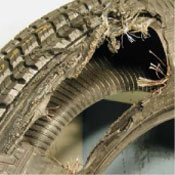
DIAMOND BAR, CA (Jan. 10, 2007) - Officials at the National Highway Traffic Safety Administration (NHTSA) believe that they have developed a test for determining the durability of aged tires, according to a report from the Specialty Equipment Market Association (SEMA).The test involves subjecting a tire to high temperatures (up to 150?F) for eight to 10 weeks in a high oxygen environment. The test was given a stamp of approval by the Aged Tire Durability Task Group, a 33-member task force that includes representatives for tire makers, the auto industry and safety groups.
The task group was formed in 2002 to establish a tire durability test.The group also endorsed its own, separate durability test that would run tires at about 75 miles an hour for more than 30 hours. Read the full article at.. http://www.motorage.com/motorage/article/articleDetail.jsp?id=398149
Monday, January 15, 2007
Winter Weather Driving Tips
Just a few square inches of rubber at each of your car's four corners is all that keeps you on the road. It's pretty amazing when you think about it. Several thousand pounds of steel, plastic, glass and you -- all kept under control by four small "contact patches" of tire tread.
Now imagine what happens when you drive over slick, ice-covered surfaces. On a curve, the car will try to keep on going straight ahead -- and right off the road. The inertia keeps it going in that direction -- and the lack of traction prevents you from being able to make corrections.
If you are on a straight stretch that's covered with black ice and you tap the brakes (even if you have ABS) sudden weight transfer could cause the car to go into a sidewise slide. Often, the only thing that will stop it is an impact with another car -- or a telephone pole.
It's best to avoid driving in icy conditions, of course -- but sometimes we can't help being caught in a storm. So here are some practical driving tips to help avoid getting into an accident when the weather turns wicked:
* Reduce speed. Even if you have four-wheel-drive or all-wheel-drive, your vehicle's ability to stop/slow down on ice and snow is no better than any other car's. And you'll need more room to come to a stop on wet/snow/ice-slicked roads than you would on dry pavement. By dropping your speed, you also reduce the amount of time/space you'll need to safely come to a complete stop -- and significantly increase your odds of avoiding an accident.
* In winter weather, double or triple your following distance between yourself and the vehicle ahead of you. This will give you more time to slow down -- and more time to consider worst-case alternatives (such as steering into a ditch rather than piling into the car ahead).
* Avoid oversteering or "jerky" movements of the wheel. Change directions gradually and smoothly. Abrupt lane changes or sudden steering inputs can l throw the weight of the car around and that could be just enough to overcome whatever little traction you've got -- resulting in a spin-out or slide.
*If you need to stop quickly, depress the brake pedal gradually and smoothly (on cars without anti-lock brakes). If you sense the wheels about to lock up, back off the pedal and downshift the transmission into a lower gear; the "engine braking" effect will help slow the car without causing the wheels to lock-up. This works with both manual and automatic transmissions. With a manual, shift to the next lowest gear; with an automatic, move the shift lever from "Drive" to the next lowest position.
* If you have ABS, push the brake pedal all the way down for maximum braking force -- and do not let up. The ABS will prevent the wheels from locking up and you will still be able to steer the car. Make sure you know whether your vehicle has ABS -- and brake accordingly.
* If you don't have ABS and the brakes begin to lock, the car will often go into a slide; this is especially dangerous, because once you've lost control of the car, recovering control is often difficult, even for a very good driver with special training. For novice/average skill drivers, if a serious skid doesn't result in an accident, it's usually just a matter of being lucky. If your car does not have ABS and you feel the wheels locking up, lift off the brake pedal immediately. In addition to preventing (or at least lessening) the skid, you will recover the ability to steer the car -- which you'd have lost if you kept your foot down and the wheels remained locked up.
On ABS-equipped vehicles, meanwhile, the thing to do is push the pedal to the floor and hold it there; the ABS system will automatically prevent the wheels from locking up and the vehicle should therefore not go into a dangerous skid. Make sure you know for sure what kind of braking system your car or truck has before you need to know!
*Use momentum to your advantage. In other words, keep moving -- if it is safe to do so. While it's important to obey traffic laws, sometimes common sense overrides rigid adherence to rules. For example, if you come to a stop sign at the top of a hill with several cars coming up behind you, it's not necessarily the smart move to come to a complete stop and risk either getting stuck or, worse, sliding back down the hill and hitting the cars behind you. Assuming you can clearly see the intersection and there are no other cars attempting to come through, a "rolling stop" in such circumstances might be saferthan risking the loss of your traction and forward momentum.
* When a rear wheel drive car loses traction, typically the back end of the car will start to "fishtail." If this happens, back off the gas and attempt to regain control by steering in the direction of the skid. Often, just backing off the gas will cause the car to stop fishtailing -- and the tail will snap back into line. Avoid the temptation to hit the brakes in a skid; this will only make it worse. Gently steer your way out of it -- and try not to panic.
* Front-wheel-drive cars are usually better in the snow and ice than rear-drive cars because all the weight of the engine and transmission are on top of the drive wheels, which gives better traction and thus the car is less apt to spin-out than a rear-drive car. On the other hand, if a bad spin happens, the front-drive car is also a bit more tricky to recover precisely because most of the weight is on one end of the car rather than more equally distributed front-to-rear.
Some hints, tricks and suggestions:
*Put something heavy (a couple of 50-lb. bags of sand, for example) in the trunk of rear wheel drive cars (and 2WD trucks and SUVs) during winter months. The added weight on the drive wheels will improve traction -- and if you have sand in the trunk, you can use it to free yourself by spreading some on an ice-covered street.
*Make sure you have decent tires. "Yul Brynners" (bald tires) or high performance summer tires (which are almost as bad as baldies in snow and ice) should be avoided. All-season tires are fine, but for maximum grip (if you live in a part of the country with serious winter weather), the small hassle of switching over to specific-use snow tires is a smart move. A set of four snow tires is a whole lot cheaper than a $5,000 body shop bill -- and the jacked-up insurance premiums that go with that.
* If it's really bad outside, take the bus/train (or bum a ride) if you drive any kind of sports car. The combination of performance tires and low ground clearance that typifies these specialty cars and makes them so fun to drive on dry pavement is exactly what makes them the worst things to be in when it snows or if there is ice on the ground.
And if the worst happens and you find yourself in a skid that you can't control or steer out of, try to plan your impact to minimize the damage to yourself, others and your vehicle (in that order). For example, you may have enough time and enough control left to choose what you will hit. If possible, go for something with "give" -- such as a snowbank or grassy ditch. And try and hit it sideways, rather than head-on. You can use small trees and bushes to slow your vehicle down. At this point, don't worry so much about body damage to the car. Worry about damage to your own body.
The goal is to avoid a full-force impact with a stationary object, such as a big tree, utility pole or something like that.
And: It's always better to be in a single car accident involving just your vehicle than it is a multi-car accident. There's less total damage this way -- and you don't have to deal with the guilt of causing personal injury to someone else.
The best thing to do -- if you have an understanding boss -- is just stay home and sleep the day away.
Now imagine what happens when you drive over slick, ice-covered surfaces. On a curve, the car will try to keep on going straight ahead -- and right off the road. The inertia keeps it going in that direction -- and the lack of traction prevents you from being able to make corrections.
If you are on a straight stretch that's covered with black ice and you tap the brakes (even if you have ABS) sudden weight transfer could cause the car to go into a sidewise slide. Often, the only thing that will stop it is an impact with another car -- or a telephone pole.
It's best to avoid driving in icy conditions, of course -- but sometimes we can't help being caught in a storm. So here are some practical driving tips to help avoid getting into an accident when the weather turns wicked:
* Reduce speed. Even if you have four-wheel-drive or all-wheel-drive, your vehicle's ability to stop/slow down on ice and snow is no better than any other car's. And you'll need more room to come to a stop on wet/snow/ice-slicked roads than you would on dry pavement. By dropping your speed, you also reduce the amount of time/space you'll need to safely come to a complete stop -- and significantly increase your odds of avoiding an accident.
* In winter weather, double or triple your following distance between yourself and the vehicle ahead of you. This will give you more time to slow down -- and more time to consider worst-case alternatives (such as steering into a ditch rather than piling into the car ahead).
* Avoid oversteering or "jerky" movements of the wheel. Change directions gradually and smoothly. Abrupt lane changes or sudden steering inputs can l throw the weight of the car around and that could be just enough to overcome whatever little traction you've got -- resulting in a spin-out or slide.
*If you need to stop quickly, depress the brake pedal gradually and smoothly (on cars without anti-lock brakes). If you sense the wheels about to lock up, back off the pedal and downshift the transmission into a lower gear; the "engine braking" effect will help slow the car without causing the wheels to lock-up. This works with both manual and automatic transmissions. With a manual, shift to the next lowest gear; with an automatic, move the shift lever from "Drive" to the next lowest position.
* If you have ABS, push the brake pedal all the way down for maximum braking force -- and do not let up. The ABS will prevent the wheels from locking up and you will still be able to steer the car. Make sure you know whether your vehicle has ABS -- and brake accordingly.
* If you don't have ABS and the brakes begin to lock, the car will often go into a slide; this is especially dangerous, because once you've lost control of the car, recovering control is often difficult, even for a very good driver with special training. For novice/average skill drivers, if a serious skid doesn't result in an accident, it's usually just a matter of being lucky. If your car does not have ABS and you feel the wheels locking up, lift off the brake pedal immediately. In addition to preventing (or at least lessening) the skid, you will recover the ability to steer the car -- which you'd have lost if you kept your foot down and the wheels remained locked up.
On ABS-equipped vehicles, meanwhile, the thing to do is push the pedal to the floor and hold it there; the ABS system will automatically prevent the wheels from locking up and the vehicle should therefore not go into a dangerous skid. Make sure you know for sure what kind of braking system your car or truck has before you need to know!
*Use momentum to your advantage. In other words, keep moving -- if it is safe to do so. While it's important to obey traffic laws, sometimes common sense overrides rigid adherence to rules. For example, if you come to a stop sign at the top of a hill with several cars coming up behind you, it's not necessarily the smart move to come to a complete stop and risk either getting stuck or, worse, sliding back down the hill and hitting the cars behind you. Assuming you can clearly see the intersection and there are no other cars attempting to come through, a "rolling stop" in such circumstances might be saferthan risking the loss of your traction and forward momentum.
* When a rear wheel drive car loses traction, typically the back end of the car will start to "fishtail." If this happens, back off the gas and attempt to regain control by steering in the direction of the skid. Often, just backing off the gas will cause the car to stop fishtailing -- and the tail will snap back into line. Avoid the temptation to hit the brakes in a skid; this will only make it worse. Gently steer your way out of it -- and try not to panic.
* Front-wheel-drive cars are usually better in the snow and ice than rear-drive cars because all the weight of the engine and transmission are on top of the drive wheels, which gives better traction and thus the car is less apt to spin-out than a rear-drive car. On the other hand, if a bad spin happens, the front-drive car is also a bit more tricky to recover precisely because most of the weight is on one end of the car rather than more equally distributed front-to-rear.
Some hints, tricks and suggestions:
*Put something heavy (a couple of 50-lb. bags of sand, for example) in the trunk of rear wheel drive cars (and 2WD trucks and SUVs) during winter months. The added weight on the drive wheels will improve traction -- and if you have sand in the trunk, you can use it to free yourself by spreading some on an ice-covered street.
*Make sure you have decent tires. "Yul Brynners" (bald tires) or high performance summer tires (which are almost as bad as baldies in snow and ice) should be avoided. All-season tires are fine, but for maximum grip (if you live in a part of the country with serious winter weather), the small hassle of switching over to specific-use snow tires is a smart move. A set of four snow tires is a whole lot cheaper than a $5,000 body shop bill -- and the jacked-up insurance premiums that go with that.
* If it's really bad outside, take the bus/train (or bum a ride) if you drive any kind of sports car. The combination of performance tires and low ground clearance that typifies these specialty cars and makes them so fun to drive on dry pavement is exactly what makes them the worst things to be in when it snows or if there is ice on the ground.
And if the worst happens and you find yourself in a skid that you can't control or steer out of, try to plan your impact to minimize the damage to yourself, others and your vehicle (in that order). For example, you may have enough time and enough control left to choose what you will hit. If possible, go for something with "give" -- such as a snowbank or grassy ditch. And try and hit it sideways, rather than head-on. You can use small trees and bushes to slow your vehicle down. At this point, don't worry so much about body damage to the car. Worry about damage to your own body.
The goal is to avoid a full-force impact with a stationary object, such as a big tree, utility pole or something like that.
And: It's always better to be in a single car accident involving just your vehicle than it is a multi-car accident. There's less total damage this way -- and you don't have to deal with the guilt of causing personal injury to someone else.
The best thing to do -- if you have an understanding boss -- is just stay home and sleep the day away.
Thursday, January 11, 2007
New EPA mileage estimates for 2008 model year
 Expect the mileage estimates published by the EPA to go down on 2008 model year vehicles, even if the vehicle itself has not changed. The percentage figures of the drops may be as high as 30 percent on some vehicles. The vehicles with the highest estimated mileage will be hit the hardest, including hybrid models such as the Toyota Prius.
The changes to mileage estimates are being made to appease buyers of vehicles who are unable to match the EPA's estimates. This has been quite a topic of conversation lately, due to the proliferation of hybrid models hitting the marketplace. Numerous web boards have discussions related to actual mileage numbers that users of the vehicles are returning.
It would be good to mention here that the mileage estimates by the EPA are not the same as the Corporate Average Fuel Economy numbers used by lawmakers to enforce mileage regulations on carmakers. Also, while it is possible for drivers to achieve drastically lower numbers than the EPA estimates, it is also possible to meet or exceed them. The numbers are being changed more to reflect drivers' habits than technology problems. The old numbers reported by the EPA were not "wrong", they were real figures which are completely achievable if the vehicle is driven under the same conditions as those the vehicle was tested under. Unfortunately, few drivers drove in a matter even remotely similar to the EPA tests. So, the new numbers are ultimately a good thing for consumers, even though they may make green cars seem a little less so.
Monday, January 08, 2007
Semi-Storage Tips for Little-Used Cars
Many of us have a second car that isn't used much; maybe we keep it under a car cover in the garage or -- worse -- just let it sit there in the driveway. This is not wise -- unless your goal is to end up with a 3,000 pound pile of West Virginia lawn sculpture.
In fact, a car with higher miles that's used every day can be in better shape -- and even last longer, ultimately -- than a car that's basically left to rot. And that is exactly what happens to a vehicle that is not properly stored or properly kept-up if it's used only occasionally (less than a couple of times per month).
For example, rubber seals and gaskets in the engine will dry out, crack and eventually leak if the engine is not fired-up and run until it reaches operating temperature. Engine oil keeps them pliable. But it has to circulate to reach many of these gaskets and seals. And for it to ciruclate, the engine has to be running.
Clean, fresh engine oil is also vital to the health of internal engine parts. Normally, the oil is supplied under pressure (or by splash effect) when the engine is running -- and afterwards a thin coat will remain on these surfaces, protecting them.
However, the film of oil that protects those internal metal surfaces will eventually dissipate -- or worse, congeal into a blob of sludge. Sludge can cause sticking valves, oiling system problems and other engine maladies -- while rust can form on the insides of cylinder walls from the mositure that gets into the engine during long periods of disuse, when there is an absence of lubrication.
Old gas inside carburetors and fuel systems leaves varnish and deposits; the gas also leaks into the engine and will wash the protective film of motor oil off of internal parts and contaminate the oil in the sump (oil pan).
Grit and gunk can cause accelerated wear, even catastrophic engine failure, when you try and start the thing after months sitting idle. At minimum, it will likely cause hard starting/rough running and poor overall performance.
Corrosion can also build up in the passages of the cooling system -- with crud building-up in the engine's cooling passages, radiator, and the heater core. This will reduce the efficiency of the cooling system and could lead to overheating -- and expensive repairs.
Some automatic transmissions can be ruined (or their lives shortened) by infrequent use; the hydraulic fluid that makes them work is also a lubricant that keeps parts such as the front pump in good working order. If seals dry out or internal passages get blocked by crud accumulated from disuse, a failure can occur when the car is eventually restarted; hydraulic problems/lack of proper oil circulation can ruin an automatic transmission very quickly.
Moisture will eventually ruin brake parts. The fluid gets contaminated and the rubber lines begin to dry rot -- or rot from the inside out. Rubber seals at calipers and wheel cylinders wear out and rust can form on disc brake rotors.
To avoid all this, you must do one of two things -- either prepare the car properly for long-term storage -- or operate the car for about half an hour or so at least twice a month.
"Operate" meaning actually drive it -- not just running the engine at idle while the car sits just there. If you don't actually drive the car, gear oil doesn't circulate in the axle and transmission (manual-equipped cars), the brake rotors and drums don't turn and the engine -- when it isn't running at more than idle speed -- isn't getting the same workout it would if you actually drove the thing.
Some people don't realize it, but simply starting the car and letting it idle is one of the absolute worst things you can do. It's especially hard on late-model, emissions-controlled vehicle because the catalytic converter and related components do not work properly until normal operating temperature has been reached. To maximize the life of these parts (as well as keep your contribution of noxious gasses to the environment at a minimum) drive the car almost immediately after you start it.
A 30-45 minute toodle will recharge the battery, circulate oil to internal seals, allow the engine to purge itself of volatile and corrosive compounds, keep the cooling system in peak shape (assuming you've kept up with maintenance of that by regularly flushing it and adding fresh anti-freeze and water), and keep the transmission/axle or transaxle (on front-drive cars) lubed.
Do this faithfully -- and adhere to a proper maintenance shedule -- and the car will last a long, long time. Fail to do it and you will have a very heavy but largely useless object d' art in your driveway.
As regards long-term storage, there are many books available on the subject (see the "transportation" area of your local book store), and it would take a separate article to detail the process. But it's definitely worth looking into if you have a car you don't plan to use for more than a couple of months at a stretch. At least, that is, if you value the car in question. For a vehicle that won't be used for six months or longer, proper storage is an absolute necessity.
Most people, however, will get by just fine with the above "twice a month" rule.
In fact, a car with higher miles that's used every day can be in better shape -- and even last longer, ultimately -- than a car that's basically left to rot. And that is exactly what happens to a vehicle that is not properly stored or properly kept-up if it's used only occasionally (less than a couple of times per month).
For example, rubber seals and gaskets in the engine will dry out, crack and eventually leak if the engine is not fired-up and run until it reaches operating temperature. Engine oil keeps them pliable. But it has to circulate to reach many of these gaskets and seals. And for it to ciruclate, the engine has to be running.
Clean, fresh engine oil is also vital to the health of internal engine parts. Normally, the oil is supplied under pressure (or by splash effect) when the engine is running -- and afterwards a thin coat will remain on these surfaces, protecting them.
However, the film of oil that protects those internal metal surfaces will eventually dissipate -- or worse, congeal into a blob of sludge. Sludge can cause sticking valves, oiling system problems and other engine maladies -- while rust can form on the insides of cylinder walls from the mositure that gets into the engine during long periods of disuse, when there is an absence of lubrication.
Old gas inside carburetors and fuel systems leaves varnish and deposits; the gas also leaks into the engine and will wash the protective film of motor oil off of internal parts and contaminate the oil in the sump (oil pan).
Grit and gunk can cause accelerated wear, even catastrophic engine failure, when you try and start the thing after months sitting idle. At minimum, it will likely cause hard starting/rough running and poor overall performance.
Corrosion can also build up in the passages of the cooling system -- with crud building-up in the engine's cooling passages, radiator, and the heater core. This will reduce the efficiency of the cooling system and could lead to overheating -- and expensive repairs.
Some automatic transmissions can be ruined (or their lives shortened) by infrequent use; the hydraulic fluid that makes them work is also a lubricant that keeps parts such as the front pump in good working order. If seals dry out or internal passages get blocked by crud accumulated from disuse, a failure can occur when the car is eventually restarted; hydraulic problems/lack of proper oil circulation can ruin an automatic transmission very quickly.
Moisture will eventually ruin brake parts. The fluid gets contaminated and the rubber lines begin to dry rot -- or rot from the inside out. Rubber seals at calipers and wheel cylinders wear out and rust can form on disc brake rotors.
To avoid all this, you must do one of two things -- either prepare the car properly for long-term storage -- or operate the car for about half an hour or so at least twice a month.
"Operate" meaning actually drive it -- not just running the engine at idle while the car sits just there. If you don't actually drive the car, gear oil doesn't circulate in the axle and transmission (manual-equipped cars), the brake rotors and drums don't turn and the engine -- when it isn't running at more than idle speed -- isn't getting the same workout it would if you actually drove the thing.
Some people don't realize it, but simply starting the car and letting it idle is one of the absolute worst things you can do. It's especially hard on late-model, emissions-controlled vehicle because the catalytic converter and related components do not work properly until normal operating temperature has been reached. To maximize the life of these parts (as well as keep your contribution of noxious gasses to the environment at a minimum) drive the car almost immediately after you start it.
A 30-45 minute toodle will recharge the battery, circulate oil to internal seals, allow the engine to purge itself of volatile and corrosive compounds, keep the cooling system in peak shape (assuming you've kept up with maintenance of that by regularly flushing it and adding fresh anti-freeze and water), and keep the transmission/axle or transaxle (on front-drive cars) lubed.
Do this faithfully -- and adhere to a proper maintenance shedule -- and the car will last a long, long time. Fail to do it and you will have a very heavy but largely useless object d' art in your driveway.
As regards long-term storage, there are many books available on the subject (see the "transportation" area of your local book store), and it would take a separate article to detail the process. But it's definitely worth looking into if you have a car you don't plan to use for more than a couple of months at a stretch. At least, that is, if you value the car in question. For a vehicle that won't be used for six months or longer, proper storage is an absolute necessity.
Most people, however, will get by just fine with the above "twice a month" rule.
Thursday, January 04, 2007
GM Fuel Sending Unit “Flipping”

Operation of a typical in-tank fuel level sending unit is based on variable resistance. As the float moves up or down according to fuel level, the resistance in the sending unit varies. This varying resistance is processed by the engine control module (ECM) and the resulting information is sent to the instrument panel cluster (IPC) for display on the fuel gauge. In the past, the sending unit was set up so that high resistance indicated high fuel level,
and low resistance indicated low fuel level.
Sulfur contaminants found in some of today's gasolines can form deposits on the sending unit, resulting in higher-than-intended resistance . The high resistance from the deposits could be misinterpreted as a high fuel level, when in fact the fuel level is low. The driver may run out of fuel, even though the fuel gauge is not indicating low or empty.
To offset this effect, engineering has begun "flipping" fuel senders, reversing the circuitry. This means that high resistance now indicates low fuel level and low resistance indicates high fuel level. So, if deposit build-up adds to sender resistance, the gauge will err in the direction of indicating less fuel than is actually in the tank.
The "flipping" process began in the 2004 model year continued through model years 2005-06. The remaining vehicles will have their fuel level sending units "flipped" for the 2007 model year:
- Cadillac CTS
- Cadillac SRX
- Cadillac STS
- Cadillac XLR
- Chevrolet Corvette
- Chevrolet Impala, Monte Carlo
- Chevrolet Malibu, Maxx
- Pontiac Grand Prix
- Buick LaCrosse (Allure)
TIP: When diagnosing fuel sender operation, it's critical to refer to the appropriate model year information to be sure which resistance specifications apply.
Monday, January 01, 2007
The Low-Down on High Octane Gasoline
Are you tempted to buy a high-octane gasoline for your car because you want to improve its performance? If so, take note: the recommended gasoline for most cars is regular octane. In fact, in most cases, using a higher octane gasoline than your owner's manual recommends offers absolutely no benefit. It won't make your car perform better, go faster, get better mileage or run cleaner. Your best bet: listen to your owner's manual.
The only time you might need to switch to a higher octane level is if your car engine knocks when you use the recommended fuel. This happens to a small percentage of cars.
Unless your engine is knocking, buying higher octane gasoline is a waste of money, too. Premium gas costs .15 to .20 cents per gallon more than regular. That can add up to $100.00 or more a year in extra costs. Studies indicate that altogether, drivers may be spending hundreds of millions of dollars each year for higher-octane gas than they need.
What Are Octane Ratings?
Octane ratings measure a gasoline's ability to resist engine knock, a rattling or pinging sound that results from premature ignition of the compressed fuel-air mixture in one or more cylinders. Most gas stations offer three octane grades: regular, usually 87 octane, mid-grade, usually 89 octane and premium, usually 92 or 93. The ratings must be posted on bright yellow stickers on each gasoline pump.
What's The Right Octane Level For Your Car?
Check your owner's manual to determine the right octane level for your car. Regular octane is recommended for most cars. However, some cars with high compression engines, like sports cars and certain luxury cars, need mid-grade or premium gasoline to prevent knock.
How Can You Tell If You're Using The Right Octane Level?
Listen to your car's engine. If it doesn't knock when you use the recommended octane, you're using the right grade of gasoline.
Will Higher Octane Gasoline Clean Your Engine Better?
As a rule, high-octane gasoline does not outperform regular octane in preventing engine deposits from forming, in removing them, or in cleaning your car's engine. In fact, the U.S. Environmental Protection Agency requires that all octane grades of all brands of gasoline contain engine cleaning detergent additives to protect against the build-up of harmful levels of engine deposits during the expected life of your car.
Should You Ever Switch To A Higher Octane Gasoline?
A few car engines may knock or ping, even if you use the recommended octane. If this happens, try switching to the next highest octane grade. In many cases, switching to the mid-grade or premium-grade gasoline will eliminate the knock. If the knocking or pinging continues after one or two fill-ups, you may need a tune-up or some other repair. After that work is done, go back to the lowest octane grade at which your engine runs without knocking.
Is Knocking Harmful?
Occasional light knocking or pinging won't harm your engine, and doesn't indicate a need for higher octane. But don't ignore severe knocking. A heavy or persistent knock can lead to engine damage.
Is All "Premium" Or "Regular" Gasoline The Same?
The octane rating of gasoline marked "premium" or "regular" is not consistent across the country. One state may require a minimum octane rating of 92 for all premium gasoline, while another may allow 90 octane to be called premium. To make sure you know what you're buying, check the octane rating on the yellow sticker on the gas pump instead of relying on the name "premium" or "regular."
The only time you might need to switch to a higher octane level is if your car engine knocks when you use the recommended fuel. This happens to a small percentage of cars.
Unless your engine is knocking, buying higher octane gasoline is a waste of money, too. Premium gas costs .15 to .20 cents per gallon more than regular. That can add up to $100.00 or more a year in extra costs. Studies indicate that altogether, drivers may be spending hundreds of millions of dollars each year for higher-octane gas than they need.
What Are Octane Ratings?
Octane ratings measure a gasoline's ability to resist engine knock, a rattling or pinging sound that results from premature ignition of the compressed fuel-air mixture in one or more cylinders. Most gas stations offer three octane grades: regular, usually 87 octane, mid-grade, usually 89 octane and premium, usually 92 or 93. The ratings must be posted on bright yellow stickers on each gasoline pump.
What's The Right Octane Level For Your Car?
Check your owner's manual to determine the right octane level for your car. Regular octane is recommended for most cars. However, some cars with high compression engines, like sports cars and certain luxury cars, need mid-grade or premium gasoline to prevent knock.
How Can You Tell If You're Using The Right Octane Level?
Listen to your car's engine. If it doesn't knock when you use the recommended octane, you're using the right grade of gasoline.
Will Higher Octane Gasoline Clean Your Engine Better?
As a rule, high-octane gasoline does not outperform regular octane in preventing engine deposits from forming, in removing them, or in cleaning your car's engine. In fact, the U.S. Environmental Protection Agency requires that all octane grades of all brands of gasoline contain engine cleaning detergent additives to protect against the build-up of harmful levels of engine deposits during the expected life of your car.
Should You Ever Switch To A Higher Octane Gasoline?
A few car engines may knock or ping, even if you use the recommended octane. If this happens, try switching to the next highest octane grade. In many cases, switching to the mid-grade or premium-grade gasoline will eliminate the knock. If the knocking or pinging continues after one or two fill-ups, you may need a tune-up or some other repair. After that work is done, go back to the lowest octane grade at which your engine runs without knocking.
Is Knocking Harmful?
Occasional light knocking or pinging won't harm your engine, and doesn't indicate a need for higher octane. But don't ignore severe knocking. A heavy or persistent knock can lead to engine damage.
Is All "Premium" Or "Regular" Gasoline The Same?
The octane rating of gasoline marked "premium" or "regular" is not consistent across the country. One state may require a minimum octane rating of 92 for all premium gasoline, while another may allow 90 octane to be called premium. To make sure you know what you're buying, check the octane rating on the yellow sticker on the gas pump instead of relying on the name "premium" or "regular."
Subscribe to:
Posts (Atom)