Once you see the flashing red lights in your rearview mirror, there's not much you can do about getting stopped. But how you handle being stopped can sometimes mean the difference between a warning and a ticket -- or at the very least, a better (or worse) experience in court.
The Do's:
* Immediately acknowledge the officer by slowing your vehicle and signaling your intention to pull over. Try to pull as far off the road (and away from traffic) as possible. By making the stop itself less dangerous and stressful for the officer, you have set the stage for a civil interaction.
* Once you're pulled over, turn off your engine and put your hazard flashers on -- so the officer knows you aren't thinking of running. (If you're on a motorcycle, remove your helmet as soon as you've stopped the bike.)
* If it is dark outside, turn on your vehicle's interior dome light so the officer can clearly see you; sit calmly and wait for the officer to approach the vehicle. Keep your hands visible. Even though you are just an Ordinary Joe (or Jane) and this is just a traffic stop, the officer doesn't know you or your intentions -- and it's possible you might be a violent criminal with a weapon. Your goal is to make it clear you're not.
* Answer the officer's questions in even tones and politely. But do not answer leading questions with admissions of guilt -- which will absolutely be used against you in court should you decide to contest the ticket.
* If you have any intention of contesting the ticket, do not immediately drive away once the paperwork has been signed and the officer has departed. Hopefully you keep a pen or pencil in the vehicle, along with a small notepad. Now is the time to write down every detail about the stop you can recall, while the event is still fresh in memory. Jot down things like the exact location of the stop, whether the speed limit was clearly posted, etc. Anything that may be relevant to a possible defense. The officer made notes; you should, too.
The Don'ts:
* Don't stop your vehicle in the middle of a busy road; impeding the flow of traffic won't win you any points for driving skill with the officer -- and he won't appreciate your making him have to get out and walk up to your vehicle with other cars whizzing past just feet away.
* Don't attempt to get out of your vehicle (unless the officer ask you to do so). Never approach the officer or his vehicle. This is a good way to get shot; at minimum, it will raise tensions -- just the opposite of what you want.
* Don't root around for things in the glovebox or under the seats -- even if all you are looking for is your insurance and registration paperwork.
* Do not be argumentative. Save it for court. In fact, if you intend to contest the ticket, it is in your best interests to give the impression that you are the type of person who will just mail in the fine. Be forgettable. At the least, you'll likely find the cop barely remembers you personally when your trail date arrives -- and unless you've given him a reason to personally dislike you, he probably won't object to a request that the charge be reduced (for example, from a moving violation with "points" to a non-moving violation that only carries a fine).
Monday, January 22, 2007
Thursday, January 18, 2007
Test for Aged Tires Gains Traction
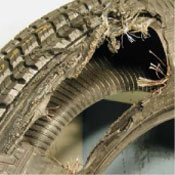
DIAMOND BAR, CA (Jan. 10, 2007) - Officials at the National Highway Traffic Safety Administration (NHTSA) believe that they have developed a test for determining the durability of aged tires, according to a report from the Specialty Equipment Market Association (SEMA).The test involves subjecting a tire to high temperatures (up to 150?F) for eight to 10 weeks in a high oxygen environment. The test was given a stamp of approval by the Aged Tire Durability Task Group, a 33-member task force that includes representatives for tire makers, the auto industry and safety groups.
The task group was formed in 2002 to establish a tire durability test.The group also endorsed its own, separate durability test that would run tires at about 75 miles an hour for more than 30 hours. Read the full article at.. http://www.motorage.com/motorage/article/articleDetail.jsp?id=398149

Monday, January 15, 2007
Winter Weather Driving Tips
Just a few square inches of rubber at each of your car's four corners is all that keeps you on the road. It's pretty amazing when you think about it. Several thousand pounds of steel, plastic, glass and you -- all kept under control by four small "contact patches" of tire tread.
Now imagine what happens when you drive over slick, ice-covered surfaces. On a curve, the car will try to keep on going straight ahead -- and right off the road. The inertia keeps it going in that direction -- and the lack of traction prevents you from being able to make corrections.
If you are on a straight stretch that's covered with black ice and you tap the brakes (even if you have ABS) sudden weight transfer could cause the car to go into a sidewise slide. Often, the only thing that will stop it is an impact with another car -- or a telephone pole.
It's best to avoid driving in icy conditions, of course -- but sometimes we can't help being caught in a storm. So here are some practical driving tips to help avoid getting into an accident when the weather turns wicked:
* Reduce speed. Even if you have four-wheel-drive or all-wheel-drive, your vehicle's ability to stop/slow down on ice and snow is no better than any other car's. And you'll need more room to come to a stop on wet/snow/ice-slicked roads than you would on dry pavement. By dropping your speed, you also reduce the amount of time/space you'll need to safely come to a complete stop -- and significantly increase your odds of avoiding an accident.
* In winter weather, double or triple your following distance between yourself and the vehicle ahead of you. This will give you more time to slow down -- and more time to consider worst-case alternatives (such as steering into a ditch rather than piling into the car ahead).
* Avoid oversteering or "jerky" movements of the wheel. Change directions gradually and smoothly. Abrupt lane changes or sudden steering inputs can l throw the weight of the car around and that could be just enough to overcome whatever little traction you've got -- resulting in a spin-out or slide.
*If you need to stop quickly, depress the brake pedal gradually and smoothly (on cars without anti-lock brakes). If you sense the wheels about to lock up, back off the pedal and downshift the transmission into a lower gear; the "engine braking" effect will help slow the car without causing the wheels to lock-up. This works with both manual and automatic transmissions. With a manual, shift to the next lowest gear; with an automatic, move the shift lever from "Drive" to the next lowest position.
* If you have ABS, push the brake pedal all the way down for maximum braking force -- and do not let up. The ABS will prevent the wheels from locking up and you will still be able to steer the car. Make sure you know whether your vehicle has ABS -- and brake accordingly.
* If you don't have ABS and the brakes begin to lock, the car will often go into a slide; this is especially dangerous, because once you've lost control of the car, recovering control is often difficult, even for a very good driver with special training. For novice/average skill drivers, if a serious skid doesn't result in an accident, it's usually just a matter of being lucky. If your car does not have ABS and you feel the wheels locking up, lift off the brake pedal immediately. In addition to preventing (or at least lessening) the skid, you will recover the ability to steer the car -- which you'd have lost if you kept your foot down and the wheels remained locked up.
On ABS-equipped vehicles, meanwhile, the thing to do is push the pedal to the floor and hold it there; the ABS system will automatically prevent the wheels from locking up and the vehicle should therefore not go into a dangerous skid. Make sure you know for sure what kind of braking system your car or truck has before you need to know!
*Use momentum to your advantage. In other words, keep moving -- if it is safe to do so. While it's important to obey traffic laws, sometimes common sense overrides rigid adherence to rules. For example, if you come to a stop sign at the top of a hill with several cars coming up behind you, it's not necessarily the smart move to come to a complete stop and risk either getting stuck or, worse, sliding back down the hill and hitting the cars behind you. Assuming you can clearly see the intersection and there are no other cars attempting to come through, a "rolling stop" in such circumstances might be saferthan risking the loss of your traction and forward momentum.
* When a rear wheel drive car loses traction, typically the back end of the car will start to "fishtail." If this happens, back off the gas and attempt to regain control by steering in the direction of the skid. Often, just backing off the gas will cause the car to stop fishtailing -- and the tail will snap back into line. Avoid the temptation to hit the brakes in a skid; this will only make it worse. Gently steer your way out of it -- and try not to panic.
* Front-wheel-drive cars are usually better in the snow and ice than rear-drive cars because all the weight of the engine and transmission are on top of the drive wheels, which gives better traction and thus the car is less apt to spin-out than a rear-drive car. On the other hand, if a bad spin happens, the front-drive car is also a bit more tricky to recover precisely because most of the weight is on one end of the car rather than more equally distributed front-to-rear.
Some hints, tricks and suggestions:
*Put something heavy (a couple of 50-lb. bags of sand, for example) in the trunk of rear wheel drive cars (and 2WD trucks and SUVs) during winter months. The added weight on the drive wheels will improve traction -- and if you have sand in the trunk, you can use it to free yourself by spreading some on an ice-covered street.
*Make sure you have decent tires. "Yul Brynners" (bald tires) or high performance summer tires (which are almost as bad as baldies in snow and ice) should be avoided. All-season tires are fine, but for maximum grip (if you live in a part of the country with serious winter weather), the small hassle of switching over to specific-use snow tires is a smart move. A set of four snow tires is a whole lot cheaper than a $5,000 body shop bill -- and the jacked-up insurance premiums that go with that.
* If it's really bad outside, take the bus/train (or bum a ride) if you drive any kind of sports car. The combination of performance tires and low ground clearance that typifies these specialty cars and makes them so fun to drive on dry pavement is exactly what makes them the worst things to be in when it snows or if there is ice on the ground.
And if the worst happens and you find yourself in a skid that you can't control or steer out of, try to plan your impact to minimize the damage to yourself, others and your vehicle (in that order). For example, you may have enough time and enough control left to choose what you will hit. If possible, go for something with "give" -- such as a snowbank or grassy ditch. And try and hit it sideways, rather than head-on. You can use small trees and bushes to slow your vehicle down. At this point, don't worry so much about body damage to the car. Worry about damage to your own body.
The goal is to avoid a full-force impact with a stationary object, such as a big tree, utility pole or something like that.
And: It's always better to be in a single car accident involving just your vehicle than it is a multi-car accident. There's less total damage this way -- and you don't have to deal with the guilt of causing personal injury to someone else.
The best thing to do -- if you have an understanding boss -- is just stay home and sleep the day away.
Now imagine what happens when you drive over slick, ice-covered surfaces. On a curve, the car will try to keep on going straight ahead -- and right off the road. The inertia keeps it going in that direction -- and the lack of traction prevents you from being able to make corrections.
If you are on a straight stretch that's covered with black ice and you tap the brakes (even if you have ABS) sudden weight transfer could cause the car to go into a sidewise slide. Often, the only thing that will stop it is an impact with another car -- or a telephone pole.
It's best to avoid driving in icy conditions, of course -- but sometimes we can't help being caught in a storm. So here are some practical driving tips to help avoid getting into an accident when the weather turns wicked:
* Reduce speed. Even if you have four-wheel-drive or all-wheel-drive, your vehicle's ability to stop/slow down on ice and snow is no better than any other car's. And you'll need more room to come to a stop on wet/snow/ice-slicked roads than you would on dry pavement. By dropping your speed, you also reduce the amount of time/space you'll need to safely come to a complete stop -- and significantly increase your odds of avoiding an accident.
* In winter weather, double or triple your following distance between yourself and the vehicle ahead of you. This will give you more time to slow down -- and more time to consider worst-case alternatives (such as steering into a ditch rather than piling into the car ahead).
* Avoid oversteering or "jerky" movements of the wheel. Change directions gradually and smoothly. Abrupt lane changes or sudden steering inputs can l throw the weight of the car around and that could be just enough to overcome whatever little traction you've got -- resulting in a spin-out or slide.
*If you need to stop quickly, depress the brake pedal gradually and smoothly (on cars without anti-lock brakes). If you sense the wheels about to lock up, back off the pedal and downshift the transmission into a lower gear; the "engine braking" effect will help slow the car without causing the wheels to lock-up. This works with both manual and automatic transmissions. With a manual, shift to the next lowest gear; with an automatic, move the shift lever from "Drive" to the next lowest position.
* If you have ABS, push the brake pedal all the way down for maximum braking force -- and do not let up. The ABS will prevent the wheels from locking up and you will still be able to steer the car. Make sure you know whether your vehicle has ABS -- and brake accordingly.
* If you don't have ABS and the brakes begin to lock, the car will often go into a slide; this is especially dangerous, because once you've lost control of the car, recovering control is often difficult, even for a very good driver with special training. For novice/average skill drivers, if a serious skid doesn't result in an accident, it's usually just a matter of being lucky. If your car does not have ABS and you feel the wheels locking up, lift off the brake pedal immediately. In addition to preventing (or at least lessening) the skid, you will recover the ability to steer the car -- which you'd have lost if you kept your foot down and the wheels remained locked up.
On ABS-equipped vehicles, meanwhile, the thing to do is push the pedal to the floor and hold it there; the ABS system will automatically prevent the wheels from locking up and the vehicle should therefore not go into a dangerous skid. Make sure you know for sure what kind of braking system your car or truck has before you need to know!
*Use momentum to your advantage. In other words, keep moving -- if it is safe to do so. While it's important to obey traffic laws, sometimes common sense overrides rigid adherence to rules. For example, if you come to a stop sign at the top of a hill with several cars coming up behind you, it's not necessarily the smart move to come to a complete stop and risk either getting stuck or, worse, sliding back down the hill and hitting the cars behind you. Assuming you can clearly see the intersection and there are no other cars attempting to come through, a "rolling stop" in such circumstances might be saferthan risking the loss of your traction and forward momentum.
* When a rear wheel drive car loses traction, typically the back end of the car will start to "fishtail." If this happens, back off the gas and attempt to regain control by steering in the direction of the skid. Often, just backing off the gas will cause the car to stop fishtailing -- and the tail will snap back into line. Avoid the temptation to hit the brakes in a skid; this will only make it worse. Gently steer your way out of it -- and try not to panic.
* Front-wheel-drive cars are usually better in the snow and ice than rear-drive cars because all the weight of the engine and transmission are on top of the drive wheels, which gives better traction and thus the car is less apt to spin-out than a rear-drive car. On the other hand, if a bad spin happens, the front-drive car is also a bit more tricky to recover precisely because most of the weight is on one end of the car rather than more equally distributed front-to-rear.
Some hints, tricks and suggestions:
*Put something heavy (a couple of 50-lb. bags of sand, for example) in the trunk of rear wheel drive cars (and 2WD trucks and SUVs) during winter months. The added weight on the drive wheels will improve traction -- and if you have sand in the trunk, you can use it to free yourself by spreading some on an ice-covered street.
*Make sure you have decent tires. "Yul Brynners" (bald tires) or high performance summer tires (which are almost as bad as baldies in snow and ice) should be avoided. All-season tires are fine, but for maximum grip (if you live in a part of the country with serious winter weather), the small hassle of switching over to specific-use snow tires is a smart move. A set of four snow tires is a whole lot cheaper than a $5,000 body shop bill -- and the jacked-up insurance premiums that go with that.
* If it's really bad outside, take the bus/train (or bum a ride) if you drive any kind of sports car. The combination of performance tires and low ground clearance that typifies these specialty cars and makes them so fun to drive on dry pavement is exactly what makes them the worst things to be in when it snows or if there is ice on the ground.
And if the worst happens and you find yourself in a skid that you can't control or steer out of, try to plan your impact to minimize the damage to yourself, others and your vehicle (in that order). For example, you may have enough time and enough control left to choose what you will hit. If possible, go for something with "give" -- such as a snowbank or grassy ditch. And try and hit it sideways, rather than head-on. You can use small trees and bushes to slow your vehicle down. At this point, don't worry so much about body damage to the car. Worry about damage to your own body.
The goal is to avoid a full-force impact with a stationary object, such as a big tree, utility pole or something like that.
And: It's always better to be in a single car accident involving just your vehicle than it is a multi-car accident. There's less total damage this way -- and you don't have to deal with the guilt of causing personal injury to someone else.
The best thing to do -- if you have an understanding boss -- is just stay home and sleep the day away.
Thursday, January 11, 2007
New EPA mileage estimates for 2008 model year
 Expect the mileage estimates published by the EPA to go down on 2008 model year vehicles, even if the vehicle itself has not changed. The percentage figures of the drops may be as high as 30 percent on some vehicles. The vehicles with the highest estimated mileage will be hit the hardest, including hybrid models such as the Toyota Prius.
The changes to mileage estimates are being made to appease buyers of vehicles who are unable to match the EPA's estimates. This has been quite a topic of conversation lately, due to the proliferation of hybrid models hitting the marketplace. Numerous web boards have discussions related to actual mileage numbers that users of the vehicles are returning.
It would be good to mention here that the mileage estimates by the EPA are not the same as the Corporate Average Fuel Economy numbers used by lawmakers to enforce mileage regulations on carmakers. Also, while it is possible for drivers to achieve drastically lower numbers than the EPA estimates, it is also possible to meet or exceed them. The numbers are being changed more to reflect drivers' habits than technology problems. The old numbers reported by the EPA were not "wrong", they were real figures which are completely achievable if the vehicle is driven under the same conditions as those the vehicle was tested under. Unfortunately, few drivers drove in a matter even remotely similar to the EPA tests. So, the new numbers are ultimately a good thing for consumers, even though they may make green cars seem a little less so.
Monday, January 08, 2007
Semi-Storage Tips for Little-Used Cars
Many of us have a second car that isn't used much; maybe we keep it under a car cover in the garage or -- worse -- just let it sit there in the driveway. This is not wise -- unless your goal is to end up with a 3,000 pound pile of West Virginia lawn sculpture.
In fact, a car with higher miles that's used every day can be in better shape -- and even last longer, ultimately -- than a car that's basically left to rot. And that is exactly what happens to a vehicle that is not properly stored or properly kept-up if it's used only occasionally (less than a couple of times per month).
For example, rubber seals and gaskets in the engine will dry out, crack and eventually leak if the engine is not fired-up and run until it reaches operating temperature. Engine oil keeps them pliable. But it has to circulate to reach many of these gaskets and seals. And for it to ciruclate, the engine has to be running.
Clean, fresh engine oil is also vital to the health of internal engine parts. Normally, the oil is supplied under pressure (or by splash effect) when the engine is running -- and afterwards a thin coat will remain on these surfaces, protecting them.
However, the film of oil that protects those internal metal surfaces will eventually dissipate -- or worse, congeal into a blob of sludge. Sludge can cause sticking valves, oiling system problems and other engine maladies -- while rust can form on the insides of cylinder walls from the mositure that gets into the engine during long periods of disuse, when there is an absence of lubrication.
Old gas inside carburetors and fuel systems leaves varnish and deposits; the gas also leaks into the engine and will wash the protective film of motor oil off of internal parts and contaminate the oil in the sump (oil pan).
Grit and gunk can cause accelerated wear, even catastrophic engine failure, when you try and start the thing after months sitting idle. At minimum, it will likely cause hard starting/rough running and poor overall performance.
Corrosion can also build up in the passages of the cooling system -- with crud building-up in the engine's cooling passages, radiator, and the heater core. This will reduce the efficiency of the cooling system and could lead to overheating -- and expensive repairs.
Some automatic transmissions can be ruined (or their lives shortened) by infrequent use; the hydraulic fluid that makes them work is also a lubricant that keeps parts such as the front pump in good working order. If seals dry out or internal passages get blocked by crud accumulated from disuse, a failure can occur when the car is eventually restarted; hydraulic problems/lack of proper oil circulation can ruin an automatic transmission very quickly.
Moisture will eventually ruin brake parts. The fluid gets contaminated and the rubber lines begin to dry rot -- or rot from the inside out. Rubber seals at calipers and wheel cylinders wear out and rust can form on disc brake rotors.
To avoid all this, you must do one of two things -- either prepare the car properly for long-term storage -- or operate the car for about half an hour or so at least twice a month.
"Operate" meaning actually drive it -- not just running the engine at idle while the car sits just there. If you don't actually drive the car, gear oil doesn't circulate in the axle and transmission (manual-equipped cars), the brake rotors and drums don't turn and the engine -- when it isn't running at more than idle speed -- isn't getting the same workout it would if you actually drove the thing.
Some people don't realize it, but simply starting the car and letting it idle is one of the absolute worst things you can do. It's especially hard on late-model, emissions-controlled vehicle because the catalytic converter and related components do not work properly until normal operating temperature has been reached. To maximize the life of these parts (as well as keep your contribution of noxious gasses to the environment at a minimum) drive the car almost immediately after you start it.
A 30-45 minute toodle will recharge the battery, circulate oil to internal seals, allow the engine to purge itself of volatile and corrosive compounds, keep the cooling system in peak shape (assuming you've kept up with maintenance of that by regularly flushing it and adding fresh anti-freeze and water), and keep the transmission/axle or transaxle (on front-drive cars) lubed.
Do this faithfully -- and adhere to a proper maintenance shedule -- and the car will last a long, long time. Fail to do it and you will have a very heavy but largely useless object d' art in your driveway.
As regards long-term storage, there are many books available on the subject (see the "transportation" area of your local book store), and it would take a separate article to detail the process. But it's definitely worth looking into if you have a car you don't plan to use for more than a couple of months at a stretch. At least, that is, if you value the car in question. For a vehicle that won't be used for six months or longer, proper storage is an absolute necessity.
Most people, however, will get by just fine with the above "twice a month" rule.
In fact, a car with higher miles that's used every day can be in better shape -- and even last longer, ultimately -- than a car that's basically left to rot. And that is exactly what happens to a vehicle that is not properly stored or properly kept-up if it's used only occasionally (less than a couple of times per month).
For example, rubber seals and gaskets in the engine will dry out, crack and eventually leak if the engine is not fired-up and run until it reaches operating temperature. Engine oil keeps them pliable. But it has to circulate to reach many of these gaskets and seals. And for it to ciruclate, the engine has to be running.
Clean, fresh engine oil is also vital to the health of internal engine parts. Normally, the oil is supplied under pressure (or by splash effect) when the engine is running -- and afterwards a thin coat will remain on these surfaces, protecting them.
However, the film of oil that protects those internal metal surfaces will eventually dissipate -- or worse, congeal into a blob of sludge. Sludge can cause sticking valves, oiling system problems and other engine maladies -- while rust can form on the insides of cylinder walls from the mositure that gets into the engine during long periods of disuse, when there is an absence of lubrication.
Old gas inside carburetors and fuel systems leaves varnish and deposits; the gas also leaks into the engine and will wash the protective film of motor oil off of internal parts and contaminate the oil in the sump (oil pan).
Grit and gunk can cause accelerated wear, even catastrophic engine failure, when you try and start the thing after months sitting idle. At minimum, it will likely cause hard starting/rough running and poor overall performance.
Corrosion can also build up in the passages of the cooling system -- with crud building-up in the engine's cooling passages, radiator, and the heater core. This will reduce the efficiency of the cooling system and could lead to overheating -- and expensive repairs.
Some automatic transmissions can be ruined (or their lives shortened) by infrequent use; the hydraulic fluid that makes them work is also a lubricant that keeps parts such as the front pump in good working order. If seals dry out or internal passages get blocked by crud accumulated from disuse, a failure can occur when the car is eventually restarted; hydraulic problems/lack of proper oil circulation can ruin an automatic transmission very quickly.
Moisture will eventually ruin brake parts. The fluid gets contaminated and the rubber lines begin to dry rot -- or rot from the inside out. Rubber seals at calipers and wheel cylinders wear out and rust can form on disc brake rotors.
To avoid all this, you must do one of two things -- either prepare the car properly for long-term storage -- or operate the car for about half an hour or so at least twice a month.
"Operate" meaning actually drive it -- not just running the engine at idle while the car sits just there. If you don't actually drive the car, gear oil doesn't circulate in the axle and transmission (manual-equipped cars), the brake rotors and drums don't turn and the engine -- when it isn't running at more than idle speed -- isn't getting the same workout it would if you actually drove the thing.
Some people don't realize it, but simply starting the car and letting it idle is one of the absolute worst things you can do. It's especially hard on late-model, emissions-controlled vehicle because the catalytic converter and related components do not work properly until normal operating temperature has been reached. To maximize the life of these parts (as well as keep your contribution of noxious gasses to the environment at a minimum) drive the car almost immediately after you start it.
A 30-45 minute toodle will recharge the battery, circulate oil to internal seals, allow the engine to purge itself of volatile and corrosive compounds, keep the cooling system in peak shape (assuming you've kept up with maintenance of that by regularly flushing it and adding fresh anti-freeze and water), and keep the transmission/axle or transaxle (on front-drive cars) lubed.
Do this faithfully -- and adhere to a proper maintenance shedule -- and the car will last a long, long time. Fail to do it and you will have a very heavy but largely useless object d' art in your driveway.
As regards long-term storage, there are many books available on the subject (see the "transportation" area of your local book store), and it would take a separate article to detail the process. But it's definitely worth looking into if you have a car you don't plan to use for more than a couple of months at a stretch. At least, that is, if you value the car in question. For a vehicle that won't be used for six months or longer, proper storage is an absolute necessity.
Most people, however, will get by just fine with the above "twice a month" rule.
Thursday, January 04, 2007
GM Fuel Sending Unit “Flipping”

Operation of a typical in-tank fuel level sending unit is based on variable resistance. As the float moves up or down according to fuel level, the resistance in the sending unit varies. This varying resistance is processed by the engine control module (ECM) and the resulting information is sent to the instrument panel cluster (IPC) for display on the fuel gauge. In the past, the sending unit was set up so that high resistance indicated high fuel level,
and low resistance indicated low fuel level.
Sulfur contaminants found in some of today's gasolines can form deposits on the sending unit, resulting in higher-than-intended resistance . The high resistance from the deposits could be misinterpreted as a high fuel level, when in fact the fuel level is low. The driver may run out of fuel, even though the fuel gauge is not indicating low or empty.
To offset this effect, engineering has begun "flipping" fuel senders, reversing the circuitry. This means that high resistance now indicates low fuel level and low resistance indicates high fuel level. So, if deposit build-up adds to sender resistance, the gauge will err in the direction of indicating less fuel than is actually in the tank.
The "flipping" process began in the 2004 model year continued through model years 2005-06. The remaining vehicles will have their fuel level sending units "flipped" for the 2007 model year:
- Cadillac CTS
- Cadillac SRX
- Cadillac STS
- Cadillac XLR
- Chevrolet Corvette
- Chevrolet Impala, Monte Carlo
- Chevrolet Malibu, Maxx
- Pontiac Grand Prix
- Buick LaCrosse (Allure)
TIP: When diagnosing fuel sender operation, it's critical to refer to the appropriate model year information to be sure which resistance specifications apply.
Monday, January 01, 2007
The Low-Down on High Octane Gasoline
Are you tempted to buy a high-octane gasoline for your car because you want to improve its performance? If so, take note: the recommended gasoline for most cars is regular octane. In fact, in most cases, using a higher octane gasoline than your owner's manual recommends offers absolutely no benefit. It won't make your car perform better, go faster, get better mileage or run cleaner. Your best bet: listen to your owner's manual.
The only time you might need to switch to a higher octane level is if your car engine knocks when you use the recommended fuel. This happens to a small percentage of cars.
Unless your engine is knocking, buying higher octane gasoline is a waste of money, too. Premium gas costs .15 to .20 cents per gallon more than regular. That can add up to $100.00 or more a year in extra costs. Studies indicate that altogether, drivers may be spending hundreds of millions of dollars each year for higher-octane gas than they need.
What Are Octane Ratings?
Octane ratings measure a gasoline's ability to resist engine knock, a rattling or pinging sound that results from premature ignition of the compressed fuel-air mixture in one or more cylinders. Most gas stations offer three octane grades: regular, usually 87 octane, mid-grade, usually 89 octane and premium, usually 92 or 93. The ratings must be posted on bright yellow stickers on each gasoline pump.
What's The Right Octane Level For Your Car?
Check your owner's manual to determine the right octane level for your car. Regular octane is recommended for most cars. However, some cars with high compression engines, like sports cars and certain luxury cars, need mid-grade or premium gasoline to prevent knock.
How Can You Tell If You're Using The Right Octane Level?
Listen to your car's engine. If it doesn't knock when you use the recommended octane, you're using the right grade of gasoline.
Will Higher Octane Gasoline Clean Your Engine Better?
As a rule, high-octane gasoline does not outperform regular octane in preventing engine deposits from forming, in removing them, or in cleaning your car's engine. In fact, the U.S. Environmental Protection Agency requires that all octane grades of all brands of gasoline contain engine cleaning detergent additives to protect against the build-up of harmful levels of engine deposits during the expected life of your car.
Should You Ever Switch To A Higher Octane Gasoline?
A few car engines may knock or ping, even if you use the recommended octane. If this happens, try switching to the next highest octane grade. In many cases, switching to the mid-grade or premium-grade gasoline will eliminate the knock. If the knocking or pinging continues after one or two fill-ups, you may need a tune-up or some other repair. After that work is done, go back to the lowest octane grade at which your engine runs without knocking.
Is Knocking Harmful?
Occasional light knocking or pinging won't harm your engine, and doesn't indicate a need for higher octane. But don't ignore severe knocking. A heavy or persistent knock can lead to engine damage.
Is All "Premium" Or "Regular" Gasoline The Same?
The octane rating of gasoline marked "premium" or "regular" is not consistent across the country. One state may require a minimum octane rating of 92 for all premium gasoline, while another may allow 90 octane to be called premium. To make sure you know what you're buying, check the octane rating on the yellow sticker on the gas pump instead of relying on the name "premium" or "regular."
The only time you might need to switch to a higher octane level is if your car engine knocks when you use the recommended fuel. This happens to a small percentage of cars.
Unless your engine is knocking, buying higher octane gasoline is a waste of money, too. Premium gas costs .15 to .20 cents per gallon more than regular. That can add up to $100.00 or more a year in extra costs. Studies indicate that altogether, drivers may be spending hundreds of millions of dollars each year for higher-octane gas than they need.
What Are Octane Ratings?
Octane ratings measure a gasoline's ability to resist engine knock, a rattling or pinging sound that results from premature ignition of the compressed fuel-air mixture in one or more cylinders. Most gas stations offer three octane grades: regular, usually 87 octane, mid-grade, usually 89 octane and premium, usually 92 or 93. The ratings must be posted on bright yellow stickers on each gasoline pump.
What's The Right Octane Level For Your Car?
Check your owner's manual to determine the right octane level for your car. Regular octane is recommended for most cars. However, some cars with high compression engines, like sports cars and certain luxury cars, need mid-grade or premium gasoline to prevent knock.
How Can You Tell If You're Using The Right Octane Level?
Listen to your car's engine. If it doesn't knock when you use the recommended octane, you're using the right grade of gasoline.
Will Higher Octane Gasoline Clean Your Engine Better?
As a rule, high-octane gasoline does not outperform regular octane in preventing engine deposits from forming, in removing them, or in cleaning your car's engine. In fact, the U.S. Environmental Protection Agency requires that all octane grades of all brands of gasoline contain engine cleaning detergent additives to protect against the build-up of harmful levels of engine deposits during the expected life of your car.
Should You Ever Switch To A Higher Octane Gasoline?
A few car engines may knock or ping, even if you use the recommended octane. If this happens, try switching to the next highest octane grade. In many cases, switching to the mid-grade or premium-grade gasoline will eliminate the knock. If the knocking or pinging continues after one or two fill-ups, you may need a tune-up or some other repair. After that work is done, go back to the lowest octane grade at which your engine runs without knocking.
Is Knocking Harmful?
Occasional light knocking or pinging won't harm your engine, and doesn't indicate a need for higher octane. But don't ignore severe knocking. A heavy or persistent knock can lead to engine damage.
Is All "Premium" Or "Regular" Gasoline The Same?
The octane rating of gasoline marked "premium" or "regular" is not consistent across the country. One state may require a minimum octane rating of 92 for all premium gasoline, while another may allow 90 octane to be called premium. To make sure you know what you're buying, check the octane rating on the yellow sticker on the gas pump instead of relying on the name "premium" or "regular."
Thursday, December 28, 2006
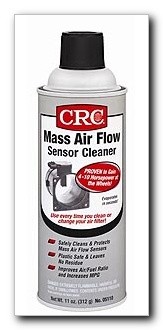
Mass Air flow Sensors(MAF) & cleaning
 The mass airflow sensor is placed in the stream of intake air. It measures the intake flow rate by measuring a part of the entire intake flow. It consists of a hot wire that is supplied with electric current from the ECM. The temperature of the hot wire is controlled by the ECM a certain amount. The heat generated by the hot wire is reduced as the intake air flows around it. The more air, the greater the heat loss. Therefore, the ECM must supply more electric current to maintain the temperature of the hot wire as airflow increases. The ECM detects the airflow by means of this current change.
The Mass Air Flow sensor is a very delicate sensor.
Between very fine dirt and the trend towards oiled filters it's very important to keep the MAF clean. MAF sensors also can get contaminated from a variety of sources: dirt, oil, silicon, spider webs, potting compound from the sensor itself, etc. When a MAF sensor gets contaminated, it skews the transfer function such that the sensor over-estimates air flow at idle (causes the fuel system to go rich) and under-estimates air flow at high air flows (causes fuel system to go lean). This means Long Term Fuel Trims will learn lean (negative) corrections at idle and learn rich (positive) corrections at higher airflows.
In the past there really was not any safe way of cleaning them without risk of damaging them. Today CRC Mass Air Flow Sensor Cleaner is the safe and an effective alternative to using aggressive chemicals like brake parts cleaners or carburetor cleaners.
Monday, December 25, 2006
Tips to ensure you get the car service you pay for:
_ Always get a written estimate for parts and labors.
_ Make sure the estimate states that the shop will contact you for approval before performing any work exceeding a specified amount of time or money.
_ When you pick up your car, ask the service manager to explain all work completed and all replacements made.
_ Get a completed repair order describing the work done. It should list each repair, parts supplied, the cost of each part, labor charges, and the vehicle's odometer reading when you brought the vehicle in as well as when the repair order was completed.
_ Ask for all replaced parts and that any major new parts that have been installed be pointed out to you, if possible.
_ If the shop guarantees its work, get the guarantee in writing.
_ Make sure the estimate states that the shop will contact you for approval before performing any work exceeding a specified amount of time or money.
_ When you pick up your car, ask the service manager to explain all work completed and all replacements made.
_ Get a completed repair order describing the work done. It should list each repair, parts supplied, the cost of each part, labor charges, and the vehicle's odometer reading when you brought the vehicle in as well as when the repair order was completed.
_ Ask for all replaced parts and that any major new parts that have been installed be pointed out to you, if possible.
_ If the shop guarantees its work, get the guarantee in writing.
Friday, December 22, 2006
Tires, date codes, & Tire Industry Association (TIA)
 Weathering and ozone cracking causes superficial cracks on
the sidewall surface around the tire circumference.
This condition is typical of tires which have
been in service for a long time.
You should check the date code on the tire.
To find the tire date code look on the
sidewall for a stamped string of letters
and numbers following the DOT.
The last four digits of the string indicate the week and year of
manufacture (e.g. 3206 would be the 32nd week of 2006).
Tire cracks can also come from exposure to ozone from
sunlight or storage next to ozone sources (e.g. electrical
equipment, air purifiers, vehicle exhaust).
According to the Tire Industry Association (TIA),
other possible causes include use of damaging tire
cleaning/dressing products, improper
inflation pressure, exposure to excessive heat, or by long
term parking when the tire is under load and deflected.
If the cracking is superficial they can be continued in
use, according to the TIA. For safety reasons, discard
tires over 6 years old or with less than 50%
remaining tread. Discard any tires wherecracking is
severe or structural material (i.e. cord) is visible
Monday, December 18, 2006
Are Hybrid Electric Vehicles The Answer To The Out Of Control Fuel Prices?
Major car manufacturers have made claims that the hybrids are the vehicles of the future. This is due to the demand that people are now making as a way of negotiating the overpriced gas prices that have risen steadily over the past few years. The hybrid vehicle is certainly the solution that many people have been searching for.
Gas prices have increased so dramatically over the recent years that many people are using public vehicles as way of going about their everyday lives instead of using their cars. So are hybrid electric vehicles the answer?
It appears so as since the launch of hybrid vehicles and promise of cost savings the sales for many hybrid cars were much higher than expected. It is fully understandable that many people have keenly awaited the launch of the hybrid automobiles on the car market.
It's time to discuss the technical aspects of the hybrid. Such vehicles are generally referred by that name if they run on joint power. Which is currently petrol and electricity which is stored in large capacity batteries.
The reason why hybrid cars save fuel is because the car is not permanently running on petrol. There are time when the car is powered by the electricity from the batteries. This is the reason why the consumption of gasoline is dramatically lowered thus reducing the petrol bills of the owner.
Over the years the technology that is involved in making a hybrid cars is constant evolving which is helping the manufactures make significant strides in modifying and making continuous improvements.
Hybrid vehicles use a rechargeable energy storage system that is also referred to as RESS which comes with a propeller that supplies the fueled propulsion power that drives the car. Other countries refer to the hybrid automobile as a petroleum electric hybrid which also goes by the name of hybrid electric vehicle that use petrol to help provide the cars internal combustion engines, technical term being ICEs and the electric batters provide the requirement to power the electrical motors.
The major car companies from all over the world are currently in tight race to produce hybrid cars on a large scale. They seem to believe that hybrid electric vehicles the answer to many commuters large gasoline bills. The competition is getting so stiff that these types of cars are becoming more intensely marketed with the cars becoming more stylish.
Opportunities do really come in time of crises so giant car makers are rushing to each offer the consumers their own hybrid car versions and models and at the same time, underpin rising demand for such cars, equating logically to higher sales and company revenues.
Japan's Honda and Toyota corps are definitely market leaders in the race to control the hybrid car market not only in Japan but in US and many other countries from around the world. The price increase of petrol is playing a key part but also people are becoming more aware of the environment issues that arise from driving a regular vehicle on a daily basis.
Other car manufacturers follow suit, and it is expected that in the next couple of years, more and more hybrid vehicles are to be unveiled in the market by the two car makers and their aggressive competitors.
No wonder, because hybrid vehicles are tagged not only as oil and cost-saving cars but also as environment-friendly vehicles. Yes, you read it right.
Because hybrid vehicles have reduced gasoline consumption, it follows that smoke and greenhouse gas emissions are also significantly reduced.
Buying a hybrid vehicle is like killing two birds with one stone. Now only will you be saving on oil and gasoline costs but you will also be playing your part in saving the environment by cutting down on gas emissions that are having a very negative affect on the earths atmosphere.
Gas prices have increased so dramatically over the recent years that many people are using public vehicles as way of going about their everyday lives instead of using their cars. So are hybrid electric vehicles the answer?
It appears so as since the launch of hybrid vehicles and promise of cost savings the sales for many hybrid cars were much higher than expected. It is fully understandable that many people have keenly awaited the launch of the hybrid automobiles on the car market.
It's time to discuss the technical aspects of the hybrid. Such vehicles are generally referred by that name if they run on joint power. Which is currently petrol and electricity which is stored in large capacity batteries.
The reason why hybrid cars save fuel is because the car is not permanently running on petrol. There are time when the car is powered by the electricity from the batteries. This is the reason why the consumption of gasoline is dramatically lowered thus reducing the petrol bills of the owner.
Over the years the technology that is involved in making a hybrid cars is constant evolving which is helping the manufactures make significant strides in modifying and making continuous improvements.
Hybrid vehicles use a rechargeable energy storage system that is also referred to as RESS which comes with a propeller that supplies the fueled propulsion power that drives the car. Other countries refer to the hybrid automobile as a petroleum electric hybrid which also goes by the name of hybrid electric vehicle that use petrol to help provide the cars internal combustion engines, technical term being ICEs and the electric batters provide the requirement to power the electrical motors.
The major car companies from all over the world are currently in tight race to produce hybrid cars on a large scale. They seem to believe that hybrid electric vehicles the answer to many commuters large gasoline bills. The competition is getting so stiff that these types of cars are becoming more intensely marketed with the cars becoming more stylish.
Opportunities do really come in time of crises so giant car makers are rushing to each offer the consumers their own hybrid car versions and models and at the same time, underpin rising demand for such cars, equating logically to higher sales and company revenues.
Japan's Honda and Toyota corps are definitely market leaders in the race to control the hybrid car market not only in Japan but in US and many other countries from around the world. The price increase of petrol is playing a key part but also people are becoming more aware of the environment issues that arise from driving a regular vehicle on a daily basis.
Other car manufacturers follow suit, and it is expected that in the next couple of years, more and more hybrid vehicles are to be unveiled in the market by the two car makers and their aggressive competitors.
No wonder, because hybrid vehicles are tagged not only as oil and cost-saving cars but also as environment-friendly vehicles. Yes, you read it right.
Because hybrid vehicles have reduced gasoline consumption, it follows that smoke and greenhouse gas emissions are also significantly reduced.
Buying a hybrid vehicle is like killing two birds with one stone. Now only will you be saving on oil and gasoline costs but you will also be playing your part in saving the environment by cutting down on gas emissions that are having a very negative affect on the earths atmosphere.
Friday, December 15, 2006
Road Force Variation & Measurement
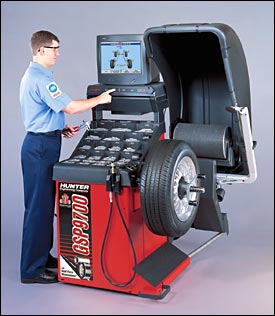
Road Force Measurement is new to the automotive service industry. This new measurement identifies tire and wheel uniformity, which has been measured for years in assembly plants and manufacturing facilities. Road Force can be used to solve uniformity related tire and wheel vibrations. Tire/wheel assembly uniformity can only be measured under load. The load roller on the GSP9700 performs a computer simulated "road test". It measures the tire/wheel assembly to determine how "round" the assembly is when rolling under a load. If a tire were not exposed to the road surface, then balance would be more than sufficient. However, not all tires roll round under a load. For example, an egg-shaped tire/wheel assembly can be balanced about its axis, but an egg-shaped tire-wheel loaded against a surface would not give a smooth ride.
Explained another way. If you were to drill a hole through a concrete block in such a manner that you could attach it to a spin-balancer, you could, by adding or subtracting weight make that concrete block spin smoothly with absolutely no vibration. Now take that same concrete block, or more specifically 4 of them, and attach them to your vehicle. Smooth ride? No!
To understand the effects of radial force variation on vibration, a model of a tire can be used. The sidewall and footprint can be understood as a collection of springs between the rim and the tire contact patch. If the "springs" are not of uniform stiffness, a varied force is exerted on the axle and causes it to move up and down as the tire rotates and flexes. This movement creates a vibration in the vehicle unrelated to balance.
Getting back to the Hunter GSP9700. It solves vibration problems balancing can't fix!
The machine works through a large roller which is pushed against the tread of the tire with 700 pounds of force as the tire rotates. During this force application cycle there are micro-sensors inside the machine that monitor variances in road force. A computer in the machine converts these readings into numbers for the technician. These numbers tell if the tire is good or bad and also if the road force variation can be brought into spec by rotating the tire on the wheel. Sounds complicated, but only to a point. In the hands of a trained technician the job can be performed without a hitch. By having this done, you instantly know
– are the tires good
– are the tires bad
– do I need to replace the tires
– do I need to matchmount the tires
– do I need to look elsewhere in the car.
You can view a video of how the Hunter GPS9700 works on the following link.
http://www.gsp9700.com/pub/images/video/gsp9700_T1_video.cfm
Wednesday, December 13, 2006
Black & Decker BB7B Simple Start Battery Booster
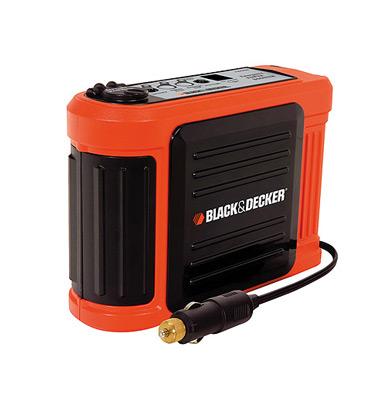
Now here is a great Stocking stuffer for the Holidays! Give your car battery a boost from inside the comfort of your car with Simple Start new from Black & Decker. No jumper cables to mess with, no way to improperly connect, no voltage surges that can damage your car's computer! So simple anyone can hook it up and in a few minutes your battery is ready to start your car!
Simply insert the Simple Start’s DC adapter into the car’s 12 volt DC outlet and wait several minutes. A boost indicator LED and audible beep lets you know when your battery is charged and ready to start.
In my opinuin a great present to give someone for the holidays.
The Simple Start Battery Booster From Black & Decker:
. Charges & starts vehicle in minutes through car’s 12V DC accessory outlet
. 12 volt DC charging port for charging cell phones
. 2 LED area light built-in for emergency use
. Compact design for storage; fits in most glove compartments
. Rechargeable from 12 volt DC vehicle outlet or 120 volt AC household charger, in charge mode
Monday, December 11, 2006
Auto Industry's 10 Best and Worst Cars for Depreciation
Cars, unlike parcels of land, do not appreciate in value over time. They normally depreciate. Moreover, vehicle owners have to know the cars that hold value best. Which cars do not easily depreciate? According to the Consumer Reports' depreciation ratings, import brands lead in car resale value while the domestic models are on the adverse position.
It was found out that those affordably priced cars like the Toyota Prius hybrid, Scion vehicles and Mini Cooper hold their value better than sports and luxury vehicles in the market. The best cars are made by either Japanese or European nameplates. On the other hand, the worst cars with high depreciation are mostly domestic brands, which are commonly used by rental companies and fleets.
The best and worst cars in depreciation are rated by Consumer Reports based on the difference between the MSRP of a 2004 model when new and its present retail value. The average depreciation was approximately 45 percent over the first 3 years. Those cars that belong to the top 10 are above average while those at the bottom are below average. The Manufacturer Suggested Retail Prices (MSRP) of the cars were rounded to the nearest $500.
The best car depreciating rating was given to Toyota Prius. As a fact, there is an overwhelming demand for this particular car. Toyota parts for Prius were further improved by several upgrades that include extra batteries, stealth mode, chargers and solar panels. A used Prius can be had at approximately $22,000. The top 10 best cars for depreciation are Toyota Prius, Mini Cooper ($17,500 to $25,500), Scion xB ($14,000 to $15,000), BMW M3 ($49,000 to $56,500), Lexus RX ($36,000 to $46,000), BMW 6-Series ($72,000 to $79,000), Lexus GX ($46,500), Acura TSX ($30,000), Scion xA ($13,000 to $13,500), and Honda Civic & Civic Hybrid ($14,500 to $24,500).
The worst car in depreciation is Ford Freestar, which has replaced Ford Windstar. Last year, the sales figure of the car was down by 20 percent. Now it has a depreciation value of $19,500 to $29,500 far below the average. Next to Ford Freestar are Ford Crown Victoria ($24,500 to $27,500), Buick Rainier ($31,500 to $33,500), Lincoln Town Car ($42,000 to $50,500), Dodge Caravan/Grand Caravan ($18,500 to $27,500), Mercury Grand Marquis ($25,000 to $29,500), GMC Envoy ($26,500 to $37,000), Ford Explorer ($26,500-$36,000), Buick Rendezvous ($25,000 to $28,500), and Chrysler Town & Country ($21,500 to $36,000).
It was found out that those affordably priced cars like the Toyota Prius hybrid, Scion vehicles and Mini Cooper hold their value better than sports and luxury vehicles in the market. The best cars are made by either Japanese or European nameplates. On the other hand, the worst cars with high depreciation are mostly domestic brands, which are commonly used by rental companies and fleets.
The best and worst cars in depreciation are rated by Consumer Reports based on the difference between the MSRP of a 2004 model when new and its present retail value. The average depreciation was approximately 45 percent over the first 3 years. Those cars that belong to the top 10 are above average while those at the bottom are below average. The Manufacturer Suggested Retail Prices (MSRP) of the cars were rounded to the nearest $500.
The best car depreciating rating was given to Toyota Prius. As a fact, there is an overwhelming demand for this particular car. Toyota parts for Prius were further improved by several upgrades that include extra batteries, stealth mode, chargers and solar panels. A used Prius can be had at approximately $22,000. The top 10 best cars for depreciation are Toyota Prius, Mini Cooper ($17,500 to $25,500), Scion xB ($14,000 to $15,000), BMW M3 ($49,000 to $56,500), Lexus RX ($36,000 to $46,000), BMW 6-Series ($72,000 to $79,000), Lexus GX ($46,500), Acura TSX ($30,000), Scion xA ($13,000 to $13,500), and Honda Civic & Civic Hybrid ($14,500 to $24,500).
The worst car in depreciation is Ford Freestar, which has replaced Ford Windstar. Last year, the sales figure of the car was down by 20 percent. Now it has a depreciation value of $19,500 to $29,500 far below the average. Next to Ford Freestar are Ford Crown Victoria ($24,500 to $27,500), Buick Rainier ($31,500 to $33,500), Lincoln Town Car ($42,000 to $50,500), Dodge Caravan/Grand Caravan ($18,500 to $27,500), Mercury Grand Marquis ($25,000 to $29,500), GMC Envoy ($26,500 to $37,000), Ford Explorer ($26,500-$36,000), Buick Rendezvous ($25,000 to $28,500), and Chrysler Town & Country ($21,500 to $36,000).
Thursday, December 07, 2006
A great tool-The Magnetic Finger!
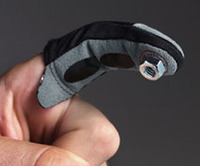
Here is a Neat Item for anyone who works on cars, trucks, airplanes, boats, Street Rods, upholstery, sewing or any other application where small ferrous metal parts are a problem to hold in place or position.
Where can you get it? http://magneticfinger.com/
Monday, December 04, 2006
Avoiding Repair Shop Rip-Offs
Avoiding Repair Shop Rip-Offs
* Be sure the shop is competent -- While outright fraud and rip-offs are still very real dangers, an equally real and equally dangerous one is simple ineptitude. Modern computer-controlled vehicles are incredibly complex pieces of equipment; if the guy under the hood lack the skills and tools to properly diagnose and fix whatever the problem is, he'll often just hunt and peck -- pulling parts (at your expense) and "fixing" things that probably don't need to be fixed. Meanwhile, your original problem's still a problem, even though you've been back to the shop two or three times now already. Look for ASE-certified (National Institute for Automotive Service Excellence) technicians. Ask for recommendations from friends and family -- people you trust. Avoid shops that look unprofessional and downtrodden -- and check with your local consumer affairs department for any history of complaints lodged against a shop you're considering doing business with.
* Get a second opinion -- As with buying a car, rush decisions when it comes to authorizing repairs can come back to haunt you. Especially if your car has developed a sudden problem and you feel panicky about getting it fixed right this minute. It is always a good idea to get a second opinion (and an additional estimate), in particular for major work that may or may not be necessary. The value of getting a second opinion is two-fold: One, if the second shop confirms the opinion of the first shop as far as the problem is concerned, you can be reasonably confident that this is, in fact, what's actually wrong with the car. Two, if you get a second estimate your feel for what constitutes a fair price for the work will be much better. If the second shop's quote is much higher, you can go back to the first one (or ask the second shop why their estimate is so much higher). And if the two estimates are about the same, you can feel secure you're not being taken for a ride.
* Trust (but verify) -- The Gipper's formulation is just as applicable to car work as it is to missile treaties. So if you're taking your car in to get the tires rotated, it's a smart move to discretely mark one of the tires with some white chalk in a place no one would notice unless they knew where to look. Then, when you pick your car up, you can check to see whether the shop actually did rotate your tires. Similarly, pull the dipstick after an oil change to make sure you got what you paid for (fresh oil) and, if you can, mark the oil filter just as you would the tires -- so that you can be certain a new one was actually installed. (Some have recommended asking to see the parts that have been replaced as evidence the work was actually done -- but this can be easily gotten around by the simple expedient of picking up a grimy old part off the shop floor and presenting it to you as "your" old part. The only way to be sure is to mark the part yourself -- before it's removed -- then check to see whether the part you're shown has that mark on it.)
* Pre-shop repair shops -- For the same reason it's good to know the doctor who's about to cut into your chest, it's a smart move to look for a shop before you need one. There are excellent dealers and excellent independent shops -- but there are also terrible dealers and equally bad independents. Don't assume that just because it's "the dealer" that it must be good -- or that an independent shop isn't as good as a dealer because it doesn't have a Toyota or Ford sign on the door. Ask your friends and family about their experiences with local shops -- the good, the bad and the ugly. Most folks are more than willing to share their experiences (either way). Do some drive-bys of the shops you're thinking about doing business with -- and be wary of places where you see the same cars sitting for weeks (or months) on end. This could indicate a glacially slow work pace -- or (worse) unhappy customers who've had to keep bringing their vehicle back for "service." Stroll inside the office/waiting area of shops you're looking over -- and note whether the employees are friendly (or hostile and sullen) and the cleanliness of the work areas (places that look like run-down Soviet-era machine shops may not be the best place to take your car).
* Lastly, don't passively accept being taken -- Your final bill should always be within a few dollars of the estimate; never tolerate a final repair bill that's significantly higher than what you were quoted (unless you agreed to something after the estimate was written). It's neither ethical nor (usually) legal for a shop to charge you for additional work you didn't specifically authorize. If this happens to you, move up the food chain and complain. If it's a dealer, speak with the service manager (and if that doesn't work, the owner of the store -- and from there, complain directly to the affiliated automaker, such as Ford, etc.) If it's an independent shop, try the owner. If you don't reach an acceptable understanding, head straight for your local town/city's government offices and lodge a complaint with the consumer protection department. The shop may have your car -- but you have the money -- as well as the title to the car, so it can't easily be converted into cash and is just taking up space on the shop's floorspace. The longer everything drags out, the more it costs the shop. Usually, once they understand you won't take being taken advantage of without visiting a serious hassle on them in return, they'll come to the table and resolve the issue satisfactorily. It also should go without saying that the car should be fixed. Be sure the problem you brought the thing in for is actually no longer a problem -- before you pay for the work. Ask to take a quick test drive, if need be. Remember -- so long as you've still got your money, you're still holding all the cards!
* Be sure the shop is competent -- While outright fraud and rip-offs are still very real dangers, an equally real and equally dangerous one is simple ineptitude. Modern computer-controlled vehicles are incredibly complex pieces of equipment; if the guy under the hood lack the skills and tools to properly diagnose and fix whatever the problem is, he'll often just hunt and peck -- pulling parts (at your expense) and "fixing" things that probably don't need to be fixed. Meanwhile, your original problem's still a problem, even though you've been back to the shop two or three times now already. Look for ASE-certified (National Institute for Automotive Service Excellence) technicians. Ask for recommendations from friends and family -- people you trust. Avoid shops that look unprofessional and downtrodden -- and check with your local consumer affairs department for any history of complaints lodged against a shop you're considering doing business with.
* Get a second opinion -- As with buying a car, rush decisions when it comes to authorizing repairs can come back to haunt you. Especially if your car has developed a sudden problem and you feel panicky about getting it fixed right this minute. It is always a good idea to get a second opinion (and an additional estimate), in particular for major work that may or may not be necessary. The value of getting a second opinion is two-fold: One, if the second shop confirms the opinion of the first shop as far as the problem is concerned, you can be reasonably confident that this is, in fact, what's actually wrong with the car. Two, if you get a second estimate your feel for what constitutes a fair price for the work will be much better. If the second shop's quote is much higher, you can go back to the first one (or ask the second shop why their estimate is so much higher). And if the two estimates are about the same, you can feel secure you're not being taken for a ride.
* Trust (but verify) -- The Gipper's formulation is just as applicable to car work as it is to missile treaties. So if you're taking your car in to get the tires rotated, it's a smart move to discretely mark one of the tires with some white chalk in a place no one would notice unless they knew where to look. Then, when you pick your car up, you can check to see whether the shop actually did rotate your tires. Similarly, pull the dipstick after an oil change to make sure you got what you paid for (fresh oil) and, if you can, mark the oil filter just as you would the tires -- so that you can be certain a new one was actually installed. (Some have recommended asking to see the parts that have been replaced as evidence the work was actually done -- but this can be easily gotten around by the simple expedient of picking up a grimy old part off the shop floor and presenting it to you as "your" old part. The only way to be sure is to mark the part yourself -- before it's removed -- then check to see whether the part you're shown has that mark on it.)
* Pre-shop repair shops -- For the same reason it's good to know the doctor who's about to cut into your chest, it's a smart move to look for a shop before you need one. There are excellent dealers and excellent independent shops -- but there are also terrible dealers and equally bad independents. Don't assume that just because it's "the dealer" that it must be good -- or that an independent shop isn't as good as a dealer because it doesn't have a Toyota or Ford sign on the door. Ask your friends and family about their experiences with local shops -- the good, the bad and the ugly. Most folks are more than willing to share their experiences (either way). Do some drive-bys of the shops you're thinking about doing business with -- and be wary of places where you see the same cars sitting for weeks (or months) on end. This could indicate a glacially slow work pace -- or (worse) unhappy customers who've had to keep bringing their vehicle back for "service." Stroll inside the office/waiting area of shops you're looking over -- and note whether the employees are friendly (or hostile and sullen) and the cleanliness of the work areas (places that look like run-down Soviet-era machine shops may not be the best place to take your car).
* Lastly, don't passively accept being taken -- Your final bill should always be within a few dollars of the estimate; never tolerate a final repair bill that's significantly higher than what you were quoted (unless you agreed to something after the estimate was written). It's neither ethical nor (usually) legal for a shop to charge you for additional work you didn't specifically authorize. If this happens to you, move up the food chain and complain. If it's a dealer, speak with the service manager (and if that doesn't work, the owner of the store -- and from there, complain directly to the affiliated automaker, such as Ford, etc.) If it's an independent shop, try the owner. If you don't reach an acceptable understanding, head straight for your local town/city's government offices and lodge a complaint with the consumer protection department. The shop may have your car -- but you have the money -- as well as the title to the car, so it can't easily be converted into cash and is just taking up space on the shop's floorspace. The longer everything drags out, the more it costs the shop. Usually, once they understand you won't take being taken advantage of without visiting a serious hassle on them in return, they'll come to the table and resolve the issue satisfactorily. It also should go without saying that the car should be fixed. Be sure the problem you brought the thing in for is actually no longer a problem -- before you pay for the work. Ask to take a quick test drive, if need be. Remember -- so long as you've still got your money, you're still holding all the cards!
Friday, December 01, 2006
Determining the time a 12 volt battery will remain viable!

Just before your battery gives out the alternator works overtime trying to keep up the proper voltage, which can cause excessive wear and tear on the charging system. Is there a way to avoid this excessive wear and yet get the most out of the life of your battery? The answer is yes!
The Midtronics battery tester, which measures the battery’s internal resistance and can actually predict the amount of time the battery will remain viable. Before the advent of internal resistance testing, the tech would apply a heavy load on the battery, which actually shortened its life. The Midtronics tester made load testing a battery antiquated. In just seconds the Midtronics tester can measure the overall health of the battery and doesn’t stress the battery. Read more at .. http://www.midtronics.com/battery/index.html
Tuesday, November 28, 2006
Is Your Car Trying to Tell You Something?
People sometimes don't listen to their cars -- even when they're trying hard to tell them something important. For example:
* Underhood screeches: Your engine bay's not Abu Graib and it shouldn't sound like it, either. If you hear screeching sounds when accelerating or turning the steering wheel, your car could be telling you it needs a new belt. Or the power steering reservoir might be low. It could also be a failing water pump. Don't just turn up the radio to drown out the noise.
* Undercar sputtering: If you suddenly begin hearing sounds of this kind, you've probably got a leaking exhaust system. Usually, the sound gets more obnoxious the harder you push on the gas pedal -- and when you suddenly lift off the gas, even more so. It's important to get this checked out as quickly as possible because a leaking exhaust system can allow dangerous fumes to seep into the car's interior -- in addition to annoying your neighbors.
* "Clunking" or "Ka-thumping": If, when you put your car in Drive, you hear a fairly loud clunking or ka-thumping sound, it's not the body in your trunk -- but more than likely worn-out universal joints. Let it go forever and eventually, the joint could fail -- and the driveshaft come loose, with potentially unpleasant results.
* Strange smells: Engine coolant has a very distinctive smell -- and if you've smelled it inside your car, you could have a real mess on your hands. A not-uncommon problem on older cars is a leaking heater core -- a small, radiator-like part buried deep inside your car's guts. When it fails, it can allow hot, smelly, disgusting engine coolant to seep into the car's interior, soaking the carpet and making your life very unpleasant. Another clue: The presence of an oily/foggy film on the inside surfaces of the windshield, right near the defroster ducts. Get thee to a shop, pronto.
* The drips: Babies leave clear signs it's time to change the diaper and in the same way, your car's leavings can clue you in to developing "issues." If you notice reddish-brown drips, it's a sign you may have a leaking transmission. Green-orange suggests cooling system trouble. As for oil (heavy, molasses-to-blackish colored goo) so long as it's just a few drips, it's probably nothing to worry about. All engines eventually drip a little. But when you see more than usual -- especially anything that could be described as a "puddle" -- you should have the car checked out right away. And be sure to top off the oil level before you drive anywhere -- and watch the oil pressure gauge as you go. If the pressure drops (or, on cars with just warning lights, the light suddenly comes on) stop the engine immediately and check/add oil. If the leak is severe (or you don't have any extra oil with you) either call a tow truck or go get some oil. Just don't run the engine -- unless you won't mind paying for a new one.
* Metallic tapping/clicking: If you hear a sound like this, it could mean you're low on engine oil. If you've checked the oil level and it's fine -- but the tapping/clicking sound won't go away -- you might have an out-of-adjustment valvetrain (or perhaps a collapsed lifter on non-overhead cam engines). In either case, the underlying cause should be investigated as soon as possible to avoid further damage -- and expense.
* Someone's knocking: If you ever hear really loud knocking sounds, it could be the funeral march/last words of your four-wheeled friend. These sounds are impossible to drown out -- and signal ugly, unpleasant things things like main bearing failure. If you shut down your engine immediately, you may limit the damage. But it's probably already too late.
* Underhood screeches: Your engine bay's not Abu Graib and it shouldn't sound like it, either. If you hear screeching sounds when accelerating or turning the steering wheel, your car could be telling you it needs a new belt. Or the power steering reservoir might be low. It could also be a failing water pump. Don't just turn up the radio to drown out the noise.
* Undercar sputtering: If you suddenly begin hearing sounds of this kind, you've probably got a leaking exhaust system. Usually, the sound gets more obnoxious the harder you push on the gas pedal -- and when you suddenly lift off the gas, even more so. It's important to get this checked out as quickly as possible because a leaking exhaust system can allow dangerous fumes to seep into the car's interior -- in addition to annoying your neighbors.
* "Clunking" or "Ka-thumping": If, when you put your car in Drive, you hear a fairly loud clunking or ka-thumping sound, it's not the body in your trunk -- but more than likely worn-out universal joints. Let it go forever and eventually, the joint could fail -- and the driveshaft come loose, with potentially unpleasant results.
* Strange smells: Engine coolant has a very distinctive smell -- and if you've smelled it inside your car, you could have a real mess on your hands. A not-uncommon problem on older cars is a leaking heater core -- a small, radiator-like part buried deep inside your car's guts. When it fails, it can allow hot, smelly, disgusting engine coolant to seep into the car's interior, soaking the carpet and making your life very unpleasant. Another clue: The presence of an oily/foggy film on the inside surfaces of the windshield, right near the defroster ducts. Get thee to a shop, pronto.
* The drips: Babies leave clear signs it's time to change the diaper and in the same way, your car's leavings can clue you in to developing "issues." If you notice reddish-brown drips, it's a sign you may have a leaking transmission. Green-orange suggests cooling system trouble. As for oil (heavy, molasses-to-blackish colored goo) so long as it's just a few drips, it's probably nothing to worry about. All engines eventually drip a little. But when you see more than usual -- especially anything that could be described as a "puddle" -- you should have the car checked out right away. And be sure to top off the oil level before you drive anywhere -- and watch the oil pressure gauge as you go. If the pressure drops (or, on cars with just warning lights, the light suddenly comes on) stop the engine immediately and check/add oil. If the leak is severe (or you don't have any extra oil with you) either call a tow truck or go get some oil. Just don't run the engine -- unless you won't mind paying for a new one.
* Metallic tapping/clicking: If you hear a sound like this, it could mean you're low on engine oil. If you've checked the oil level and it's fine -- but the tapping/clicking sound won't go away -- you might have an out-of-adjustment valvetrain (or perhaps a collapsed lifter on non-overhead cam engines). In either case, the underlying cause should be investigated as soon as possible to avoid further damage -- and expense.
* Someone's knocking: If you ever hear really loud knocking sounds, it could be the funeral march/last words of your four-wheeled friend. These sounds are impossible to drown out -- and signal ugly, unpleasant things things like main bearing failure. If you shut down your engine immediately, you may limit the damage. But it's probably already too late.
Friday, November 24, 2006
BP-Amoco Golden Mechanic for 2006

For the second year in a row at SEMA, the BP-Amoco Corporation has crowned a new "Golden Mechanic". Last year's winner Ryan Kooiman was the first to win the prestigious award and was on hand to pass the torch.
From June 19 to August 11,
independent mechanics could register or be nominated to compete head-to-head with other contestants, with the winner receiving $25,000.00 in cash, a one-year supply of BP-Amoco gas, and a complete Klein Tool kit. In addition the winner will be named the Amoco Ultimate spokesperson for 2007.
Damon, 43, is the shop manager and lead technician of Sant Automotive in Crestwood, MO. He is an ASE certified Master Automobile Technician, with an Advanced Level Specialist Certification (L1) in engine performance, Certified Under Car Specialist (X1) and a Gateway Clean Air Program Recognized Repair Technician.
In addition, Damon hosts a weekly automotive radio talk program on KMOX 1120 in St Louis Check out a recent program when available at http://kmox.com/pages/2659.php
For more information on the competition, visit http://www.bpgoldenmechanic.com
Sunday, November 19, 2006
How to Deal With Distracted Drivers
Blamed in an estimated 4,000 to 8,000 crashes each day, distracted drivers require careful monitoring
if you're nearby.
Children should always ride in the back seat for maximum protection in the event of a crash; however, d
rivers can be easily distracted by tending to a fussing youngster.
One study found between 25 percent and 50 percent of all crashes are due to driver inattention or distraction.
This driver was caught on camera reading behind the wheel. Stay alert for erratic movements from other vehicles and steer clear of distracted drivers.
Automaker officials tout "hands free" cell phones as one solution to driver distraction. Others say that the device is not the issue: if drivers are talking while driving their attention is divided; that distraction puts them at a higher risk for a crash.
I wondered why the car in front of me on the freeway kept speeding up, then slowing down. Tired of the erratic driving, I moved out to pass. Imagine my surprise when I saw the driver was flossing her teeth while behind the steering wheel!
Sickened by the thought of what her car interior must look like and fearing she could lose control of her car at any time, I pressed pedal to the metal and got as far from this distracted driver as I could.
But I was curious whether my urge to flee was a safe and correct one. Really, what should a motorist do when a distracted driver is nearby?
Not a Simple Situation
Police, safety advocates and an official at a motorists' rights group don't provide any one rule. It all depends on the situation, they said.
"It's not dissimilar to when you encounter someone who is intoxicated, but in this case, with a distracted person, it's not—per se—illegal (as is drunken driving)," said Lt. Ray Samuels of the Newark, N.J., Police Department.
To be sure, the state of New York and a few local jurisdictions around the U.S. have passed laws that ban the use of handheld cell phones—one kind of distraction—in moving vehicles. But more widespread restrictions on cell phone use and other in-vehicle distractions—such as eating—aren't coming any time soon.
So, it's pretty much every driver for himself and herself.
Give Them Wide Berth
If there's a simple message, it is to "drive defensively," said Kathy Lusby-Treber, executive director of the Network of Employers for Traffic Safety (NETS), a Washington D.C. group.
NETS, which promotes the theme that "safe driving is a full-time job," found that nearly all drivers—94 percent—admitted to having engaged in some kind of activity that was potentially distracting, including tuning the radio, eating and tending to a child. A NETS phone survey, conducted in late summer 2001, also found that 39 percent of these activities went on while drivers were on the clock for work. The organization reports between 25 percent and 50 percent of all crashes are due to driver inattention or distraction.
"I would be aware and I'd steer clear of [the distracted driver], whatever it means," Lusby-Treber advised, adding, "I don't really encourage motorists to confront a distracted driver."
Besides, she said, "Lots of times, these people are doing more than one distracting thing."
Samuels called it "making a safety cushion around them" so if the distracted driver loses control or does something abrupt, you have an opportunity—and room—to react.
Allan Williams, chief scientist at the Insurance Institute for Highway Safety in Arlington, Va., recommended "staying alert," even for cell-phone users and other distracted drivers at intersections.
Steering clear, though, can involve different strategies, said Eric Skrum, communications director for the Waunakee, Wis.-based National Motorists Association.
"Take a look at the particular driver and the environment," he said. "If it's a single lane road and you can't get around them, slow down [and give them space]. If you're in front, definitely, get out of the way. If they're weaving through traffic and causing a dangerous situation, you must use your own judgment [to stay out of harm's way]."
And, he noted, "If someone is driving like that, you can call the police. That can be reckless driving."
Where Is the Driver's Mind?
Sgt. Al Della Fave of the New Jersey State Police has seen a lot of distracted drivers. And he says it's simplistic to blame it all on cell phones.
"Most of the time, it's not the cell phone that's the problem," Della Fave said. "It's when they start getting emotional about things and the conversation on the phone gets heated [that driving irregularities occur]."
He also noted drivers can be distracted for other reasons. "When I was on patrol in the early '80s, I found drivers reading novels, even having full-course meals spread out on the front seat," he said. "They had the special sauces right there, too. It amazed me, and it went on every other day."
More Distractions Coming
While you're trying to stay safe on the roads, lawmakers and regulators continue to study driver distraction.
Road conditions are expected to get worse, since automakers are adding more information and entertainment devices inside their newest models. Everything from navigation systems to MP3 players to movie players are potential distractions.
Yes, automaker officials tout "hands free" cell phones as one solution because they allow drivers to keep their hands on the steering wheels. But Della Fave and Samuels still urge caution. "It doesn't matter if it's hands free or a headset," Samuels said. "Drivers are still distracted."
Della Fave added: "For some reason, people don't like to dedicate time to just drive."
if you're nearby.
Children should always ride in the back seat for maximum protection in the event of a crash; however, d
rivers can be easily distracted by tending to a fussing youngster.
One study found between 25 percent and 50 percent of all crashes are due to driver inattention or distraction.
This driver was caught on camera reading behind the wheel. Stay alert for erratic movements from other vehicles and steer clear of distracted drivers.
Automaker officials tout "hands free" cell phones as one solution to driver distraction. Others say that the device is not the issue: if drivers are talking while driving their attention is divided; that distraction puts them at a higher risk for a crash.
I wondered why the car in front of me on the freeway kept speeding up, then slowing down. Tired of the erratic driving, I moved out to pass. Imagine my surprise when I saw the driver was flossing her teeth while behind the steering wheel!
Sickened by the thought of what her car interior must look like and fearing she could lose control of her car at any time, I pressed pedal to the metal and got as far from this distracted driver as I could.
But I was curious whether my urge to flee was a safe and correct one. Really, what should a motorist do when a distracted driver is nearby?
Not a Simple Situation
Police, safety advocates and an official at a motorists' rights group don't provide any one rule. It all depends on the situation, they said.
"It's not dissimilar to when you encounter someone who is intoxicated, but in this case, with a distracted person, it's not—per se—illegal (as is drunken driving)," said Lt. Ray Samuels of the Newark, N.J., Police Department.
To be sure, the state of New York and a few local jurisdictions around the U.S. have passed laws that ban the use of handheld cell phones—one kind of distraction—in moving vehicles. But more widespread restrictions on cell phone use and other in-vehicle distractions—such as eating—aren't coming any time soon.
So, it's pretty much every driver for himself and herself.
Give Them Wide Berth
If there's a simple message, it is to "drive defensively," said Kathy Lusby-Treber, executive director of the Network of Employers for Traffic Safety (NETS), a Washington D.C. group.
NETS, which promotes the theme that "safe driving is a full-time job," found that nearly all drivers—94 percent—admitted to having engaged in some kind of activity that was potentially distracting, including tuning the radio, eating and tending to a child. A NETS phone survey, conducted in late summer 2001, also found that 39 percent of these activities went on while drivers were on the clock for work. The organization reports between 25 percent and 50 percent of all crashes are due to driver inattention or distraction.
"I would be aware and I'd steer clear of [the distracted driver], whatever it means," Lusby-Treber advised, adding, "I don't really encourage motorists to confront a distracted driver."
Besides, she said, "Lots of times, these people are doing more than one distracting thing."
Samuels called it "making a safety cushion around them" so if the distracted driver loses control or does something abrupt, you have an opportunity—and room—to react.
Allan Williams, chief scientist at the Insurance Institute for Highway Safety in Arlington, Va., recommended "staying alert," even for cell-phone users and other distracted drivers at intersections.
Steering clear, though, can involve different strategies, said Eric Skrum, communications director for the Waunakee, Wis.-based National Motorists Association.
"Take a look at the particular driver and the environment," he said. "If it's a single lane road and you can't get around them, slow down [and give them space]. If you're in front, definitely, get out of the way. If they're weaving through traffic and causing a dangerous situation, you must use your own judgment [to stay out of harm's way]."
And, he noted, "If someone is driving like that, you can call the police. That can be reckless driving."
Where Is the Driver's Mind?
Sgt. Al Della Fave of the New Jersey State Police has seen a lot of distracted drivers. And he says it's simplistic to blame it all on cell phones.
"Most of the time, it's not the cell phone that's the problem," Della Fave said. "It's when they start getting emotional about things and the conversation on the phone gets heated [that driving irregularities occur]."
He also noted drivers can be distracted for other reasons. "When I was on patrol in the early '80s, I found drivers reading novels, even having full-course meals spread out on the front seat," he said. "They had the special sauces right there, too. It amazed me, and it went on every other day."
More Distractions Coming
While you're trying to stay safe on the roads, lawmakers and regulators continue to study driver distraction.
Road conditions are expected to get worse, since automakers are adding more information and entertainment devices inside their newest models. Everything from navigation systems to MP3 players to movie players are potential distractions.
Yes, automaker officials tout "hands free" cell phones as one solution because they allow drivers to keep their hands on the steering wheels. But Della Fave and Samuels still urge caution. "It doesn't matter if it's hands free or a headset," Samuels said. "Drivers are still distracted."
Della Fave added: "For some reason, people don't like to dedicate time to just drive."
Thursday, November 16, 2006
"The world hates change, but it is the only thing that has brought progress." - Charles Kettering

[Pictured here is Kettering with his starter invention]
Before starter motors, engines were hand-cranked. Then, in 1911 a friend of Henry Leland (who was the founder of the Cadillac) was trying to start a car for a lady and was killed from injuries caused by the starter crank flying off hitting him in the head.
Leland saw the need for a starting system that didn’t risk personal injuries, especially since so many people suffered from broken wrists and forearms when the engine timing wasn’t retarded properly and the crank handle kicked back. Leland commissioned Charles Kettering (who was head of Dayton Electric Company—which later became Delco) to invent a safer and better method of starting an engine. Within a year all Cadillac’s came standard with electric starter motors.
But you still had to stomp on a mechanical switch on the floorboard which would both engage the starter motor gear as well as provide an electrical switch to power it up. Vincent Bendix designed the starter “Bendix” and was granted a patent 1910. This is essentially the same starter design that’s used today.
Today, with the invention of super-magnets, a starter motor for a 4-cylinder engine produces 1,200 watts of power, which is equivalent to approximately 1.6 horsepower.
Sunday, November 12, 2006
ultra-low-sulfur diesel- ULSD
By this fall, most of the diesel fuel available in truck stops will be ultra-low-sulfur diesel, or ULSD, with sulfur content of less than 15 parts per million. Currently available low-sulfur diesel contains up to 500 ppm sulfur, 33 times more than the new federal standard.
The super-refined fuel is designed not only to curb emissions but to prevent sulfur damage to the diesel particulate filters used on 2007 trucks.
The DPF’s( diesel particulate filters)biggest downside is the need to clean it of ash every 150,000 to 300,000 miles, depending on application. The ash is a consequence of the oil additives that protect the engine from sulfuric acid.
Drivers of pre-2007 trucks shouldn’t be overly concerned about the effects of the new fuel, Leonardi-Cattolica says. The transition to 500 ppm sulfur back in 1993 changed the fuel chemistry to a much greater degree than the upcoming introduction of ULSD, she says. ULSD will neither smell nor appear any different from any other diesel fuel.
What is happening is very similar to what happened when Unleaded gasoline replaced all leaded gasolines back in the 1970's. learn more read the article at ..
http://www.etrucker.com/apps/news/article.asp?id=54137
Wednesday, November 08, 2006
When The Car Doesn't Work
As I have said before, check your owner's manual to see what maintenance is needed on your vehicle
before it needs repairs. Maintenance is much cheaper than repairs. By not taking care of your vehicle
and ignoring warning signs such as pulling or drifting, noises or mysterious problems that seem to fix
themselves will result in a costly repair and leave you stuck. There are three main types of problems you
will run into.
Starting Problems.
Most starting problems are a result of a battery in poor condition. Most of the time these problems are
solved with a jump-start or battery charge. If neither of these cures gets the car started, you will need
a mechanic to look at it to determine the problem.
Moving Problems.
These are problems such as hesitation, loss of power or idle problems. An experienced mechanic is
the best person to handle these problems. Overheating could be due to low coolant level or vehicle
overloading.Turning on the A/C could help lower the temperature as well as turning the heater on high
speed and full hot. In these cases you should check and top off the coolant or lighten the load and,
if you are towing a trailer, dropping the trailer off. If this doesn't help, you will need a mechanic.
A professional mechanic should always inspect transmission problems for repair or adjustment. If you
can still drive the vehicle, drive slowly and carefully to the nearest repair shop. If it won't move at all,
call a tow truck.
Stopping Problems.
If the brakes grab, squeal, drag or don't hold, they should be checked and repaired at a repair shop.
If the problem is due to bad or worn out tires, they should be replaced before damage to other, more
expensive parts of the car, can occur.
Tips on Tires
There will be instructions on using the jack on the underside of the trunk lid or under the spare tire cover, so when changing a tire these are the first places to look. You should carry a piece of plywood
24" x 24" x 1" to place under the jack in case there is no hard surface where you get a flat tire.
Never use a brick or any kind of patio block since there is the possibility of breaking under the weight
of the vehicle. Once the vehicle is up, do not get under the car for any reason!
How to Change A Flat Tire
Changing a flat is something you should practice before you get a flat. This is something that should
be done by everyone who drives the vehicle, Mom, Dad, Son, or Daughter. Pull off the road as far and as
safely as possible. Park on a hard level surface if at all possible, even if it means driving into a nearby
parking lot. Turn on your four way flashers. Chock one front and one rear wheel. Place an automatic
transmission into PARK or a manual transmission into REVERSE. You should have wheel chocks, a lug
wrench, rubber hammer, penetrating oil and, of course, the jack in your trunk.If your vehicle has hubcaps, use the screwdriver or the end of the jack handle to pry it off. Some hubcaps have a lock in the center that needs a special key to remove. In most vehicles it is attached to, or near, the jack or jack handle.
On some vehicles it is in the glove compartment. Make sure you know where it is before you need it.
Crack the lug nuts loose before you jack up the vehicle so you don't knock the vehicle off the jack.
Put your foot on the lug wrench and turn the lug nuts counterclockwise. Remember, righty tighty
lefty loosey.Some lug nuts have a left-handed thread. Look on the end of the wheel stud and if you see
an "L", it is a left-handed thread. In that case you would turn the lug wrench clockwise to remove them.
Use the penetrating oil on the lug nuts and wait a few minutes to make getting them off easier,
especially if they are rusted.
Scissor jacks will have a pad, slot or protrusion that they fit into; bumper jacks will fit into a slot in the
bumper. Actually, I haven't seen a bumper jack in years but a lot of older vehicles will have them.
Place the jack in the position shown in the owner's manual. Some vehicles have detailed instructions
with diagrams. Jack up the vehicle until the wheel is about an inch off the ground. Now remove all the
lug nuts and slide the tire off.Position the spare in the wheel well and line up the holes in the spare
with the wheel studs and place the tire on the vehicle. Most spare tires on passenger cars are of the
"Space Saver" type. These tires are for temporary use only and you should not exceed the maximum
speed prominently marked on the tire, usually 50 miles per hour. Have the original tire repaired or
replaced as soon as possible.Install the lug nuts and tighten them by hand, then a ¼ turn with the
lug wrench. Don't tighten them completely just yet. Lower the vehicle and remove the jack. In a
crisscross pattern, tighten the lug nuts in this order. Be careful not to over tighten them or they may
break off. Another ½ turn is tight usually enough.
If it is a full size spare, replace the hubcap being careful the valve stem goes through the hole provided
for it in the hubcap. Use the rubber mallet to tap the hubcap on or hit it hard with the heel of your hand.
Check it by tugging on it to make sure it is on tightly.
If the tire has a slow leak, you can use a can of flat fixer to temporarily repair it. Just follow the directions on the can carefully. Drive to the next service station and have it repaired as soon as possible.
Be sure to tell the attendant that the tire contains an aerosol flat-tire fixer so he can take the proper
precautions when repairing it.
Low air pressure and worn tires can make squealing noises, mostly when turning. Check the tire
pressures and replace worn out tires. Low air pressure, bad front-end parts or the front end being out
of alignment will cause rapid tire wear. Check and correct the tire pressures. If they are okay,
take it to a repair shop and have the front end and wheel alignment checked.
A few things can cause a tire wobble. Always first, check the tire pressures, lug nuts or bad tires.
Correct the problem if one of these problems is found. Missing wheel weights, bent rims, worn steering
linkage or misalignment can also cause a wheel wobble. Have the car repaired by a mechanic if you
can't fix it yourself.
Other Problems
If there is any steam, fluids, smells or smoke coming from your car, other than the normal cold morning
steam from the tail pipe, catalytic converter smell or diesel engine smell, someone with repair experience or a professional mechanic should check the car. Any problems found should be repaired as soon as possible.
Any strange noises such as hissing, clunking, squealing, clicking or whirring coming from the front, rear
or from the engine should be investigated and repaired by a mechanic if it is not something you can
do yourself.
Most windshield wiper problems are due to a burnt fuse or worn out wiper blades. If you find the problem
is elsewhere, you should have a mechanic repair it before it rains again.
If you have lights, headlights high and low beam, turn signals, tail lights, emergency flashers etc.,
that don't work or stay on all the time the first thing to do is check the fuse and bulbs. Other than
that the problem may be bad wiring or bad switches. Have a mechanic look at it and repair the problem.
before it needs repairs. Maintenance is much cheaper than repairs. By not taking care of your vehicle
and ignoring warning signs such as pulling or drifting, noises or mysterious problems that seem to fix
themselves will result in a costly repair and leave you stuck. There are three main types of problems you
will run into.
Starting Problems.
Most starting problems are a result of a battery in poor condition. Most of the time these problems are
solved with a jump-start or battery charge. If neither of these cures gets the car started, you will need
a mechanic to look at it to determine the problem.
Moving Problems.
These are problems such as hesitation, loss of power or idle problems. An experienced mechanic is
the best person to handle these problems. Overheating could be due to low coolant level or vehicle
overloading.Turning on the A/C could help lower the temperature as well as turning the heater on high
speed and full hot. In these cases you should check and top off the coolant or lighten the load and,
if you are towing a trailer, dropping the trailer off. If this doesn't help, you will need a mechanic.
A professional mechanic should always inspect transmission problems for repair or adjustment. If you
can still drive the vehicle, drive slowly and carefully to the nearest repair shop. If it won't move at all,
call a tow truck.
Stopping Problems.
If the brakes grab, squeal, drag or don't hold, they should be checked and repaired at a repair shop.
If the problem is due to bad or worn out tires, they should be replaced before damage to other, more
expensive parts of the car, can occur.
Tips on Tires
There will be instructions on using the jack on the underside of the trunk lid or under the spare tire cover, so when changing a tire these are the first places to look. You should carry a piece of plywood
24" x 24" x 1" to place under the jack in case there is no hard surface where you get a flat tire.
Never use a brick or any kind of patio block since there is the possibility of breaking under the weight
of the vehicle. Once the vehicle is up, do not get under the car for any reason!
How to Change A Flat Tire
Changing a flat is something you should practice before you get a flat. This is something that should
be done by everyone who drives the vehicle, Mom, Dad, Son, or Daughter. Pull off the road as far and as
safely as possible. Park on a hard level surface if at all possible, even if it means driving into a nearby
parking lot. Turn on your four way flashers. Chock one front and one rear wheel. Place an automatic
transmission into PARK or a manual transmission into REVERSE. You should have wheel chocks, a lug
wrench, rubber hammer, penetrating oil and, of course, the jack in your trunk.If your vehicle has hubcaps, use the screwdriver or the end of the jack handle to pry it off. Some hubcaps have a lock in the center that needs a special key to remove. In most vehicles it is attached to, or near, the jack or jack handle.
On some vehicles it is in the glove compartment. Make sure you know where it is before you need it.
Crack the lug nuts loose before you jack up the vehicle so you don't knock the vehicle off the jack.
Put your foot on the lug wrench and turn the lug nuts counterclockwise. Remember, righty tighty
lefty loosey.Some lug nuts have a left-handed thread. Look on the end of the wheel stud and if you see
an "L", it is a left-handed thread. In that case you would turn the lug wrench clockwise to remove them.
Use the penetrating oil on the lug nuts and wait a few minutes to make getting them off easier,
especially if they are rusted.
Scissor jacks will have a pad, slot or protrusion that they fit into; bumper jacks will fit into a slot in the
bumper. Actually, I haven't seen a bumper jack in years but a lot of older vehicles will have them.
Place the jack in the position shown in the owner's manual. Some vehicles have detailed instructions
with diagrams. Jack up the vehicle until the wheel is about an inch off the ground. Now remove all the
lug nuts and slide the tire off.Position the spare in the wheel well and line up the holes in the spare
with the wheel studs and place the tire on the vehicle. Most spare tires on passenger cars are of the
"Space Saver" type. These tires are for temporary use only and you should not exceed the maximum
speed prominently marked on the tire, usually 50 miles per hour. Have the original tire repaired or
replaced as soon as possible.Install the lug nuts and tighten them by hand, then a ¼ turn with the
lug wrench. Don't tighten them completely just yet. Lower the vehicle and remove the jack. In a
crisscross pattern, tighten the lug nuts in this order. Be careful not to over tighten them or they may
break off. Another ½ turn is tight usually enough.
If it is a full size spare, replace the hubcap being careful the valve stem goes through the hole provided
for it in the hubcap. Use the rubber mallet to tap the hubcap on or hit it hard with the heel of your hand.
Check it by tugging on it to make sure it is on tightly.
If the tire has a slow leak, you can use a can of flat fixer to temporarily repair it. Just follow the directions on the can carefully. Drive to the next service station and have it repaired as soon as possible.
Be sure to tell the attendant that the tire contains an aerosol flat-tire fixer so he can take the proper
precautions when repairing it.
Low air pressure and worn tires can make squealing noises, mostly when turning. Check the tire
pressures and replace worn out tires. Low air pressure, bad front-end parts or the front end being out
of alignment will cause rapid tire wear. Check and correct the tire pressures. If they are okay,
take it to a repair shop and have the front end and wheel alignment checked.
A few things can cause a tire wobble. Always first, check the tire pressures, lug nuts or bad tires.
Correct the problem if one of these problems is found. Missing wheel weights, bent rims, worn steering
linkage or misalignment can also cause a wheel wobble. Have the car repaired by a mechanic if you
can't fix it yourself.
Other Problems
If there is any steam, fluids, smells or smoke coming from your car, other than the normal cold morning
steam from the tail pipe, catalytic converter smell or diesel engine smell, someone with repair experience or a professional mechanic should check the car. Any problems found should be repaired as soon as possible.
Any strange noises such as hissing, clunking, squealing, clicking or whirring coming from the front, rear
or from the engine should be investigated and repaired by a mechanic if it is not something you can
do yourself.
Most windshield wiper problems are due to a burnt fuse or worn out wiper blades. If you find the problem
is elsewhere, you should have a mechanic repair it before it rains again.
If you have lights, headlights high and low beam, turn signals, tail lights, emergency flashers etc.,
that don't work or stay on all the time the first thing to do is check the fuse and bulbs. Other than
that the problem may be bad wiring or bad switches. Have a mechanic look at it and repair the problem.
Saturday, November 04, 2006
Video-Dangers of refueling your automobile!
This is a surveillance camera view of an actual incident. Notice the victim returns to her car during the refueling process. She appears to pull her hair back as she exits the vehicle. As she returns to the gas pump, a fire is sparked as she reaches for the nozzle. See for yourself, watch the video at ...
http://www.pei.org/static/static.avi
You should know that..
* Static electricity can be generated by many different sources. There are documented fires caused by plastic gas cans, nylon windbreakers and, possibly most dangerous of all, human nature. We found a common thread in a substantial number of these accidents: the victims got back in their cars.
* Cell phones have been cited as the cause in e-mails circulating on the Internet. So far the PEI.org has not been unable to document any incidents that were sparked by a cellular telephone. In fact, many researchers have tried to ignite fuel vapors with a cell phone and failed. PEI still recommends not using any electronic device that might distract the motorist during the refueling process.
* If you must re-enter your vehicle during refueling, be sure to discharge any static that may have built up before reaching for the nozzle. Static may be safely discharged by touching a metal part of the vehicle, such as the vehicle door, or some other metal surface, away from the nozzle, with a bare hand.Read more at http://www.pei.org/news/static.htm
Monday, October 30, 2006
Making Emergency Stops
In an emergency situation, there is no time to think, ask questions or RTFM. You will need to immediately
know what to do. Hopefully you may gain that knowledge by reading these emergency methods that are
listed below.
You're driving down the road when one of your front tires blows out. Do NOT slam on the brakes.
Apply gentle even pressure, as if you were coming to a stop sign, to the brakes. Then slowly pull
off the road on a hard, level surface if at all possible.
As Harry Chapin said in one of his songs "The pedal floored easily, without a sound..." You lost your brakes. If there is time, try to pump the brake pedal to get, at the very least, some brakes back.
If there is no time, apply the parking brake firmly but slowly. You do not want the wheels to lock up.
Another way to slow down is to down shift from DRIVE to SECOND to FIRST. You can also shift it into
reverse. A transmission is a small price to pay to save your life and the lives of your kids in the back seat.
Do not try to shift into PARK; it just won't go unless the vehicle is stopped.
If all else fails, try sideswiping signposts, guard rails or trees and bushes to slow down. Be careful to
not make a direct hit, which will probably cause injury or death.
It's night and you are on one of the many unlit roads that are common in this country. Suddenly the
lights go out and it is pitch dark. Do NOT slam on the brakes. Turn the hazard lights or turn signals on.
Even those small lights will help you see where you're going. At the same time step on the brakes slowly
and pull off the road. Don't panic, there will be plenty of time for that later.
You have lots of time and space in which to come to a safe and complete stop, unless you are on a
hairpin curve on the side of a mountain. Then you should place your head between your knees as far
as it will go and kiss your *** goodbye.
You are driving down Broadway in Manhattan and your steering locks up or goes out. Now, what is it we
don't do? That's right. Do NOT slam on the brakes because the vehicle will probably swerve out of
control. Apply the brakes slowly. Flip on the hazard flashers, blow your horn and wave your left arm
frantically out of the window to warn other drivers. Get off the road as soon as possible.
You need to come to a stop and your accelerator sticks. This is an easy one. Shut off the engine and
shift into NEUTRAL. You'll lose power steering and power brakes, so turning and stopping will be more
difficult. Once you have stopped and are safely on the side of the road, you can try to fix the problem
if you can.Try lifting the gas pedal with your hand or foot. Sometimes a stuck pedal is as simple as a
floor mat that slid forward and is jamming the gas pedal. A lot of times a stuck pedal is caused by
broken springs or binding linkages. If you can't find and repair the problem, no not drive the car.
Call a tow truck and have your vehicle taken to the repair shop.
You're driving down an L.A. freeway and suddenly the hood flies up. Again, what is it we don't do?
We do NOT slam on the brakes. Are you detecting a pattern here? Look down and through the space
between the hood the cowl of stick your head out the window to see where you are going. Apply the
brakes slowly, use your signals and get to the side of the road as far as possible.
Take a look at the hood latch. It's probably broken. If you can't tie it down with a necktie, belt or brassiere, call a tow truck and have it taken to the repair shop.
You're driving down a road in Chappaquiddick and as you cross over a bridge, you've had a little too
much to drink and run over the side of the bridge into the deep water below. What do you do? If your
vehicle is equipped with power windows, open them immediately and hold on to the steering wheel or
whatever is handy as tightly as you can.Once the vehicle is filled with water you can swim out the window.
I have power windows in my cars and I keep a special hammer/seat belt cutter in both of them just in case I can't get the power window to work. When you hit the door glass it will shatter the glass. If you can't get the seat belt to unfasten you can use the cutter to cut the belt.
Don't try to use the hammer on the windshield because the windshield consists of laninated layers of glass and will not shatter.You can purchase this tool at your local auto parts store.
If you have manually operated windows wait until the vehicle is almost filled with water then open the
window and swim out. Don't panic, there is enough air in the vehicle for you to breathe. Don't waste
time trying to open the door; the water pressure will hold them shut tightly. The window is the best
way to escape.
You are driving down the road and you realize your vehicle is on fire. Don't panic, just pull over to the
side of the road immediately and get out of the vehicle. If it is a small fire you might be able to put it
out with dirt, a coat or blanket. Never use water to put out a vehicle fire. If it is an oil or gasoiline fire all
that would do is spread it. If it is a fuel system fire, get as far away as possible, at least 500 or 600 feet
since there is a distinct possibility the vehicle will explode. Then call your insurance agent because he
has said that you are in good hands with him.
You see a car jump the median and headed straight for you. You realize he is going to hit you head on.
If you don't have your seat belts on, lay down across the front seats or on the floor. The idea is to get
as far below the windshield and windows as possible. If you have your seat belts on and have an airbag,
you have to do the hardest thing in the world at that point. RELAX!!
Tensing and tightening up will greatly increase the chance of serious injury. Ever wonder why so many
drunk drivers hurt others and never themselves? It's because the alcohol has relaxed them so much
they are practically limp. Don't worry, the seat belts and air bag will do their job and protect you.
This is something that has happened to most of us at one time or another, a bee flies into the car.
Just slow down and pull off to the side of the road. Don't panic and slam on the brakes. That could cause
the car in back of you to run into you. With a bee in the car the worse thing that could happen is you get
stung. That's a lot better than wrecking a car.
Your windows suddenly fog up. If they are fogged up on the outside, turn on your windshield wipers.
If it's inside, wipe the window with a napkin or your hand. Brake gently and pull off the road. Turn on
the defroster and A/C and wait until the windshield clears and you can safely continue driving. If it
doesn't clear, you probably have a leaking heater core and it's time to call a tow truck.
You are driving home from visiting your parents and all of a sudden you are going sideways. You are
skidding on black ice. Do NOT slam on the brakes! In fact, do not use the brakes at all!! Just take your
foot off the gas pedal and steer into the direction you want the vehicle to go. That, and praying, is just
about all you can do until you regain control of the vehicle.
You are distracted for a moment and your wheels fall into a low or soft shoulder. Don't fight the road,
brake gently and let the vehicle slow down and then turn the car back onto the road. Jerking the
steering wheel can cause the vehicle to skid out of control.
Your engine dies while you are driving. Shift into neutral. Brake gently and coast to the side of the road.
You'll lose power steering and power brakes, so turning and stopping will be more difficult.
And no matter where you are or where you are going, wear your seat belts! That's the best thing to have
on in an emergency.
know what to do. Hopefully you may gain that knowledge by reading these emergency methods that are
listed below.
You're driving down the road when one of your front tires blows out. Do NOT slam on the brakes.
Apply gentle even pressure, as if you were coming to a stop sign, to the brakes. Then slowly pull
off the road on a hard, level surface if at all possible.
As Harry Chapin said in one of his songs "The pedal floored easily, without a sound..." You lost your brakes. If there is time, try to pump the brake pedal to get, at the very least, some brakes back.
If there is no time, apply the parking brake firmly but slowly. You do not want the wheels to lock up.
Another way to slow down is to down shift from DRIVE to SECOND to FIRST. You can also shift it into
reverse. A transmission is a small price to pay to save your life and the lives of your kids in the back seat.
Do not try to shift into PARK; it just won't go unless the vehicle is stopped.
If all else fails, try sideswiping signposts, guard rails or trees and bushes to slow down. Be careful to
not make a direct hit, which will probably cause injury or death.
It's night and you are on one of the many unlit roads that are common in this country. Suddenly the
lights go out and it is pitch dark. Do NOT slam on the brakes. Turn the hazard lights or turn signals on.
Even those small lights will help you see where you're going. At the same time step on the brakes slowly
and pull off the road. Don't panic, there will be plenty of time for that later.
You have lots of time and space in which to come to a safe and complete stop, unless you are on a
hairpin curve on the side of a mountain. Then you should place your head between your knees as far
as it will go and kiss your *** goodbye.
You are driving down Broadway in Manhattan and your steering locks up or goes out. Now, what is it we
don't do? That's right. Do NOT slam on the brakes because the vehicle will probably swerve out of
control. Apply the brakes slowly. Flip on the hazard flashers, blow your horn and wave your left arm
frantically out of the window to warn other drivers. Get off the road as soon as possible.
You need to come to a stop and your accelerator sticks. This is an easy one. Shut off the engine and
shift into NEUTRAL. You'll lose power steering and power brakes, so turning and stopping will be more
difficult. Once you have stopped and are safely on the side of the road, you can try to fix the problem
if you can.Try lifting the gas pedal with your hand or foot. Sometimes a stuck pedal is as simple as a
floor mat that slid forward and is jamming the gas pedal. A lot of times a stuck pedal is caused by
broken springs or binding linkages. If you can't find and repair the problem, no not drive the car.
Call a tow truck and have your vehicle taken to the repair shop.
You're driving down an L.A. freeway and suddenly the hood flies up. Again, what is it we don't do?
We do NOT slam on the brakes. Are you detecting a pattern here? Look down and through the space
between the hood the cowl of stick your head out the window to see where you are going. Apply the
brakes slowly, use your signals and get to the side of the road as far as possible.
Take a look at the hood latch. It's probably broken. If you can't tie it down with a necktie, belt or brassiere, call a tow truck and have it taken to the repair shop.
You're driving down a road in Chappaquiddick and as you cross over a bridge, you've had a little too
much to drink and run over the side of the bridge into the deep water below. What do you do? If your
vehicle is equipped with power windows, open them immediately and hold on to the steering wheel or
whatever is handy as tightly as you can.Once the vehicle is filled with water you can swim out the window.
I have power windows in my cars and I keep a special hammer/seat belt cutter in both of them just in case I can't get the power window to work. When you hit the door glass it will shatter the glass. If you can't get the seat belt to unfasten you can use the cutter to cut the belt.
Don't try to use the hammer on the windshield because the windshield consists of laninated layers of glass and will not shatter.You can purchase this tool at your local auto parts store.
If you have manually operated windows wait until the vehicle is almost filled with water then open the
window and swim out. Don't panic, there is enough air in the vehicle for you to breathe. Don't waste
time trying to open the door; the water pressure will hold them shut tightly. The window is the best
way to escape.
You are driving down the road and you realize your vehicle is on fire. Don't panic, just pull over to the
side of the road immediately and get out of the vehicle. If it is a small fire you might be able to put it
out with dirt, a coat or blanket. Never use water to put out a vehicle fire. If it is an oil or gasoiline fire all
that would do is spread it. If it is a fuel system fire, get as far away as possible, at least 500 or 600 feet
since there is a distinct possibility the vehicle will explode. Then call your insurance agent because he
has said that you are in good hands with him.
You see a car jump the median and headed straight for you. You realize he is going to hit you head on.
If you don't have your seat belts on, lay down across the front seats or on the floor. The idea is to get
as far below the windshield and windows as possible. If you have your seat belts on and have an airbag,
you have to do the hardest thing in the world at that point. RELAX!!
Tensing and tightening up will greatly increase the chance of serious injury. Ever wonder why so many
drunk drivers hurt others and never themselves? It's because the alcohol has relaxed them so much
they are practically limp. Don't worry, the seat belts and air bag will do their job and protect you.
This is something that has happened to most of us at one time or another, a bee flies into the car.
Just slow down and pull off to the side of the road. Don't panic and slam on the brakes. That could cause
the car in back of you to run into you. With a bee in the car the worse thing that could happen is you get
stung. That's a lot better than wrecking a car.
Your windows suddenly fog up. If they are fogged up on the outside, turn on your windshield wipers.
If it's inside, wipe the window with a napkin or your hand. Brake gently and pull off the road. Turn on
the defroster and A/C and wait until the windshield clears and you can safely continue driving. If it
doesn't clear, you probably have a leaking heater core and it's time to call a tow truck.
You are driving home from visiting your parents and all of a sudden you are going sideways. You are
skidding on black ice. Do NOT slam on the brakes! In fact, do not use the brakes at all!! Just take your
foot off the gas pedal and steer into the direction you want the vehicle to go. That, and praying, is just
about all you can do until you regain control of the vehicle.
You are distracted for a moment and your wheels fall into a low or soft shoulder. Don't fight the road,
brake gently and let the vehicle slow down and then turn the car back onto the road. Jerking the
steering wheel can cause the vehicle to skid out of control.
Your engine dies while you are driving. Shift into neutral. Brake gently and coast to the side of the road.
You'll lose power steering and power brakes, so turning and stopping will be more difficult.
And no matter where you are or where you are going, wear your seat belts! That's the best thing to have
on in an emergency.
Friday, October 27, 2006
Green Diamond Tires- Traction from diamond-hard silicon carbide granules

In 1995 New Industries Ltd developed a highly sophisticated technique for mixing hard silicon carbide granules into the material compound of a tire tread.
The high standards of performance of Green Diamond Tires are based on the thousands of small sharp-edged granules making firm contact with the icy road surfaces, giving them superior traction without the hammering and damaging effect of studded tires. The granules are distributed evenly throughout the rubber. This infusion of the granules throughout the tire’s wear surface ensures that as the tire wears down and granules are worn away, new ones are uncovered. For more information see..
http://www.greendiamondtire.com
Comments: Not a terrible expensive tire for what it does. Perhaps better suited for the real cold snowy and icy climates.
Monday, October 23, 2006
Warranties -
There are two types of warranties that come with a new car -- the standard (and so-called "bumper-to-bumper") warranty and the powertrain warranty.
The standard warranty is like a comprehensive insurance policy and covers the entire vehicle and its systems -- everything from the paint to the lug nuts -- with the exception of normal wear and tear items such as brake pads, filters and fluids and so on. (There are also exceptions in most cases for damage or problems attributable to "abuse" -- which can be defined as failing to have the vehicle serviced and maintained per the factory recommendations.)
The powertrain warranty typically lasts longer -- but its coverage extends only to the engine, transmission and drive axle. A major engine failure would be covered -- but peeling paint would be your problem.
Surprisingly, the vehicles with the best standard warranties aren't necessarily Japanese imports. While the mainline Japanese brands (Honda and Toyota) enjoy a reputation for better-than-average quality, the standard warranties on their 2007 model year vehicles are only good for three years and 36,000 miles. General Motors now offers a standard four year/50,000 mile warranty on all Buick, Cadillac, Saab and Hummer models -- matching BMW, Volvo and Mercedes-Benz. GM has also introduced a 5-year/100,000 mile powertrain warranty, surpassing the coverage offered by BMW, Mercedes and Volvo -- all of which offer four year/50,000 mile powertrain warranties in addition to their standard warranties.
Honda's powertrain coverage extends to five years/60,000 miles -- while Toyota's is slightly less generous at five years and 50,000 miles. (Hybrid vehicles like the Civic hybrid typically have additional/separate warranty coverage on their hybrid-specific components; in the case of the hybrid Civic, this extra coverage is good for eight years and 80,000 miles.)
The Korean automakers -- Hyundai and Kia -- continue to offer some of the best standard and powertrain warranties in the industry. New 2007 model year Kias, for example, come with five-year/60,000 mile standard warranties -- and 10-year/100,000 mile powertrain coverage. Hyundai cars come with the same 5/50k and 10/100k coverage as well.
Ford and Chrysler remain near the bottom in terms of the generosity of their warranty coverage. Their standard warranties are good for just three years and 36,000 miles -- although Ford's recently upgraded five-year/60,000 mile powertrain coverage (six years and 60,000 miles for Lincoln models) is better than Chrysler's minimalist three-year/36,000 mile powertrain coverage -- scaled back from the previous seven-year/70,000 mile deal that had been offered until last year as inducement to attract buyers.
Several manufacturers also offer free roadside assistance, in addition to their standard and powertrain warranties. In the case of makes/models with skimpy warranty coverage -- and all that implies about the manufacturer's confidence in the long-term durability of its vehicles -- having access to a tow service might be some comfort.
For vehicles not backed-up with long-lived warranties, you might want to give thought to purchasing an extended warranty, if available. You may even be able to negotiate for the inclusion of its cost in the final purchase price of the vehicle.
An extended warranty can pay for itself very quickly -- and sometimes, many times over -- if you happen to buy a car that ends up needing a new transmission, rebuilt engine or other big ticket repair.
And the peace of mind is priceless.
The standard warranty is like a comprehensive insurance policy and covers the entire vehicle and its systems -- everything from the paint to the lug nuts -- with the exception of normal wear and tear items such as brake pads, filters and fluids and so on. (There are also exceptions in most cases for damage or problems attributable to "abuse" -- which can be defined as failing to have the vehicle serviced and maintained per the factory recommendations.)
The powertrain warranty typically lasts longer -- but its coverage extends only to the engine, transmission and drive axle. A major engine failure would be covered -- but peeling paint would be your problem.
Surprisingly, the vehicles with the best standard warranties aren't necessarily Japanese imports. While the mainline Japanese brands (Honda and Toyota) enjoy a reputation for better-than-average quality, the standard warranties on their 2007 model year vehicles are only good for three years and 36,000 miles. General Motors now offers a standard four year/50,000 mile warranty on all Buick, Cadillac, Saab and Hummer models -- matching BMW, Volvo and Mercedes-Benz. GM has also introduced a 5-year/100,000 mile powertrain warranty, surpassing the coverage offered by BMW, Mercedes and Volvo -- all of which offer four year/50,000 mile powertrain warranties in addition to their standard warranties.
Honda's powertrain coverage extends to five years/60,000 miles -- while Toyota's is slightly less generous at five years and 50,000 miles. (Hybrid vehicles like the Civic hybrid typically have additional/separate warranty coverage on their hybrid-specific components; in the case of the hybrid Civic, this extra coverage is good for eight years and 80,000 miles.)
The Korean automakers -- Hyundai and Kia -- continue to offer some of the best standard and powertrain warranties in the industry. New 2007 model year Kias, for example, come with five-year/60,000 mile standard warranties -- and 10-year/100,000 mile powertrain coverage. Hyundai cars come with the same 5/50k and 10/100k coverage as well.
Ford and Chrysler remain near the bottom in terms of the generosity of their warranty coverage. Their standard warranties are good for just three years and 36,000 miles -- although Ford's recently upgraded five-year/60,000 mile powertrain coverage (six years and 60,000 miles for Lincoln models) is better than Chrysler's minimalist three-year/36,000 mile powertrain coverage -- scaled back from the previous seven-year/70,000 mile deal that had been offered until last year as inducement to attract buyers.
Several manufacturers also offer free roadside assistance, in addition to their standard and powertrain warranties. In the case of makes/models with skimpy warranty coverage -- and all that implies about the manufacturer's confidence in the long-term durability of its vehicles -- having access to a tow service might be some comfort.
For vehicles not backed-up with long-lived warranties, you might want to give thought to purchasing an extended warranty, if available. You may even be able to negotiate for the inclusion of its cost in the final purchase price of the vehicle.
An extended warranty can pay for itself very quickly -- and sometimes, many times over -- if you happen to buy a car that ends up needing a new transmission, rebuilt engine or other big ticket repair.
And the peace of mind is priceless.
Friday, October 20, 2006
New Poll Suggests 85 Percent of Motorists Do Not Know How to Check Tire Pressure
National Tire Check Day this year is on Oct. 20, 2006. The National Highway Traffic Safety Administration (NHTSA) statistics show one in every three cars has a significantly under inflated tire. Did you know..
Read the full story at http://biz.yahoo.com/bw/061020/20061020005157.html?.v=1
Then if your in the market for a Tire Pressure Gauge, check out the The ValveLock Tire Pressure Gauge pictured below.

It's only available on the web at
http://www.valvelock.net/ It's one of the best tire gauges around!
Only 15 percent of drivers properly check their tire pressure including checking the pressure at least once a month when the tires are cold, and inflating them to the vehicle manufacturer's recommended pressure.
26 percent of drivers mistakenly believe the best time to check their tires is when they are warm after being driven several miles.Only 36 percent of drivers know where to find the recommended tire pressure for their vehicle. It is in the owner's manual, and also usually printed on a tire information decal attached to the driver's door jamb.
55 percent of drivers mistakenly believe the inflation pressure
molded into the tire sidewall is the recommendation for their vehicle.Only 34 percent of drivers know how to tell if their tires are bald.
Four out of five drivers do not know that the rear axle is the proper mounting position when replacing only two tires.
Read the full story at http://biz.yahoo.com/bw/061020/20061020005157.html?.v=1
Then if your in the market for a Tire Pressure Gauge, check out the The ValveLock Tire Pressure Gauge pictured below.

It's only available on the web at
http://www.valvelock.net/ It's one of the best tire gauges around!
Monday, October 16, 2006
Tools for the do it yourselfers (DIY)
Whether on the road or at home, you need to be equipped with some basic survival items and tools that can make driving and living with your car easier, safer and more convenient. Here are some suggestions as a starting place, divided into two categories: Emergency Road Kit and Basic Maintenance Tools. You can customize the list according to your needs and your ambitions.
Emergency Road Kit
• Jumper cables
• Cellular phone, charger power cord, along with a list of emergency numbers
• Ice scraper and snow brush (winter months)
• Flashlight or spotlight with extra set of batteries
• Rain suit or poncho (brightly-colored)
• Safety goggles or glasses
• Pair of disposable work “coveralls”
• Emergency flares, warning triangle or cones
• Fire extinguisher
• First-aid kit
• Hose-patch kit for emergency mending of coolant hoses. These kits are usually available at auto parts and discount stores.
• Pressurized can of tire inflator and sealer for emergency filling of a flat tire.
• Battery-powered air compressor
• Bottled water and snacks, such as crackers or energy bars (in sub-freezing temperatures, remember that bottles may burst if they freeze).
• Blankets
• Roll of duct tape
• Wheel chocks (placed under the wheels to prevent the car from rolling)
• Basic tool set including an adjustable wrench, pliers, screwdrivers, and wrenches. Many auto parts and retail establishments sell compact “tool kits”, perfect for storage in the trunk of your car.
• Mini shovel (winter months)
• Bag or container of sand for traction (winter months)
• An extra pair of gloves, a scarf and hat
• Extra windshield washer fluid that can be used in cold weather driving.
• Funnel for pouring liquids
• Extra fuses (refer to your owner’s manual to determine amperage sizes needed)
• Mechanical or elastic tie-down straps
• Roll of heavy-duty paper towels or rags
• Pair of work gloves
Basic Maintenance Tools:
• Oil filter wrench (there are different types, including cap wrenches and strap wrenches). You will have to decide which provides best grip of the filter, based on accessibility.
• Catch pan (for capturing used oil and coolant)
• 3/8” basic socket wrench set, including sockets (SAE and metric sizes) ratchets, extensions, adapters, and 5/8” and 13/16” spark-plug sockets
• Torx? sockets or bits
• Combination wrench set (SAE and metric sizes)
• Hex-key wrench set (commonly referred to as Allen? wrenches)
• Flare-nut fitting wrenches (most commonly used to help prevent the rounding-off of brake line fittings and bleeder fittings)
• Fender cover (to protect the finish of your car while working under the hood)
• Basic screwdriver set
• Test light (for checking the availability of voltage and ground in circuits)
• Multimeter (a more advanced electrical checking tool that provides readings of voltage, ohms, amps and sometimes more)
• Slip-joint, groove-joint, needle-nose, and locking pliers
• Torque wrench (a wrench that indicates the “tightness” of nuts and bolts)
• Air pressure gauge
• Radiator hydrometer
• Penetrating oil (used to help free and lubricate seized or frozen fasteners)
• Soldering gun & solder
• Electrical pliers
• Jack stands
• Ramps
• Hydraulic Jack
• Battery charger
Emergency Road Kit
• Jumper cables
• Cellular phone, charger power cord, along with a list of emergency numbers
• Ice scraper and snow brush (winter months)
• Flashlight or spotlight with extra set of batteries
• Rain suit or poncho (brightly-colored)
• Safety goggles or glasses
• Pair of disposable work “coveralls”
• Emergency flares, warning triangle or cones
• Fire extinguisher
• First-aid kit
• Hose-patch kit for emergency mending of coolant hoses. These kits are usually available at auto parts and discount stores.
• Pressurized can of tire inflator and sealer for emergency filling of a flat tire.
• Battery-powered air compressor
• Bottled water and snacks, such as crackers or energy bars (in sub-freezing temperatures, remember that bottles may burst if they freeze).
• Blankets
• Roll of duct tape
• Wheel chocks (placed under the wheels to prevent the car from rolling)
• Basic tool set including an adjustable wrench, pliers, screwdrivers, and wrenches. Many auto parts and retail establishments sell compact “tool kits”, perfect for storage in the trunk of your car.
• Mini shovel (winter months)
• Bag or container of sand for traction (winter months)
• An extra pair of gloves, a scarf and hat
• Extra windshield washer fluid that can be used in cold weather driving.
• Funnel for pouring liquids
• Extra fuses (refer to your owner’s manual to determine amperage sizes needed)
• Mechanical or elastic tie-down straps
• Roll of heavy-duty paper towels or rags
• Pair of work gloves
Basic Maintenance Tools:
• Oil filter wrench (there are different types, including cap wrenches and strap wrenches). You will have to decide which provides best grip of the filter, based on accessibility.
• Catch pan (for capturing used oil and coolant)
• 3/8” basic socket wrench set, including sockets (SAE and metric sizes) ratchets, extensions, adapters, and 5/8” and 13/16” spark-plug sockets
• Torx? sockets or bits
• Combination wrench set (SAE and metric sizes)
• Hex-key wrench set (commonly referred to as Allen? wrenches)
• Flare-nut fitting wrenches (most commonly used to help prevent the rounding-off of brake line fittings and bleeder fittings)
• Fender cover (to protect the finish of your car while working under the hood)
• Basic screwdriver set
• Test light (for checking the availability of voltage and ground in circuits)
• Multimeter (a more advanced electrical checking tool that provides readings of voltage, ohms, amps and sometimes more)
• Slip-joint, groove-joint, needle-nose, and locking pliers
• Torque wrench (a wrench that indicates the “tightness” of nuts and bolts)
• Air pressure gauge
• Radiator hydrometer
• Penetrating oil (used to help free and lubricate seized or frozen fasteners)
• Soldering gun & solder
• Electrical pliers
• Jack stands
• Ramps
• Hydraulic Jack
• Battery charger
Wednesday, October 11, 2006
Getting better traction in the snow

When it snows many drivers let air out of their tires assuming they’ll get better traction. Don’t do it because with modern tires this will usually lead to less, not more traction. You may also feel that adding weight over the rear wheels will increase traction. This one is true however never use solid items such as concrete blocks, bricks, or heavy pieces of metal. Even a minor fender bender or bumping a curb could cause heavy, solid items to come crashing through the rear seat leading to severe injuries. If you’re going to add weight it should be sand in soft bags placed low in the trunk. The bags that contain the sand must be light enough that during a crash they break open rather than permit the weight of the sand to propel them into the passenger compartment.
Tuesday, October 10, 2006
Windshield Repair Will Save You Big Money Over Replacement
Most people have no idea that cracks, chips and scratches in windshield glass can be repaired and restored to new again at a huge savings over replacement. It is a proven fact that windshield scratches, nicks and chips can cause added glare and increase or add blind spots while driving. A windshield must be free of any imperfections caused by road debris as it will greatly impede vision and driver safety. Many windshield problems like cracks, scratches and nicks can easily be fixed or repaired without replacement.
Windshield repair was started as a sideline business and has grown into a nationwide aftermarket and additional service. It can be found at almost every used car dealership. There are outside crews that provide services like windshield repair, scratch and paint, headlight repair and restoration and paintless dent removal. All you have to do is ask a used car salesperson or the used car manager about it. If they don't have someone there ask whom they would recommend. All used car dealers use windshield repair instead of replacement, especially since the average windshield replacement is now over $400 and the average windshield repair is only around $25.
Windshield repair may even be free as your insurance company may wave the deductible if you go with a repair instead of a replacement. It saves them lots of money and it improves your driving safety. A windshield repair when professionally done is just as safe as a new or replaced windshield. It also looks a million times better.
Basically a windshield repair squeezes acrylic resin into the blemish by a vacuum that seals out air and moisture. It is then exposed to UV light which hardens the resin and it dries to a crystal clear. When properly done most repairs cannot even be seen by a trained eye and it will stop the spreading or worsening that usually occurs with most cracks. Most small blemishes like nicks, scratches, and cracks can be repaired. Long or spidered cracks that can cover the whole windshield cannot be economically fixed and the integrity of the windshield glass is gone so repair would be futile. A trained windshield repair technician could easily tell you if your windshield is repairable or not.
Scratches are a little different. They will use a glass polishing kit which is made only for glass. This will grind the glass level to the bottom of the scratch and then through different grades of glass polish optical clarity will be brought back. As a final step the best detailers will wax the glass for you. This, when properly done, will have a better effect at removing water and rain then advertised window treatments and it lasts ten times longer (waxing the glass also stops squeaky windshield wipers).
Windshield repair should be professionally done and is beyond the scope of most weekend home repair jobs. Due to its effect on your vision and driving safety and being that the price is only around $25 it is best to see a technician trained in windshield repair.
Windshield repair was started as a sideline business and has grown into a nationwide aftermarket and additional service. It can be found at almost every used car dealership. There are outside crews that provide services like windshield repair, scratch and paint, headlight repair and restoration and paintless dent removal. All you have to do is ask a used car salesperson or the used car manager about it. If they don't have someone there ask whom they would recommend. All used car dealers use windshield repair instead of replacement, especially since the average windshield replacement is now over $400 and the average windshield repair is only around $25.
Windshield repair may even be free as your insurance company may wave the deductible if you go with a repair instead of a replacement. It saves them lots of money and it improves your driving safety. A windshield repair when professionally done is just as safe as a new or replaced windshield. It also looks a million times better.
Basically a windshield repair squeezes acrylic resin into the blemish by a vacuum that seals out air and moisture. It is then exposed to UV light which hardens the resin and it dries to a crystal clear. When properly done most repairs cannot even be seen by a trained eye and it will stop the spreading or worsening that usually occurs with most cracks. Most small blemishes like nicks, scratches, and cracks can be repaired. Long or spidered cracks that can cover the whole windshield cannot be economically fixed and the integrity of the windshield glass is gone so repair would be futile. A trained windshield repair technician could easily tell you if your windshield is repairable or not.
Scratches are a little different. They will use a glass polishing kit which is made only for glass. This will grind the glass level to the bottom of the scratch and then through different grades of glass polish optical clarity will be brought back. As a final step the best detailers will wax the glass for you. This, when properly done, will have a better effect at removing water and rain then advertised window treatments and it lasts ten times longer (waxing the glass also stops squeaky windshield wipers).
Windshield repair should be professionally done and is beyond the scope of most weekend home repair jobs. Due to its effect on your vision and driving safety and being that the price is only around $25 it is best to see a technician trained in windshield repair.
Wednesday, October 04, 2006
Video of a fuel saving product that just might work!
Here is a video of a fuel saving product that just might work. Your mileage will vary, but there is some of truth that a cleaner engine just might give you that extra MPG that you have been looking for!
http://www.bgprod.com/fuelstory/fuelstory.swf
Monday, October 02, 2006
Solving Some Electrical Problems
Electric problems in cars can be among the most frustrating and expensive to diagnose and repair. But if you have access to a multimeter/voltmeter and rudimentary underhood knowledge, you might be able to diagnose-or even fix-these five common problems before you bring the car to a mechanic:
Blown fuse(s). If one particular accessory, set of lights, or convenience in your vehicle stops functioning altogether, a fuse has probably been triggered. Fuses are simple to diagnose, find, and replace yourself. Just look in your owner's manual for the location of the fuse panel (your car might have more than one), and the location of the particular fuse for the failed accessory. Using a fuse puller (it looks like small plastic tweezers), slowly and evenly pull the fuse out of the board and hold it up to the light. If the strand of metal that passes through the middle is broken, then the fuse needs to be replaced. Make sure you replace the fuse with one of an identical amp rating (usually color-coded and listed on the outside with an amp rating). If the fuse blows again, then you know there is another problem. Fuses are inexpensive. Auto parts shops sell 'variety packs' of various popular fuse sizes-a good idea to keep in your emergency roadside kit.
Dead battery, or bad battery terminals. Auto batteries can fail without warning, if they've been in service for two years or more or if they're defective. If you have no juice, make sure your battery terminals are tightened and clean of corrosion. If they're not, then that might be the cause. If they are snug and clean, use your voltmeter to check the battery by touching the meter's probes to the battery's plus and minus posts, scratching slightly to ensure a good connection. With the engine and ignition off, if the voltmeter reads between 10 and 12 volts, then the battery is good (9-9.5 is barely acceptable). Now that you know the battery is good, go back and measure the voltage at the terminal clamps, and then again with the positive probe touching the positive terminal clamp and the negative probe touching the bare metal or frame member that the ground wire (narrower black wire) leads to. If all of these tests measure near the same voltage, then you can rule out the terminals, too.
Alternator. A newer battery that won't keep a charge, the dimming of headlights, or stalling at stoplights are all signs of an alternator that is about to fail completely. If you suspect that your charging system is giving out, test it for certain by touching the probes of your voltmeter to the plus and minus terminal clamps when the engine is running. If it registers between 12.8 and 14.7 volts, this is usually considered within the normal range and your charging system is fine. If the voltage is too low, try the voltage at the alternator output terminals, and if it measures as low, then your alternator likely needs replacement.
Fusible link. A fusible link is a higher-capacity connector that protects accessories wired directly from the battery, including the starter. Fusible links can either fail gradually or suddenly, depending on the cause. Sluggish electrical accessories, an unusual pause before the starter turns, and odd behavior of accessories plugged into the power socket are all symptoms of a failing fusible link. If the electrical system is completely dead, the battery cables are tight, and jump-starting does absolutely nothing, then the fusible link has likely failed or been triggered. For replacement, get a proper repair manual for your car or take it to your mechanic. Fusible links can be significantly more expensive than fuses, so check all major electrical connections to see if there's an obvious problem before installing another one. People sometimes cause fusible links to fail by jump-starting a car with the clamps reversed.
Faulty switch. Test the switch that has failed in all possible positions, to see if the accessory works at all, or to test for loose connections or shorts. Particular switches, such as those for headlights, sometimes have built-in circuit breakers. Consult with your owner's manual or shop manual on how to reset the breaker.
Blown fuse(s). If one particular accessory, set of lights, or convenience in your vehicle stops functioning altogether, a fuse has probably been triggered. Fuses are simple to diagnose, find, and replace yourself. Just look in your owner's manual for the location of the fuse panel (your car might have more than one), and the location of the particular fuse for the failed accessory. Using a fuse puller (it looks like small plastic tweezers), slowly and evenly pull the fuse out of the board and hold it up to the light. If the strand of metal that passes through the middle is broken, then the fuse needs to be replaced. Make sure you replace the fuse with one of an identical amp rating (usually color-coded and listed on the outside with an amp rating). If the fuse blows again, then you know there is another problem. Fuses are inexpensive. Auto parts shops sell 'variety packs' of various popular fuse sizes-a good idea to keep in your emergency roadside kit.
Dead battery, or bad battery terminals. Auto batteries can fail without warning, if they've been in service for two years or more or if they're defective. If you have no juice, make sure your battery terminals are tightened and clean of corrosion. If they're not, then that might be the cause. If they are snug and clean, use your voltmeter to check the battery by touching the meter's probes to the battery's plus and minus posts, scratching slightly to ensure a good connection. With the engine and ignition off, if the voltmeter reads between 10 and 12 volts, then the battery is good (9-9.5 is barely acceptable). Now that you know the battery is good, go back and measure the voltage at the terminal clamps, and then again with the positive probe touching the positive terminal clamp and the negative probe touching the bare metal or frame member that the ground wire (narrower black wire) leads to. If all of these tests measure near the same voltage, then you can rule out the terminals, too.
Alternator. A newer battery that won't keep a charge, the dimming of headlights, or stalling at stoplights are all signs of an alternator that is about to fail completely. If you suspect that your charging system is giving out, test it for certain by touching the probes of your voltmeter to the plus and minus terminal clamps when the engine is running. If it registers between 12.8 and 14.7 volts, this is usually considered within the normal range and your charging system is fine. If the voltage is too low, try the voltage at the alternator output terminals, and if it measures as low, then your alternator likely needs replacement.
Fusible link. A fusible link is a higher-capacity connector that protects accessories wired directly from the battery, including the starter. Fusible links can either fail gradually or suddenly, depending on the cause. Sluggish electrical accessories, an unusual pause before the starter turns, and odd behavior of accessories plugged into the power socket are all symptoms of a failing fusible link. If the electrical system is completely dead, the battery cables are tight, and jump-starting does absolutely nothing, then the fusible link has likely failed or been triggered. For replacement, get a proper repair manual for your car or take it to your mechanic. Fusible links can be significantly more expensive than fuses, so check all major electrical connections to see if there's an obvious problem before installing another one. People sometimes cause fusible links to fail by jump-starting a car with the clamps reversed.
Faulty switch. Test the switch that has failed in all possible positions, to see if the accessory works at all, or to test for loose connections or shorts. Particular switches, such as those for headlights, sometimes have built-in circuit breakers. Consult with your owner's manual or shop manual on how to reset the breaker.
Subscribe to:
Posts (Atom)