In an emergency situation, there is no time to think, ask questions or RTFM. You will need to immediately
know what to do. Hopefully you may gain that knowledge by reading these emergency methods that are
listed below.
You're driving down the road when one of your front tires blows out. Do NOT slam on the brakes.
Apply gentle even pressure, as if you were coming to a stop sign, to the brakes. Then slowly pull
off the road on a hard, level surface if at all possible.
As Harry Chapin said in one of his songs "The pedal floored easily, without a sound..." You lost your brakes. If there is time, try to pump the brake pedal to get, at the very least, some brakes back.
If there is no time, apply the parking brake firmly but slowly. You do not want the wheels to lock up.
Another way to slow down is to down shift from DRIVE to SECOND to FIRST. You can also shift it into
reverse. A transmission is a small price to pay to save your life and the lives of your kids in the back seat.
Do not try to shift into PARK; it just won't go unless the vehicle is stopped.
If all else fails, try sideswiping signposts, guard rails or trees and bushes to slow down. Be careful to
not make a direct hit, which will probably cause injury or death.
It's night and you are on one of the many unlit roads that are common in this country. Suddenly the
lights go out and it is pitch dark. Do NOT slam on the brakes. Turn the hazard lights or turn signals on.
Even those small lights will help you see where you're going. At the same time step on the brakes slowly
and pull off the road. Don't panic, there will be plenty of time for that later.
You have lots of time and space in which to come to a safe and complete stop, unless you are on a
hairpin curve on the side of a mountain. Then you should place your head between your knees as far
as it will go and kiss your *** goodbye.
You are driving down Broadway in Manhattan and your steering locks up or goes out. Now, what is it we
don't do? That's right. Do NOT slam on the brakes because the vehicle will probably swerve out of
control. Apply the brakes slowly. Flip on the hazard flashers, blow your horn and wave your left arm
frantically out of the window to warn other drivers. Get off the road as soon as possible.
You need to come to a stop and your accelerator sticks. This is an easy one. Shut off the engine and
shift into NEUTRAL. You'll lose power steering and power brakes, so turning and stopping will be more
difficult. Once you have stopped and are safely on the side of the road, you can try to fix the problem
if you can.Try lifting the gas pedal with your hand or foot. Sometimes a stuck pedal is as simple as a
floor mat that slid forward and is jamming the gas pedal. A lot of times a stuck pedal is caused by
broken springs or binding linkages. If you can't find and repair the problem, no not drive the car.
Call a tow truck and have your vehicle taken to the repair shop.
You're driving down an L.A. freeway and suddenly the hood flies up. Again, what is it we don't do?
We do NOT slam on the brakes. Are you detecting a pattern here? Look down and through the space
between the hood the cowl of stick your head out the window to see where you are going. Apply the
brakes slowly, use your signals and get to the side of the road as far as possible.
Take a look at the hood latch. It's probably broken. If you can't tie it down with a necktie, belt or brassiere, call a tow truck and have it taken to the repair shop.
You're driving down a road in Chappaquiddick and as you cross over a bridge, you've had a little too
much to drink and run over the side of the bridge into the deep water below. What do you do? If your
vehicle is equipped with power windows, open them immediately and hold on to the steering wheel or
whatever is handy as tightly as you can.Once the vehicle is filled with water you can swim out the window.
I have power windows in my cars and I keep a special hammer/seat belt cutter in both of them just in case I can't get the power window to work. When you hit the door glass it will shatter the glass. If you can't get the seat belt to unfasten you can use the cutter to cut the belt.
Don't try to use the hammer on the windshield because the windshield consists of laninated layers of glass and will not shatter.You can purchase this tool at your local auto parts store.
If you have manually operated windows wait until the vehicle is almost filled with water then open the
window and swim out. Don't panic, there is enough air in the vehicle for you to breathe. Don't waste
time trying to open the door; the water pressure will hold them shut tightly. The window is the best
way to escape.
You are driving down the road and you realize your vehicle is on fire. Don't panic, just pull over to the
side of the road immediately and get out of the vehicle. If it is a small fire you might be able to put it
out with dirt, a coat or blanket. Never use water to put out a vehicle fire. If it is an oil or gasoiline fire all
that would do is spread it. If it is a fuel system fire, get as far away as possible, at least 500 or 600 feet
since there is a distinct possibility the vehicle will explode. Then call your insurance agent because he
has said that you are in good hands with him.
You see a car jump the median and headed straight for you. You realize he is going to hit you head on.
If you don't have your seat belts on, lay down across the front seats or on the floor. The idea is to get
as far below the windshield and windows as possible. If you have your seat belts on and have an airbag,
you have to do the hardest thing in the world at that point. RELAX!!
Tensing and tightening up will greatly increase the chance of serious injury. Ever wonder why so many
drunk drivers hurt others and never themselves? It's because the alcohol has relaxed them so much
they are practically limp. Don't worry, the seat belts and air bag will do their job and protect you.
This is something that has happened to most of us at one time or another, a bee flies into the car.
Just slow down and pull off to the side of the road. Don't panic and slam on the brakes. That could cause
the car in back of you to run into you. With a bee in the car the worse thing that could happen is you get
stung. That's a lot better than wrecking a car.
Your windows suddenly fog up. If they are fogged up on the outside, turn on your windshield wipers.
If it's inside, wipe the window with a napkin or your hand. Brake gently and pull off the road. Turn on
the defroster and A/C and wait until the windshield clears and you can safely continue driving. If it
doesn't clear, you probably have a leaking heater core and it's time to call a tow truck.
You are driving home from visiting your parents and all of a sudden you are going sideways. You are
skidding on black ice. Do NOT slam on the brakes! In fact, do not use the brakes at all!! Just take your
foot off the gas pedal and steer into the direction you want the vehicle to go. That, and praying, is just
about all you can do until you regain control of the vehicle.
You are distracted for a moment and your wheels fall into a low or soft shoulder. Don't fight the road,
brake gently and let the vehicle slow down and then turn the car back onto the road. Jerking the
steering wheel can cause the vehicle to skid out of control.
Your engine dies while you are driving. Shift into neutral. Brake gently and coast to the side of the road.
You'll lose power steering and power brakes, so turning and stopping will be more difficult.
And no matter where you are or where you are going, wear your seat belts! That's the best thing to have
on in an emergency.
Monday, October 30, 2006
Friday, October 27, 2006
Green Diamond Tires- Traction from diamond-hard silicon carbide granules

In 1995 New Industries Ltd developed a highly sophisticated technique for mixing hard silicon carbide granules into the material compound of a tire tread.
The high standards of performance of Green Diamond Tires are based on the thousands of small sharp-edged granules making firm contact with the icy road surfaces, giving them superior traction without the hammering and damaging effect of studded tires. The granules are distributed evenly throughout the rubber. This infusion of the granules throughout the tire’s wear surface ensures that as the tire wears down and granules are worn away, new ones are uncovered. For more information see..
http://www.greendiamondtire.com
Comments: Not a terrible expensive tire for what it does. Perhaps better suited for the real cold snowy and icy climates.

Monday, October 23, 2006
Warranties -
There are two types of warranties that come with a new car -- the standard (and so-called "bumper-to-bumper") warranty and the powertrain warranty.
The standard warranty is like a comprehensive insurance policy and covers the entire vehicle and its systems -- everything from the paint to the lug nuts -- with the exception of normal wear and tear items such as brake pads, filters and fluids and so on. (There are also exceptions in most cases for damage or problems attributable to "abuse" -- which can be defined as failing to have the vehicle serviced and maintained per the factory recommendations.)
The powertrain warranty typically lasts longer -- but its coverage extends only to the engine, transmission and drive axle. A major engine failure would be covered -- but peeling paint would be your problem.
Surprisingly, the vehicles with the best standard warranties aren't necessarily Japanese imports. While the mainline Japanese brands (Honda and Toyota) enjoy a reputation for better-than-average quality, the standard warranties on their 2007 model year vehicles are only good for three years and 36,000 miles. General Motors now offers a standard four year/50,000 mile warranty on all Buick, Cadillac, Saab and Hummer models -- matching BMW, Volvo and Mercedes-Benz. GM has also introduced a 5-year/100,000 mile powertrain warranty, surpassing the coverage offered by BMW, Mercedes and Volvo -- all of which offer four year/50,000 mile powertrain warranties in addition to their standard warranties.
Honda's powertrain coverage extends to five years/60,000 miles -- while Toyota's is slightly less generous at five years and 50,000 miles. (Hybrid vehicles like the Civic hybrid typically have additional/separate warranty coverage on their hybrid-specific components; in the case of the hybrid Civic, this extra coverage is good for eight years and 80,000 miles.)
The Korean automakers -- Hyundai and Kia -- continue to offer some of the best standard and powertrain warranties in the industry. New 2007 model year Kias, for example, come with five-year/60,000 mile standard warranties -- and 10-year/100,000 mile powertrain coverage. Hyundai cars come with the same 5/50k and 10/100k coverage as well.
Ford and Chrysler remain near the bottom in terms of the generosity of their warranty coverage. Their standard warranties are good for just three years and 36,000 miles -- although Ford's recently upgraded five-year/60,000 mile powertrain coverage (six years and 60,000 miles for Lincoln models) is better than Chrysler's minimalist three-year/36,000 mile powertrain coverage -- scaled back from the previous seven-year/70,000 mile deal that had been offered until last year as inducement to attract buyers.
Several manufacturers also offer free roadside assistance, in addition to their standard and powertrain warranties. In the case of makes/models with skimpy warranty coverage -- and all that implies about the manufacturer's confidence in the long-term durability of its vehicles -- having access to a tow service might be some comfort.
For vehicles not backed-up with long-lived warranties, you might want to give thought to purchasing an extended warranty, if available. You may even be able to negotiate for the inclusion of its cost in the final purchase price of the vehicle.
An extended warranty can pay for itself very quickly -- and sometimes, many times over -- if you happen to buy a car that ends up needing a new transmission, rebuilt engine or other big ticket repair.
And the peace of mind is priceless.
Friday, October 20, 2006
New Poll Suggests 85 Percent of Motorists Do Not Know How to Check Tire Pressure
National Tire Check Day this year is on Oct. 20, 2006. The National Highway Traffic Safety Administration (NHTSA) statistics show one in every three cars has a significantly under inflated tire. Did you know..
Read the full story at http://biz.yahoo.com/bw/061020/20061020005157.html?.v=1
Then if your in the market for a Tire Pressure Gauge, check out the The ValveLock Tire Pressure Gauge pictured below.

It's only available on the web at
http://www.valvelock.net/ It's one of the best tire gauges around!
Only 15 percent of drivers properly check their tire pressure including checking the pressure at least once a month when the tires are cold, and inflating them to the vehicle manufacturer's recommended pressure.
26 percent of drivers mistakenly believe the best time to check their tires is when they are warm after being driven several miles.Only 36 percent of drivers know where to find the recommended tire pressure for their vehicle. It is in the owner's manual, and also usually printed on a tire information decal attached to the driver's door jamb.
55 percent of drivers mistakenly believe the inflation pressure
molded into the tire sidewall is the recommendation for their vehicle.Only 34 percent of drivers know how to tell if their tires are bald.
Four out of five drivers do not know that the rear axle is the proper mounting position when replacing only two tires.
Read the full story at http://biz.yahoo.com/bw/061020/20061020005157.html?.v=1
Then if your in the market for a Tire Pressure Gauge, check out the The ValveLock Tire Pressure Gauge pictured below.

It's only available on the web at
http://www.valvelock.net/ It's one of the best tire gauges around!
Monday, October 16, 2006
Tools for the do it yourselfers (DIY)
Whether on the road or at home, you need to be equipped with some basic survival items and tools that can make driving and living with your car easier, safer and more convenient. Here are some suggestions as a starting place, divided into two categories: Emergency Road Kit and Basic Maintenance Tools. You can customize the list according to your needs and your ambitions.
Emergency Road Kit
• Jumper cables
• Cellular phone, charger power cord, along with a list of emergency numbers
• Ice scraper and snow brush (winter months)
• Flashlight or spotlight with extra set of batteries
• Rain suit or poncho (brightly-colored)
• Safety goggles or glasses
• Pair of disposable work “coveralls”
• Emergency flares, warning triangle or cones
• Fire extinguisher
• First-aid kit
• Hose-patch kit for emergency mending of coolant hoses. These kits are usually available at auto parts and discount stores.
• Pressurized can of tire inflator and sealer for emergency filling of a flat tire.
• Battery-powered air compressor
• Bottled water and snacks, such as crackers or energy bars (in sub-freezing temperatures, remember that bottles may burst if they freeze).
• Blankets
• Roll of duct tape
• Wheel chocks (placed under the wheels to prevent the car from rolling)
• Basic tool set including an adjustable wrench, pliers, screwdrivers, and wrenches. Many auto parts and retail establishments sell compact “tool kits”, perfect for storage in the trunk of your car.
• Mini shovel (winter months)
• Bag or container of sand for traction (winter months)
• An extra pair of gloves, a scarf and hat
• Extra windshield washer fluid that can be used in cold weather driving.
• Funnel for pouring liquids
• Extra fuses (refer to your owner’s manual to determine amperage sizes needed)
• Mechanical or elastic tie-down straps
• Roll of heavy-duty paper towels or rags
• Pair of work gloves
Basic Maintenance Tools:
• Oil filter wrench (there are different types, including cap wrenches and strap wrenches). You will have to decide which provides best grip of the filter, based on accessibility.
• Catch pan (for capturing used oil and coolant)
• 3/8” basic socket wrench set, including sockets (SAE and metric sizes) ratchets, extensions, adapters, and 5/8” and 13/16” spark-plug sockets
• Torx? sockets or bits
• Combination wrench set (SAE and metric sizes)
• Hex-key wrench set (commonly referred to as Allen? wrenches)
• Flare-nut fitting wrenches (most commonly used to help prevent the rounding-off of brake line fittings and bleeder fittings)
• Fender cover (to protect the finish of your car while working under the hood)
• Basic screwdriver set
• Test light (for checking the availability of voltage and ground in circuits)
• Multimeter (a more advanced electrical checking tool that provides readings of voltage, ohms, amps and sometimes more)
• Slip-joint, groove-joint, needle-nose, and locking pliers
• Torque wrench (a wrench that indicates the “tightness” of nuts and bolts)
• Air pressure gauge
• Radiator hydrometer
• Penetrating oil (used to help free and lubricate seized or frozen fasteners)
• Soldering gun & solder
• Electrical pliers
• Jack stands
• Ramps
• Hydraulic Jack
• Battery charger
Wednesday, October 11, 2006
Getting better traction in the snow

When it snows many drivers let air out of their tires assuming they’ll get better traction. Don’t do it because with modern tires this will usually lead to less, not more traction. You may also feel that adding weight over the rear wheels will increase traction. This one is true however never use solid items such as concrete blocks, bricks, or heavy pieces of metal. Even a minor fender bender or bumping a curb could cause heavy, solid items to come crashing through the rear seat leading to severe injuries. If you’re going to add weight it should be sand in soft bags placed low in the trunk. The bags that contain the sand must be light enough that during a crash they break open rather than permit the weight of the sand to propel them into the passenger compartment.
Tuesday, October 10, 2006
Windshield Repair Will Save You Big Money Over Replacement
Most people have no idea that cracks, chips and scratches in windshield glass can be repaired and restored to new again at a huge savings over replacement. It is a proven fact that windshield scratches, nicks and chips can cause added glare and increase or add blind spots while driving. A windshield must be free of any imperfections caused by road debris as it will greatly impede vision and driver safety. Many windshield problems like cracks, scratches and nicks can easily be fixed or repaired without replacement.
Windshield repair was started as a sideline business and has grown into a nationwide aftermarket and additional service. It can be found at almost every used car dealership. There are outside crews that provide services like windshield repair, scratch and paint, headlight repair and restoration and paintless dent removal. All you have to do is ask a used car salesperson or the used car manager about it. If they don't have someone there ask whom they would recommend. All used car dealers use windshield repair instead of replacement, especially since the average windshield replacement is now over $400 and the average windshield repair is only around $25.
Windshield repair may even be free as your insurance company may wave the deductible if you go with a repair instead of a replacement. It saves them lots of money and it improves your driving safety. A windshield repair when professionally done is just as safe as a new or replaced windshield. It also looks a million times better.
Basically a windshield repair squeezes acrylic resin into the blemish by a vacuum that seals out air and moisture. It is then exposed to UV light which hardens the resin and it dries to a crystal clear. When properly done most repairs cannot even be seen by a trained eye and it will stop the spreading or worsening that usually occurs with most cracks. Most small blemishes like nicks, scratches, and cracks can be repaired. Long or spidered cracks that can cover the whole windshield cannot be economically fixed and the integrity of the windshield glass is gone so repair would be futile. A trained windshield repair technician could easily tell you if your windshield is repairable or not.
Scratches are a little different. They will use a glass polishing kit which is made only for glass. This will grind the glass level to the bottom of the scratch and then through different grades of glass polish optical clarity will be brought back. As a final step the best detailers will wax the glass for you. This, when properly done, will have a better effect at removing water and rain then advertised window treatments and it lasts ten times longer (waxing the glass also stops squeaky windshield wipers).
Windshield repair should be professionally done and is beyond the scope of most weekend home repair jobs. Due to its effect on your vision and driving safety and being that the price is only around $25 it is best to see a technician trained in windshield repair.
Wednesday, October 04, 2006
Video of a fuel saving product that just might work!
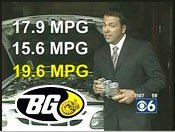
Here is a video of a fuel saving product that just might work. Your mileage will vary, but there is some of truth that a cleaner engine just might give you that extra MPG that you have been looking for!
http://www.bgprod.com/fuelstory/fuelstory.swf
Monday, October 02, 2006
Solving Some Electrical Problems
Electric problems in cars can be among the most frustrating and expensive to diagnose and repair. But if you have access to a multimeter/voltmeter and rudimentary underhood knowledge, you might be able to diagnose-or even fix-these five common problems before you bring the car to a mechanic:
Blown fuse(s). If one particular accessory, set of lights, or convenience in your vehicle stops functioning altogether, a fuse has probably been triggered. Fuses are simple to diagnose, find, and replace yourself. Just look in your owner's manual for the location of the fuse panel (your car might have more than one), and the location of the particular fuse for the failed accessory. Using a fuse puller (it looks like small plastic tweezers), slowly and evenly pull the fuse out of the board and hold it up to the light. If the strand of metal that passes through the middle is broken, then the fuse needs to be replaced. Make sure you replace the fuse with one of an identical amp rating (usually color-coded and listed on the outside with an amp rating). If the fuse blows again, then you know there is another problem. Fuses are inexpensive. Auto parts shops sell 'variety packs' of various popular fuse sizes-a good idea to keep in your emergency roadside kit.
Dead battery, or bad battery terminals. Auto batteries can fail without warning, if they've been in service for two years or more or if they're defective. If you have no juice, make sure your battery terminals are tightened and clean of corrosion. If they're not, then that might be the cause. If they are snug and clean, use your voltmeter to check the battery by touching the meter's probes to the battery's plus and minus posts, scratching slightly to ensure a good connection. With the engine and ignition off, if the voltmeter reads between 10 and 12 volts, then the battery is good (9-9.5 is barely acceptable). Now that you know the battery is good, go back and measure the voltage at the terminal clamps, and then again with the positive probe touching the positive terminal clamp and the negative probe touching the bare metal or frame member that the ground wire (narrower black wire) leads to. If all of these tests measure near the same voltage, then you can rule out the terminals, too.
Alternator. A newer battery that won't keep a charge, the dimming of headlights, or stalling at stoplights are all signs of an alternator that is about to fail completely. If you suspect that your charging system is giving out, test it for certain by touching the probes of your voltmeter to the plus and minus terminal clamps when the engine is running. If it registers between 12.8 and 14.7 volts, this is usually considered within the normal range and your charging system is fine. If the voltage is too low, try the voltage at the alternator output terminals, and if it measures as low, then your alternator likely needs replacement.
Fusible link. A fusible link is a higher-capacity connector that protects accessories wired directly from the battery, including the starter. Fusible links can either fail gradually or suddenly, depending on the cause. Sluggish electrical accessories, an unusual pause before the starter turns, and odd behavior of accessories plugged into the power socket are all symptoms of a failing fusible link. If the electrical system is completely dead, the battery cables are tight, and jump-starting does absolutely nothing, then the fusible link has likely failed or been triggered. For replacement, get a proper repair manual for your car or take it to your mechanic. Fusible links can be significantly more expensive than fuses, so check all major electrical connections to see if there's an obvious problem before installing another one. People sometimes cause fusible links to fail by jump-starting a car with the clamps reversed.
Faulty switch. Test the switch that has failed in all possible positions, to see if the accessory works at all, or to test for loose connections or shorts. Particular switches, such as those for headlights, sometimes have built-in circuit breakers. Consult with your owner's manual or shop manual on how to reset the breaker.
Friday, September 29, 2006
Headlamp bulbs need periodic replacement
 The days are getting shorter and you will be using your headlights a lot more so did you know that headlamp bulbs need periodic replacement?

Contrary to popular belief headlamp bulbs lose their brightness over time. Just because a headlamp bulb lights doesn't mean it's good! As a matter of fact you could be driving with far less light than when your bulbs were new. A headlamp bulb can lose as much as fifty percent of its intensity in as little as three years. To be really safe this winter replace your headlamp bulbs if they are three years old or older
Sunday, September 24, 2006
Winter wiper blades, What's so good about them!

Do you have winter wiper blades? If you don’t you should! Winter wiper blades can give you a much clearer view when it snows and good vision means a safer trip whether it’s to the corner store or cross country. Winter wiper blades have a thin rubber membrane that covers the metal frame of the blade. The rubber flexes as the blades move across the windshield causing ice and snow to fall off rather than collect inside the blade. This helps keep the blade edge firmly against the glass leaving a clean path on the glass
Tuesday, September 19, 2006
Use white lithium grease to prevent wear and frozen doors

Applying white lithium grease to hinges and latches helps prevent wear and frozen doors. As the weather turns colder moisture will enter the door, hood, and trunk latches and hinges on your car. If the weather is cold enough the water freezes causing the door, hood, or trunk to be difficult or sometimes impossible to open. Also freezing water expands with amazing force. The expansion of water as it turns to ice is strong enough to bend or break steel. White lithium grease prevents water intrusion and the problems that go with it. Spray hinges and latches before the cold weather arrives.
What Is The Difference Between Synthetic Oil And Conventional Motor Oil?
Motor oil is designed to serve many different purposes within a cars engine. While the primary function is to simply lubricate all the moving parts and provide protection from wear and corrosion, it also is intended to keep the engine cool and free from small pieces of debris. Conventional motor oils are made from crude oil which has been pumped from the ground and then processed in a refinery to create a base oil. Additives are then mixed into the base oil to change the viscosity, protection properties and heat breakdown levels of the oil. Synthetic oil is also created in a similar manner to a conventional engine oil, using a base oil combined with a series of additives. The difference lies in the fact that synthetic motor oils are created utilizing a specially "synthesized" base oil where the size of the oil molecules are all of an ideal weight and of a consistent size. While a conventional motor oil, despite the refining processes, is made up of different molecule sizes which are mixed together, along with various waxes and impurities, a fully synthetic oil is made to provide a much purer base oil, with less waxes and with a uniform ideal particle size to help increase the oils viscosity level. Added to this ideal base oil is a combination of more technically sophisticated additives than are used with the conventional oils. The additives which are used in the production of synthetic oils can help to create an extremely stable engine oil which will sustain the correct viscosity levels across a large range of temperatures and which will flow properly at lower temperatures when compared against conventional oils. Additional friction inhibitors which are activated at lower temperatures than those of conventional oils, are generally included in synthetic motor oils, to provide improved protection for the engine from the moment of start-up. This means that the synthetic oil is designed with improved lubricate properties and enhanced viscosity to provide superior protection from engine wear, reduced heat breakdown volatility for decreased oil consumption, improved fuel mileage, easier engine cold starting and a reduction in engine deposits. When deciding whether it is best to use synthetic or conventional car engine oils, it is always best to bear in mind the age of the vehicle as problems and oil leaks can occur when switching to a fully synthetic oil with an old engine. This is because there can be a build-up of waxes and sludge left by conventional oils over time, which may mask worn engine seals. The introduction of a synthetic oil may cause the detergents in the synthetic oil to break down and clean-up this protective build-up which is maintaining the seal, this will then result in oil leaking through the engine seals when the oil thins as it gets hot. Semi-synthetic oils are an alternative to buying a pure synthetic oil. These combine a certain quantity of synthetic base oil with a conventional base oil in order to provide a high quality oil which can be used to gain some of the protection benefits of a fully synthetic for slightly older vehicles. However semi-synthetic engine oils do not typically include all the synthetic oil's advanced additives. Whilst older vehicles are frequently better using conventional oils due to the engine seals, new cars which experience normal day-to-day use with its short journeys, traffic jams, extreme temperature changes, etc, can benefit from the extra protection of afforded by synthetics, but it is always safest to refer to the manufacturer's recommendations before making any changes.
Sunday, September 17, 2006
Top Tips On How To Get The Best Shine From Your Car
We all love that brilliant shine of a new car in the dealer's showroom or at an auto show. There are hundreds of car care products and treatments available. The question is what works best and how do you do it? First, you must properly clean and wash your car. Polishing and waxing a unclean car is sure to leave hairline scratches from dirt and debris on the car. Proper car washing and cleaning should be a main staple of any car care regimen or treatment. It is a proven fact that cars that receive routine car washes will last longer (as evidenced in a recent Popular Mechanics magazine). To properly wash your car, first rinse it off. Get the whole car wet and try to spray off any loose dirt and debris. Then use specific car wash soap (regular household items and chemicals are usually too harsh and can strip the wax or sealant right off) and a soft sponge or towel. Wash one panel or area at a time and rinse when done so the suds and soap won't dry on the paint. When done dry off the car with clean terry towels or microfiber towels (a chamois works great also). Next, examine your car. Look at the bumpers, behind the tires, the roof, etc... Are there any contaminants like bug splatter, bird droppings, tree sap, etc... that are still there after washing? You can try and rewash these areas with a little more pressure to try and loosen them up. If they still don't come off, you will need a contaminant remover. This is a spray and each has their own unique formula and set of directions. Some are similar to foaming glass cleaners and others are a thick emulsion that will sit right on the problem area and not drip off. These contaminant sprays will remove most stuck on road debris and there are formulas specifically for road tar and tree sap as they can be more difficult. Follow the directions and then rinse and dry. To smooth out any imperfections in the paint we recommend a cleaner wax. According to a study by Consumer Reports of every wax currently produced it was found that Turtle Wax was the best for value, durability and shine. So, there is no need to waste your money on expensive treatments that will not deliver a finish as well as a $2 bottle of Turtle Wax. Apply the cleaner wax in small circular motions and do one panel at a time, same as you did with car washing. Let the cleaner wax dry to a white haze and then buff with a clean terry cloth. Repeat as necessary. Next, what we recommend is that you use a polymer car polish (again, there is no need for expensive treatments - you are just wasting your money). A good polymer car polish can be obtained at Walmart for between $2 and $5. They always come as a liquid and are very easy to apply and really do last longer than any car wax (up to 1 year and 50 car washes as some labels state). Apply to the whole car and buff dry. Apply 2-3 coats for maximum protection. After the car polish we recommend a high class carnauba wax (again there is no need for expensive treatments). Turtle wax platinum car wax is around $5-$7 and so are some Meguiars and Mothers top waxes. This will give you a better than new deep and wet looking shine. Apply 2 coats in similar fashion to the cleaner wax. Wait until you see the resultant shine from wax on top of polish. It is unbelievable and gives your car the best shine possible and also the maximum protection available. This is how they get that extra deep shine on cars at the auto shows - it works and you will be amazed.
Thursday, September 14, 2006
Restoring plastic headlight lenses to like new!

You know it’s important to be able to see and be seen but that isn’t always as easy as it sounds. Over the years cars have adopted plastic headlamps that blend with the car’s styling. They look great but after a few years their plastic lens becomes hazy and scratched. This reduces light output making night driving hazardous. Rather than spend big bucks to replace your headlamps use convertible top plastic window cleaner to polish away the haze and scratches. There are also special products like the one shown on the left which can Improve the clarity of cloudy headlights. Some vehicles have lens covers for improved driving safety! Most vehicles now have a protective, transparent, plastic lens covering the headlights. These lenses protect expensive lamps from flying stones and road debris but will discolor over time. When these lenses become opaque and cloudy, they severely restrict the amount of light reaching the road which makes night driving dangerous. This clouding is caused by accumulated exposure to ultraviolet light. If you live in a southern state, this discoloration can become noticeable in as little as 2 years. By using these products often(be sure to follow instructions on each indivual product for frequency of application)you will keep your headlight lenses from turning opaque!

Sunday, September 03, 2006
Oil Change Outrage-Video

The clip from LOS ANGELES, where there was an undercover investigation. Reporter Joel Grover exposes how some of the state's biggest car repair chains could be cheating customers -- even breaking the law. As seen in this video there some well-known chains mentioned that specialize in doing quick and easy oil changes.
Just remember that what you see in this video does not represent what goes on in all oil change shops around the country, which is what the folks who did this investigation would want you to believe!
http://www.nbc4.tv/video/2620224/index.html
Note:If the above link does not load the video try this link below.
http://mfile.akamai.com/12924/wmv/vod.ibsys.com/2003/1107/2620224.200k.asx
Friday, September 01, 2006
Weekly tips- When replacing a fuel filter..

When replacing a fuel filter, pour a little fuel through the filter inlet to "pre-wet" the filter element inside. This will reduce the risk of the filter element shredding loose paper fibers into the fuel system when the pump starts up and sends fuel at full force through the filter. Some filters come with cap(s) on the end as shown in the picture which keeps the filter element from drying out before installation.
Friday, August 25, 2006
POGUE CARBURETOR-200 miles on a gallon of gasoline!

Between 1928 and 1935, Charles Nelson Pogue, an inventor from Canada, applied for numerous patents for what he claimed was a new type of carburetor that supposedly completely vaporized gasoline before introducing it to the cylinders, thereby extracting a great deal more energy from the fuel.
The Pogue carburetor was touted as getting 200+ miles to the gallon.
See the full story at http://www.snopes.com/autos/business/carburetor.asp
Also see.. http://www.mikebrownsolutions.com/fish3.htm
Thursday, August 24, 2006
Virginia man wins Volvo's XC90 treasure hunt
 Here is another example of what the carfixonline blog can be used for. Enjoy!
The Pirates of the Caribbean-themed Volvo XC90, that was buried as part of the automaker's treasure hunt/film tie-in, has a new owner. David Hutz, 30, of Herndon, VA, and six other finalists were flown to Abaco Island in the Bahamas, where they competed in a group of Survivor-style challenges to complete the search. David was awarded the SUV after he had determined what its ultimate location was. Thankfully for him, he didn't need to dig it up himself. Assistants handled those duties on his behalf.
The V8-powered, movie-themed Volvo is valued at $82,000 and sports 20-inch custom wheels, a full Pirates of the Caribbean graphics package, black leather seating, a quad-tip Borla exhaust system, and numerous other upgrades. After learning that he was the winner, Hutz announced that he'd be giving the car to his wife, who will undoubtedly get right to work removing its way-over-the-top pirate graphics.No need to fret for the other six finalists, when Volvo, in a surprise move, awarded each of them a new vehicle as well. Happy faces were all 'round.Volvo was likely in a good mood, seeing as the contest drew very high interest from people around the world. If you just can't get enough of the hunt, Volvo will post Webisodes documenting the competition on August 25. To see what it was all about go to..
http://thehunt.volvocars.net/us/thehunt
Sunday, August 20, 2006
Diagnostic Tech 2
This is part 2 of a series.
In Diagnostic Tech 1 I began some initial tests on a Dodge Stratus that the owner said would stall occasionally and not restart for several minutes. The car did stall after running for some time but restarted immediately. I suspected the fuel system was ok because the stalling was sudden with no poor running preceding the stall. After the restart and while waiting for the next stalling event it seemed a good time to look at scan tool information. I found no codes in the OBDII system but did find the monitors had been reset and not all had been run since the reset.
cont....
With a full-function scan tool connected the module/computer information available included the engine, transmission, abs, airbag, instrument cluster and body modules. If you are wondering why I would be interested in airbag module data, for example, to diagnose a stall/no-start complaint let me explain. The modules on this car are all in constant communication, exchanging information with each other and so well done is the integration that it is actually possible for a fault in the abs module to cause the instrument cluster to malfunction even though there is nothing wrong with the instrument cluster.
A look at the engine module code information showed no stored codes but did back up the OBDII information that the computer had been recently reset. I found no other codes or clues in any of the module information. I left the scan tool connected to the car and set it to monitor sensor data. A scan tool isn't much help on an intermittent stall. Even if you have a scan tool with a record feature, the datastream information updates too slowly to be reliable for the diagnosis of the problem other than just letting you know that yes the car just died. A scan tool can be helpful on the no-start if it has graphing capability or if you have software to graph the data. In hopes that the no-start would occur with the next stall, and with the thought that graphing some key sensor data while the problem was present might help, I left the tool connected.
Example of graphed scan data:

The car stalled yet again but immediately restarted and the scan tool with graphing was of no help. Hmmmm. I had just that same day received the Waekon/Hickok Flight Recorder I had purchased previously. The idea behind the tool is that you connect it to a car with intermittent complaints exactly as my Stratus has and press a button to record data when the problem appears. It seemed a great time to combine testing a new piece of equipment with diagnosing a car problem. I can connect the tool leads to the ignition secondary, the injector pulse signal, the battery and one auxillary channel is up for grabs. I chose to place the auxillary channel on the power side of the fuel injectors. A very important relay on any Chrysler built car is the auto-shutdown which powers the fuel pump, fuel injectors and ignition coil when closed by the engine computer. A monitor of the power feed to the injectors was easy and had potential to be helpful.
The next time the car stalled I had some captured data. The flight recorder captures 30 seconds of data when the button is pressed. The data must be then uploaded to the pc. From left to right the screen grids display 5 second intervals. You can see the car stall almost 15 seconds into the frame. Actually you can see my delayed response, the car died and the recording began when I pressed the button less than a second later.

I can see from the recorded data that I lost ignition spark, injector signal AND injector power all at the same time. I've mentioned the shutdown relay, it seems more important now since the powered circuits from the relay appear to be quitting. Now, don't forget that some other culprit like fuel delivery could cause the stall and the recorder simply record the results. I've mentioned why I thought the problem wasn't in fuel delivery. In theory, this data capture confirms that. If the fuel delivery was failing then the injector pulse width should climb to compensate. You should see that happen before the stall.
It seems to be leading me to that shutdown relay. The car's engine computer will keep that relay closed as long as there is a good camshaft and/or crankshaft position sensor signal. The camshaft position sensor is easier to access for testing purposes. Both of these sensors are notorious for leaking oil and the leaked oil damaging the wiring and connectors. Both connectors and wires on this car were melted together from just that problem. I cleaned the connectors and separated the melted wiring. I still got the stalling condition.
I moved the auxillary connection on the flight recorder to the camshaft position sensor signal output.
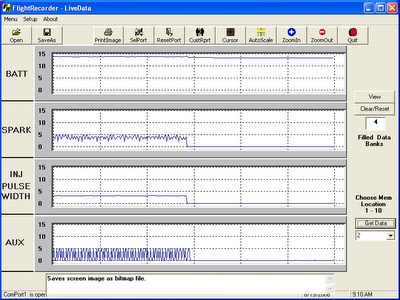
I made the pic larger for a reason. Look closely at the camshaft position sensor signal. It not only does not drop out before the stall, it even gets a pulse after the stall. The camshaft position sensor is not a problem.
Here I connected the auxillary to the crankshaft position sensor and recorded on the next engine stall.
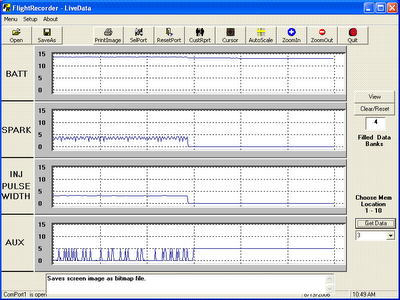
The crankshaft position sensor is not the problem. Like the camshaft position sensor, you can see a pulse signal from the cps after the engine stall. I see even more reason to look at the shutdown relay circuits. However, no matter how good the signals are near the cam or crank sensor connectors, the engine computer only sees those signals at it's own connector. I monitor both the camshaft and crankshaft position sensor signals at the engine module while monitoring the power feed to the fuel injectors. The car stalls yet again and both the cam and crank signals appear to have been good while the shutdown relay appeared to shut down. This time though, guess what? The car does not restart! There is no voltage output from the auto shutdown relay. It's like I said, a no-start is much easier to diagnose. There is no power from the relay because there is no ground from the computer to close the relay. With both the cam and crank signals present on the restart attempt the computer should close the relay. I have the scan tool connected and with the scan tool I should be able to command the relay closed just to find out if the computer is capable of doing so. When I attempt to do just that, I get a message from the scan tool that there is no communication with the engine computer. All the car's modules must sign in to the CCD bus when they are functional. I used my scan tool to look for the engine module in the CCD bus and it did show up as present. The car also started then.
The car died again soon after with again no re-start. Again the engine module would not communicate with the scan tool. A test of powers and grounds at the engine computer while it appeared to be dead confirmed it was a bad computer.
In Diagnostic Tech 1 I began some initial tests on a Dodge Stratus that the owner said would stall occasionally and not restart for several minutes. The car did stall after running for some time but restarted immediately. I suspected the fuel system was ok because the stalling was sudden with no poor running preceding the stall. After the restart and while waiting for the next stalling event it seemed a good time to look at scan tool information. I found no codes in the OBDII system but did find the monitors had been reset and not all had been run since the reset.
cont....
With a full-function scan tool connected the module/computer information available included the engine, transmission, abs, airbag, instrument cluster and body modules. If you are wondering why I would be interested in airbag module data, for example, to diagnose a stall/no-start complaint let me explain. The modules on this car are all in constant communication, exchanging information with each other and so well done is the integration that it is actually possible for a fault in the abs module to cause the instrument cluster to malfunction even though there is nothing wrong with the instrument cluster.
A look at the engine module code information showed no stored codes but did back up the OBDII information that the computer had been recently reset. I found no other codes or clues in any of the module information. I left the scan tool connected to the car and set it to monitor sensor data. A scan tool isn't much help on an intermittent stall. Even if you have a scan tool with a record feature, the datastream information updates too slowly to be reliable for the diagnosis of the problem other than just letting you know that yes the car just died. A scan tool can be helpful on the no-start if it has graphing capability or if you have software to graph the data. In hopes that the no-start would occur with the next stall, and with the thought that graphing some key sensor data while the problem was present might help, I left the tool connected.
Example of graphed scan data:

The car stalled yet again but immediately restarted and the scan tool with graphing was of no help. Hmmmm. I had just that same day received the Waekon/Hickok Flight Recorder I had purchased previously. The idea behind the tool is that you connect it to a car with intermittent complaints exactly as my Stratus has and press a button to record data when the problem appears. It seemed a great time to combine testing a new piece of equipment with diagnosing a car problem. I can connect the tool leads to the ignition secondary, the injector pulse signal, the battery and one auxillary channel is up for grabs. I chose to place the auxillary channel on the power side of the fuel injectors. A very important relay on any Chrysler built car is the auto-shutdown which powers the fuel pump, fuel injectors and ignition coil when closed by the engine computer. A monitor of the power feed to the injectors was easy and had potential to be helpful.
The next time the car stalled I had some captured data. The flight recorder captures 30 seconds of data when the button is pressed. The data must be then uploaded to the pc. From left to right the screen grids display 5 second intervals. You can see the car stall almost 15 seconds into the frame. Actually you can see my delayed response, the car died and the recording began when I pressed the button less than a second later.

I can see from the recorded data that I lost ignition spark, injector signal AND injector power all at the same time. I've mentioned the shutdown relay, it seems more important now since the powered circuits from the relay appear to be quitting. Now, don't forget that some other culprit like fuel delivery could cause the stall and the recorder simply record the results. I've mentioned why I thought the problem wasn't in fuel delivery. In theory, this data capture confirms that. If the fuel delivery was failing then the injector pulse width should climb to compensate. You should see that happen before the stall.
It seems to be leading me to that shutdown relay. The car's engine computer will keep that relay closed as long as there is a good camshaft and/or crankshaft position sensor signal. The camshaft position sensor is easier to access for testing purposes. Both of these sensors are notorious for leaking oil and the leaked oil damaging the wiring and connectors. Both connectors and wires on this car were melted together from just that problem. I cleaned the connectors and separated the melted wiring. I still got the stalling condition.
I moved the auxillary connection on the flight recorder to the camshaft position sensor signal output.

I made the pic larger for a reason. Look closely at the camshaft position sensor signal. It not only does not drop out before the stall, it even gets a pulse after the stall. The camshaft position sensor is not a problem.
Here I connected the auxillary to the crankshaft position sensor and recorded on the next engine stall.

The crankshaft position sensor is not the problem. Like the camshaft position sensor, you can see a pulse signal from the cps after the engine stall. I see even more reason to look at the shutdown relay circuits. However, no matter how good the signals are near the cam or crank sensor connectors, the engine computer only sees those signals at it's own connector. I monitor both the camshaft and crankshaft position sensor signals at the engine module while monitoring the power feed to the fuel injectors. The car stalls yet again and both the cam and crank signals appear to have been good while the shutdown relay appeared to shut down. This time though, guess what? The car does not restart! There is no voltage output from the auto shutdown relay. It's like I said, a no-start is much easier to diagnose. There is no power from the relay because there is no ground from the computer to close the relay. With both the cam and crank signals present on the restart attempt the computer should close the relay. I have the scan tool connected and with the scan tool I should be able to command the relay closed just to find out if the computer is capable of doing so. When I attempt to do just that, I get a message from the scan tool that there is no communication with the engine computer. All the car's modules must sign in to the CCD bus when they are functional. I used my scan tool to look for the engine module in the CCD bus and it did show up as present. The car also started then.
The car died again soon after with again no re-start. Again the engine module would not communicate with the scan tool. A test of powers and grounds at the engine computer while it appeared to be dead confirmed it was a bad computer.
Subscribe to:
Posts (Atom)